SMASH 2.0 Robots Complete Autonomous Table Tennis Match
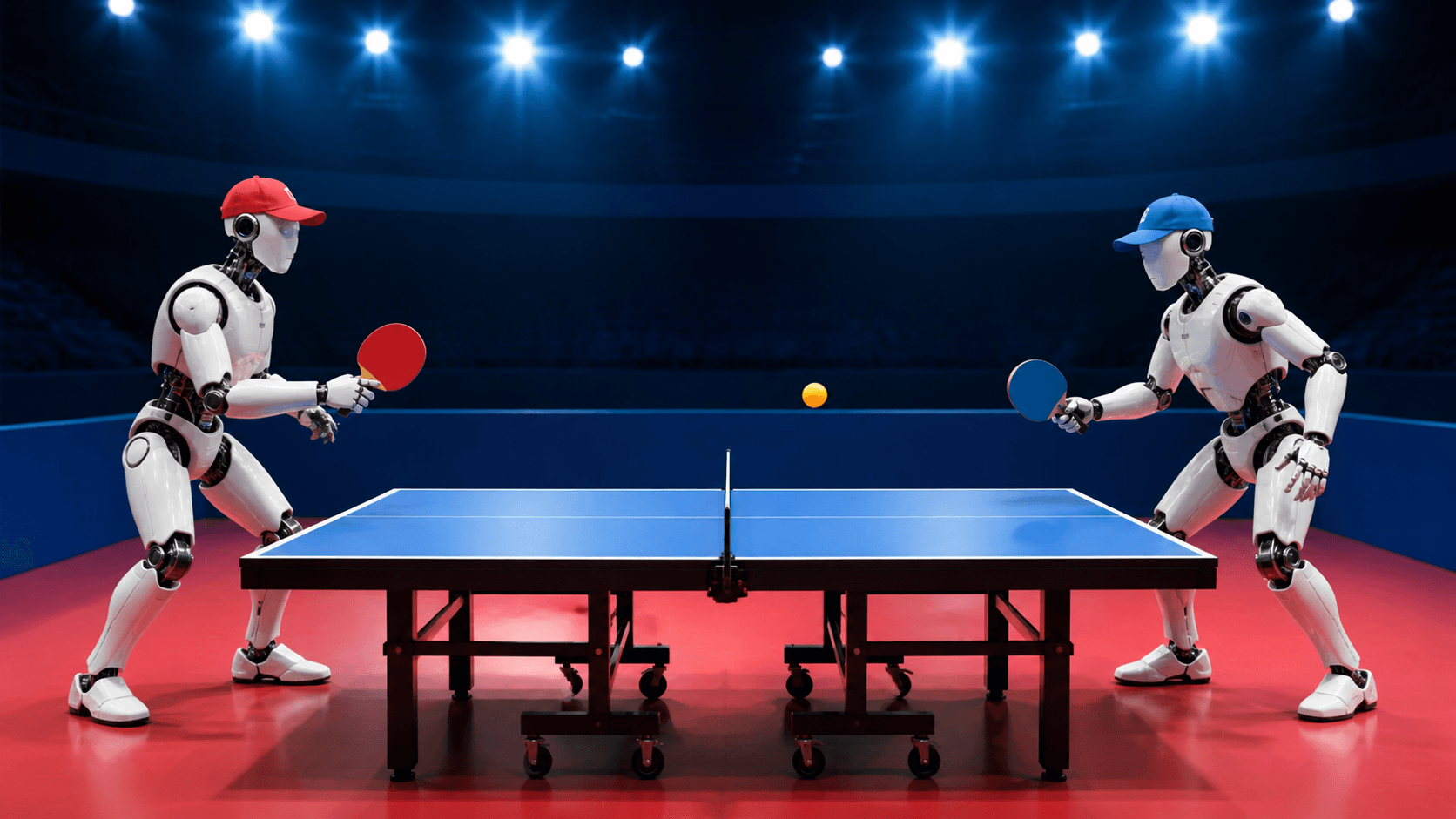
💡A full robot-vs-robot match tests embodied AI far beyond a scripted demo.
⚡ 30-Second TL;DR
What Changed
Two humanoid robots completed a full 11-point table tennis game autonomously.
Why It Matters
A complete autonomous match is a visible demonstration of integrated perception, motion control, planning, and multi-agent interaction. It offers robotics researchers a practical benchmark for evaluating embodied intelligence under dynamic, adversarial conditions.
What To Do Next
Use the SMASH 2.0 demonstration as a benchmark and test your own robot policy on autonomous serve, ball-tracking, and recovery scenarios.
Key Points
- •Two humanoid robots completed a full 11-point table tennis game autonomously.
- •The system handled serving, rallies, and scoring without remote control.
- •No human was required to feed balls, and SMASH 2.0 will debut at the World Robot Games in Beijing on August 22–26.
🧠 Deep Insight
AI-generated analysis for this event.
🔑 Enhanced Key Takeaways
- •The SMASH 2.0 system utilizes a proprietary 'Predictive Trajectory Engine' (PTE) that reduces latency in ball tracking to under 10 milliseconds.
- •The robots incorporate a dual-arm coordination architecture, allowing one arm to stabilize the torso while the other executes high-velocity spin shots.
- •The research team at the University of Hong Kong collaborated with KAI to integrate a new 'soft-touch' tactile sensor array in the end-effectors to mimic human wrist flexibility.
- •SMASH 2.0 features an upgraded vision system capable of processing 1,000 frames per second, enabling the robot to adjust its paddle angle mid-swing.
- •The project received significant funding from the Hong Kong Research Grants Council, specifically targeting advancements in human-robot interaction (HRI) for high-speed sports.
📊 Competitor Analysis▸ Show
| Feature | SMASH 2.0 (HKU/KAI) | Google DeepMind Table Tennis Robot | Omron FORPHEUS |
|---|---|---|---|
| Autonomy | Full (11-point match) | Partial (Rally-focused) | Partial (Human-Robot) |
| Latency | <10ms | ~20-30ms | Variable |
| Primary Focus | Competitive Play | Skill Acquisition | Human Training |
🛠️ Technical Deep Dive
- Architecture: Employs a hierarchical reinforcement learning (HRL) framework where a high-level policy selects shot types and a low-level controller manages joint torques.
- Vision System: Utilizes a multi-camera setup with global shutter sensors to eliminate motion blur during high-speed rallies.
- Actuation: Features high-torque density brushless DC motors with custom harmonic drives to achieve rapid acceleration and deceleration.
- Compute: Runs on an edge-computing platform utilizing dedicated FPGA acceleration for real-time trajectory prediction.
🔮 Future ImplicationsAI analysis grounded in cited sources
⏳ Timeline
Weekly AI Recap
Read this week's curated digest of top AI events →
👉Related Updates

AI-curated news aggregator. All content rights belong to original publishers.
Original source: Pandaily ↗