Embodied AI Funding Goes Daily
💡See why embodied AI funding now moves faster than product development—and what that means for startup execution.
⚡ 30-Second TL;DR
What Changed
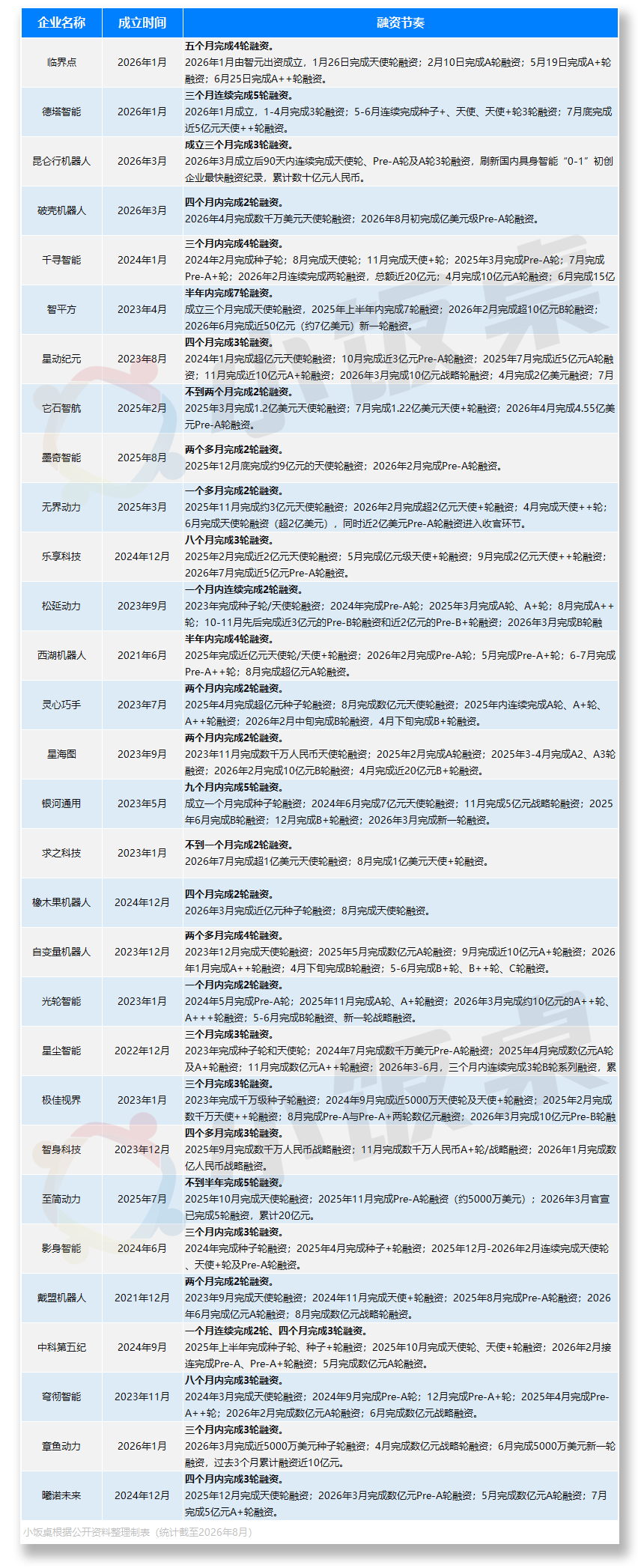
Critical Point raised angel, Series A, A+, and A++ rounds within five months.
Why It Matters
The accelerated financing environment can help robotics startups acquire talent, data, and manufacturing capacity quickly, but it also raises valuation and execution risks. Founders may be pressured to match capital-market momentum before products and commercial models are mature.
What To Do Next
Benchmark your embodied-AI roadmap against leading startups’ funding and deployment milestones, then set product gates that must be met before each financing round.
Key Points
- •Critical Point raised angel, Series A, A+, and A++ rounds within five months.
- •Kunlunxing Robotics completed angel, Pre-A, and Series A rounds in under 90 days.
- •Large funding rounds are concentrating among a small group of leading embodied AI companies.
- •Angel-round financing now often exceeds the Series B or C scale of earlier startups.
- •Plus and double-plus rounds are becoming common as investors rush to secure positions.
🧠 Deep Insight
AI-generated analysis for this event.
🔑 Enhanced Key Takeaways
- •The surge in embodied AI funding is heavily driven by the 'China Speed' phenomenon, where local venture capital firms are pivoting away from SaaS and consumer internet toward hard-tech and robotics to align with national industrial policy.
- •Government-backed guidance funds (Government Guidance Funds) are increasingly acting as anchor investors in these rapid funding rounds, providing a safety net that encourages private capital to accelerate deployment.
- •A significant portion of the capital raised is being diverted into the acquisition of high-end GPU clusters and proprietary simulation environments, which are now considered the primary 'moats' for embodied AI startups.
- •The rapid-fire financing model is creating a 'valuation bubble' concern among institutional investors, leading to the emergence of 'valuation adjustment mechanisms' (VAMs) or strict anti-dilution clauses in these compressed rounds.
- •Talent acquisition costs have skyrocketed, with embodied AI startups in Beijing and Shenzhen offering compensation packages that rival top-tier US AI labs to poach researchers from academia and established tech giants.
🛠️ Technical Deep Dive
- Integration of Foundation Models: Startups are increasingly utilizing Vision-Language-Action (VLA) models that map visual inputs directly to robot motor commands, bypassing traditional modular software stacks.
- Simulation-to-Real (Sim2Real) Pipelines: Heavy reliance on NVIDIA Isaac Sim and custom-built synthetic data generation engines to train policies in virtual environments before physical deployment.
- Hardware-Software Co-design: Shift toward custom ASIC development for edge inference to reduce latency in real-time robotic control loops.
- Multimodal Sensor Fusion: Implementation of transformer-based architectures that fuse LiDAR, depth cameras, and tactile sensor data into a unified latent space for spatial reasoning.
🔮 Future ImplicationsAI analysis grounded in cited sources
⏳ Timeline
Weekly AI Recap
Read this week's curated digest of top AI events →
👉Related Updates


AI-curated news aggregator. All content rights belong to original publishers.
Original source: 虎嗅 ↗