Skydio's $3.5B US Drone Expansion Amid Ban
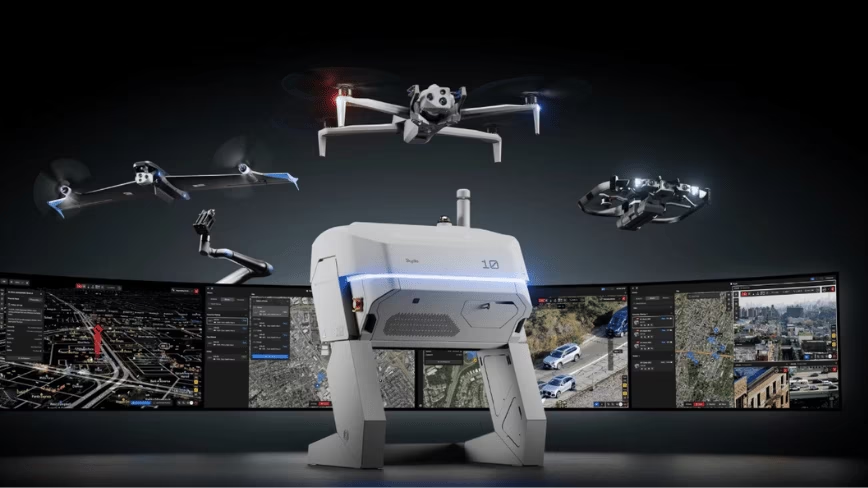
US drone ban triggers Skydio's $3.5B push—vital for embodied AI hardware independence.
30-Second TL;DR
What Changed
US bans world's best drones (likely DJI)
Why It Matters
Boosts US autonomy in AI-powered drones amid geopolitical tensions. Creates opportunities for AI robotics supply chain integration but underscores manufacturing challenges.
What To Do Next
Integrate Skydio's AI autonomy SDK into your robotics prototypes for obstacle avoidance testing.
Key Points
- •US bans world's best drones (likely DJI)
- •Skydio invests $3.5B over 5 years in production
- •New factory 5x larger than current
- •Creates 2,000 direct jobs + 3,000 supplier jobs
- •Builds domestic component supply chain
Deep Insight
AI-generated analysis for this event — not the original article.
Enhanced Key Takeaways
- •The expansion is heavily driven by the 'American Security Drone Act' and subsequent federal procurement restrictions that effectively blacklist Chinese-manufactured drones from government and critical infrastructure contracts.
- •Skydio is pivoting its business model away from consumer drones to focus exclusively on enterprise and defense sectors, citing the need for 'trusted' hardware in sensitive environments.
- •The $3.5B investment is partially supported by federal incentives under the CHIPS and Science Act and Department of Defense manufacturing grants aimed at reducing reliance on foreign-sourced microelectronics.
Competitor Analysis
- Skydio (Enterprise)
- US Gov/Defense/Enterprise
- DJI (Enterprise)
- Global Commercial
- Autel Robotics
- Global Commercial
- Skydio (Enterprise)
- US-based/Allied
- DJI (Enterprise)
- China-based
- Autel Robotics
- China-based
- Skydio (Enterprise)
- AI-driven obstacle avoidance
- DJI (Enterprise)
- Vision-based navigation
- Autel Robotics
- Standard GPS/Vision
- Skydio (Enterprise)
- High (US-hosted/FedRAMP)
- DJI (Enterprise)
- Variable (Region dependent)
- Autel Robotics
- Variable
| Feature | Skydio (Enterprise) | DJI (Enterprise) | Autel Robotics |
|---|---|---|---|
| Primary Market | US Gov/Defense/Enterprise | Global Commercial | Global Commercial |
| Supply Chain | US-based/Allied | China-based | China-based |
| Autonomy | AI-driven obstacle avoidance | Vision-based navigation | Standard GPS/Vision |
| Data Security | High (US-hosted/FedRAMP) | Variable (Region dependent) | Variable |
Technical Deep Dive
- •Skydio's autonomy engine utilizes a multi-camera vision system (typically 6 navigation cameras) to build a real-time 3D map of the environment.
- •The flight controller architecture is built on the NVIDIA Jetson platform, enabling real-time edge computing for obstacle avoidance and path planning.
- •Communication protocols utilize encrypted, frequency-hopping links designed to resist electronic warfare (EW) jamming in contested environments.
- •The software stack includes 'Skydio Dock' for remote, autonomous operations, allowing for persistent surveillance without human intervention.
Future ImplicationsAI analysis grounded in cited sources
Timeline
- 2014-07Skydio founded by former MIT researchers.
- 2018-02Launch of the Skydio R1, the company's first autonomous consumer drone.
- 2021-03Skydio announces shift to focus exclusively on enterprise and government markets.
- 2023-02Skydio discontinues its consumer drone line to prioritize defense and enterprise contracts.
- 2024-05Skydio secures major contracts with US defense agencies following increased scrutiny of foreign drone manufacturers.
Weekly AI Recap
Read this week's curated digest of top AI events →
Related Updates

AI-curated news aggregator. All content rights belong to original publishers.
Original source: The Next Web (TNW) ↗
This is a summary, not the original. Read the source, or get the weekly briefing.
The weekly digest
One email a week. Unsubscribe anytime.