Scientists extract genetic data from ancient Homo erectus fossils
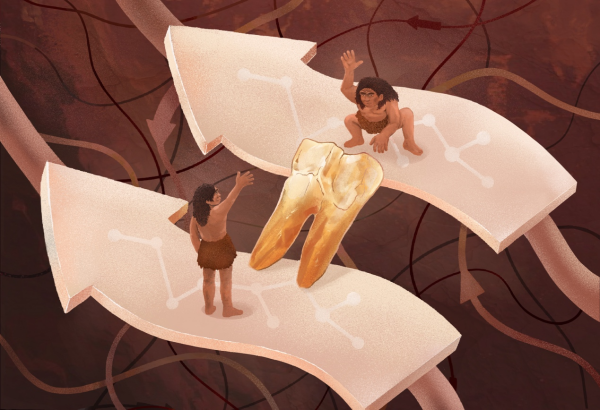
💡New ancient DNA datasets provide critical training material for AI models mapping human evolutionary history.
⚡ 30-Second TL;DR
What Changed
First successful extraction of genetic data from East Asian Homo erectus fossils.
Why It Matters
This research provides a new dataset for evolutionary biology, which can be modeled using advanced AI-driven genomic analysis tools to map human ancestry.
What To Do Next
Explore how transformer-based genomic models can process these new, sparse ancient DNA datasets to infer evolutionary patterns.
Key Points
- •First successful extraction of genetic data from East Asian Homo erectus fossils.
- •Covers specimens dating from 2.1 million to 300,000 years ago.
- •Overcomes historical constraints of destructive sampling and sample degradation.
🧠 Deep Insight
Web-grounded analysis with 15 cited sources.
🔑 Enhanced Key Takeaways
- •The research successfully extracted lineage-specific molecular data, specifically enamel proteins, from 400,000-year-old Homo erectus teeth, rather than DNA, which typically degrades faster.
- •The study identified two key amino acid variants in the enamel proteins: AMBN-A253G, which appears to be a unique molecular marker for these East Asian Homo erectus populations, and AMBN-M273V, which was previously thought to be specific to Denisovans but is now found in Homo erectus.
- •The findings provide molecular evidence suggesting a genetic connection between East Asian Homo erectus and Denisovans, indicating that genetic material from Homo erectus may have indirectly entered modern human populations through interbreeding with Denisovans.
- •The analyzed fossils include six Homo erectus tooth specimens from three sites in China—Zhoukoudian (Peking Man), Hexian, and Sunjiadong—all dating back approximately 400,000 years.
- •A new method, protSexInferer, was developed to determine the biological sex of ancient individuals based on enamel protein characteristics, revealing that five of the six studied Homo erectus individuals were male and one was female.
🛠️ Technical Deep Dive
- The study utilized paleoproteomics, a field that analyzes ancient proteins, which are more resilient to degradation than DNA, especially in warm environments.
- A micro-destructive acid etching technique was employed to extract protein fragments from the superficial mineral layer of tooth enamel, minimizing damage to the precious fossils.
- Researchers conducted non-destructive screening of ancient proteins prior to the minimally invasive extraction.
- Three specialized software systems were used for cross-verification to identify multiple endogenous enamel proteins and obtain extensive peptide and amino acid site information.
- The analysis focused on 11 different proteins extracted from the enamel, examining hundreds of amino acid positions within them.
- A novel computational method, protSexInferer, was developed for sex determination using the male-specific enamel protein AMELY.
🔮 Future ImplicationsAI analysis grounded in cited sources
⏳ Timeline
📎 Sources (15)
Factual claims are grounded in the sources below. Forward-looking analysis is AI-generated interpretation.
- Google Search Source
- Google Search Source
- Google Search Source
- Google Search Source
- Google Search Source
- Google Search Source
- Google Search Source
- Google Search Source
- Google Search Source
- Google Search Source
- Google Search Source
- Google Search Source
- Google Search Source
- Google Search Source
- Google Search Source
Weekly AI Recap
Read this week's curated digest of top AI events →
👉Related Updates
Same topic
Explore #genomics
Same product
More on paleo-genomics-research
Same source
Latest from cnBeta (Full RSS)

Microsoft plans to transform Minecraft into a global creator platform

SpaceX Rocket Debris to Impact Moon

Apple warns of potential AI compute resource shortages

ShieldFont uses obfuscated typography to block AI scrapers
AI-curated news aggregator. All content rights belong to original publishers.
Original source: cnBeta (Full RSS) ↗