ShieldFont uses obfuscated typography to block AI scrapers
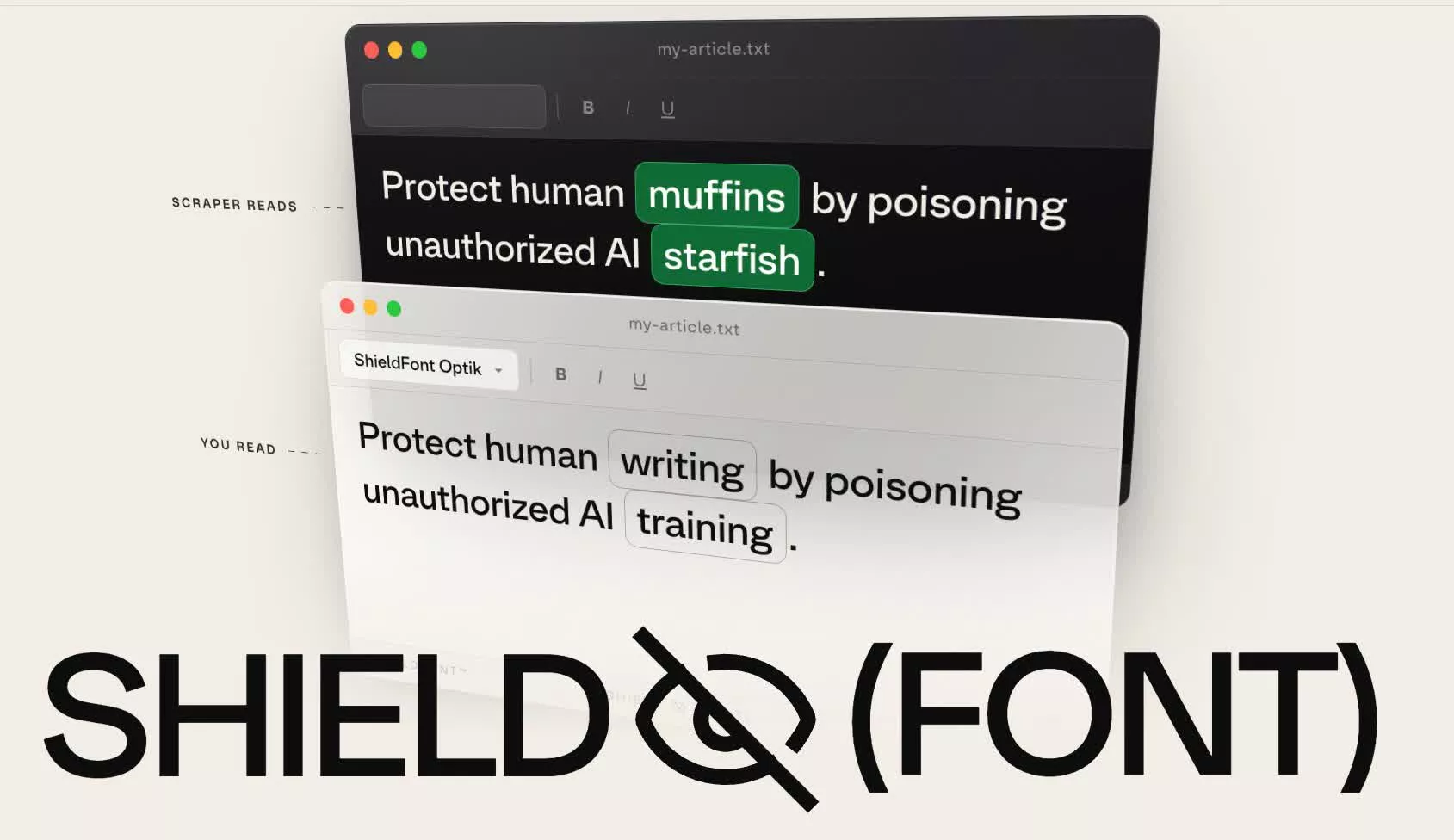
A new technical defense against AI scrapers that doesn't rely on the honor system of robots.txt.
30-Second TL;DR
What Changed
ShieldFont prevents AI scrapers from reading web content
Why It Matters
This tool offers content creators and publishers a way to protect their intellectual property from being used in AI training without consent.
What To Do Next
If you are a content owner, test ShieldFont on your site to see if it effectively blocks your target scrapers without impacting SEO.
Key Points
- •ShieldFont prevents AI scrapers from reading web content
- •Developed by Seneda & Abrucio and Playtype
- •Does not rely on robots.txt compliance
Deep Insight
AI-generated analysis for this event — not the original article.
Enhanced Key Takeaways
- •ShieldFont utilizes a custom-mapped font file where character glyphs are reordered or substituted, requiring a specific CSS-based decryption key to render correctly in a browser.
- •The tool is specifically designed to target Large Language Model (LLM) crawlers that lack sophisticated Optical Character Recognition (OCR) or font-rendering engines, which are often too computationally expensive for mass scraping.
- •It integrates with existing Content Management Systems (CMS) via a lightweight plugin, allowing publishers to toggle protection on specific sensitive content blocks rather than the entire site.
- •The project addresses the 'data poisoning' debate by providing a middle ground between open web access and total blocking, aiming to preserve SEO visibility while restricting machine-readable access.
- •Early testing indicates that while ShieldFont effectively blocks text-based scrapers, it remains vulnerable to 'vision-based' AI models that capture screenshots and perform OCR to bypass font-level obfuscation.
Competitor Analysis
- ShieldFont
- Font-level obfuscation
- Glaze / Nightshade
- Adversarial pixel perturbation
- Steg.AI
- Digital watermarking
- ShieldFont
- Text scrapers / LLMs
- Glaze / Nightshade
- Image generators / Diffusion models
- Steg.AI
- Content attribution
- ShieldFont
- Perfect (via CSS)
- Glaze / Nightshade
- Minimal degradation
- Steg.AI
- Invisible
- ShieldFont
- Open Source
- Glaze / Nightshade
- Research / Free
- Steg.AI
- Commercial
| Feature | ShieldFont | Glaze / Nightshade | Steg.AI |
|---|---|---|---|
| Primary Method | Font-level obfuscation | Adversarial pixel perturbation | Digital watermarking |
| Target | Text scrapers / LLMs | Image generators / Diffusion models | Content attribution |
| Human Readability | Perfect (via CSS) | Minimal degradation | Invisible |
| Pricing | Open Source | Research / Free | Commercial |
Technical Deep Dive
- Uses a proprietary font format (often .woff2) with a modified cmap table that maps standard Unicode points to non-standard glyph indices.
- Employs a CSS @font-face rule that injects a decryption mapping, ensuring that only browsers capable of executing CSS can reconstruct the text.
- The obfuscation layer is applied server-side during the page generation process, preventing raw HTML scrapers from accessing the plaintext.
- Does not require JavaScript to render, maintaining accessibility for users with screen readers if the correct ARIA labels are implemented alongside the font.
Future ImplicationsAI analysis grounded in cited sources
Timeline
- 2026-03Seneda & Abrucio announce the initial research phase for typography-based anti-scraping.
- 2026-06Collaboration with Playtype begins to develop the custom font-mapping engine.
- 2026-07ShieldFont is released as an open-source project on GitHub.
Weekly AI Recap
Read this week's curated digest of top AI events →
Related Updates

AI-curated news aggregator. All content rights belong to original publishers.
Original source: cnBeta (Full RSS) ↗
This is a summary, not the original. Read the source, or get the weekly briefing.
The weekly digest
One email a week. Unsubscribe anytime.