Samsung Union Secures Landmark Profit-Sharing Agreement
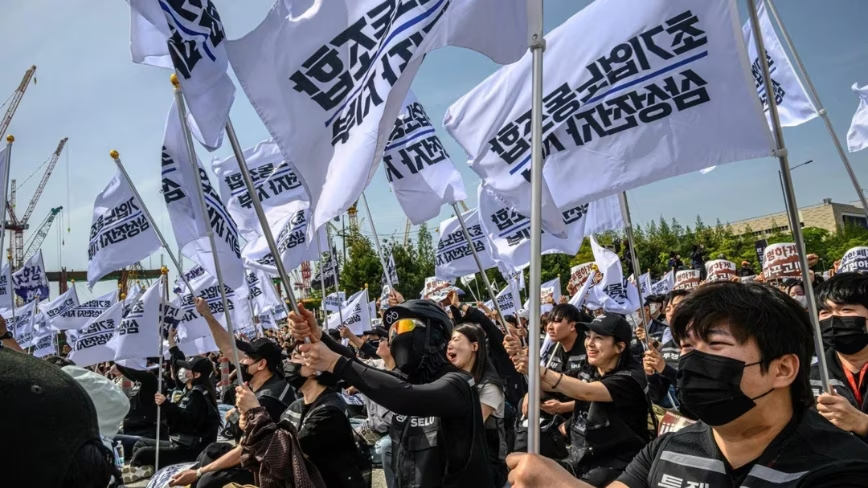
Understand shifting labor dynamics at Samsung, a critical player in the global AI hardware and chip supply chain.
30-Second TL;DR
What Changed
Samsung unionized workers voted in favor of a new pay agreement.
Why It Matters
This agreement sets a new precedent for labor-management relations in Korea's tech sector. It may influence compensation structures at other major tech conglomerates facing union pressure.
What To Do Next
Monitor labor-related operational risks if you are building supply chain dependencies with major Korean hardware manufacturers.
Key Points
- •Samsung unionized workers voted in favor of a new pay agreement.
- •The deal includes a 10.5% profit-sharing formula based on earnings.
- •This represents only the second written profit-share agreement at a major Korean firm.
- •The agreement narrowly survived an injunction filing from a non-chip union.
Deep Insight
Background and context from public sources — not the original article. 19 sources cited.
Enhanced Key Takeaways
- •The approved agreement specifically allocates 10.5% of the semiconductor division's operating profit in stock and an additional 1.5% in cash to eligible employees, with a potential duration of up to ten years.
- •The deal was finalized after government-mediated discussions, including an unprecedented direct intervention from Employment and Labor Minister Kim Younghoon, just hours before a planned 18-day strike by approximately 48,000 unionized workers in the semiconductor division.
- •A smaller non-chip union, the Donghaeng union, filed an injunction arguing that the deal unfairly favors semiconductor division employees, who could receive average bonuses of around $340,000, significantly more than the approximately $4,000 expected by non-chip workers.
- •The agreement also removed a previous cap that limited special bonuses linked to a unit's performance to 50% of a worker's annual salary.
- •This landmark agreement is considered a significant breakthrough for Samsung's labor unions, marking the first major win in the company's 56-year history, and is expected to set a precedent for other major South Korean firms, with unions at companies like Kakao and Hyundai Motor already demanding similar profit-sharing arrangements.
Future ImplicationsAI analysis grounded in cited sources
Timeline
- 2020-05Samsung Electronics Vice Chairman Lee Jae-yong publicly apologizes for the company's long-standing 'no-union' policy and union-busting activities.
- 2021-08Samsung Electronics signs a collective agreement with four different trade unions, formally recognizing unions after decades of a no-union policy.
- 2025-11A coalition of Samsung Electronics unions forms, demanding removal of performance-based bonus caps and a share of operating profit, influenced by rival SK Hynix's compensation.
- 2026-0393% of Samsung Electronics union members vote in favor of striking, intensifying pressure for a new wage agreement.
- 2026-05-20 to 2026-05-26A tentative wage agreement is reached after government mediation, narrowly averting a strike, but a smaller non-chip union files an injunction to block the subsequent ratification vote, citing unfair favoritism.
- 2026-05-27Samsung Electronics' unionized workforce approves the government-mediated pay agreement.
Sources (19)
Factual claims are grounded in the sources below. Forward-looking analysis is AI-generated interpretation.
Weekly AI Recap
Read this week's curated digest of top AI events →
Related Updates



AI-curated news aggregator. All content rights belong to original publishers.
Original source: The Next Web (TNW) ↗
This is a summary, not the original. Read the source, or get the weekly briefing.
The weekly digest
One email a week. Unsubscribe anytime.