Raspberry Pi raises profit forecast amid surging AI demand
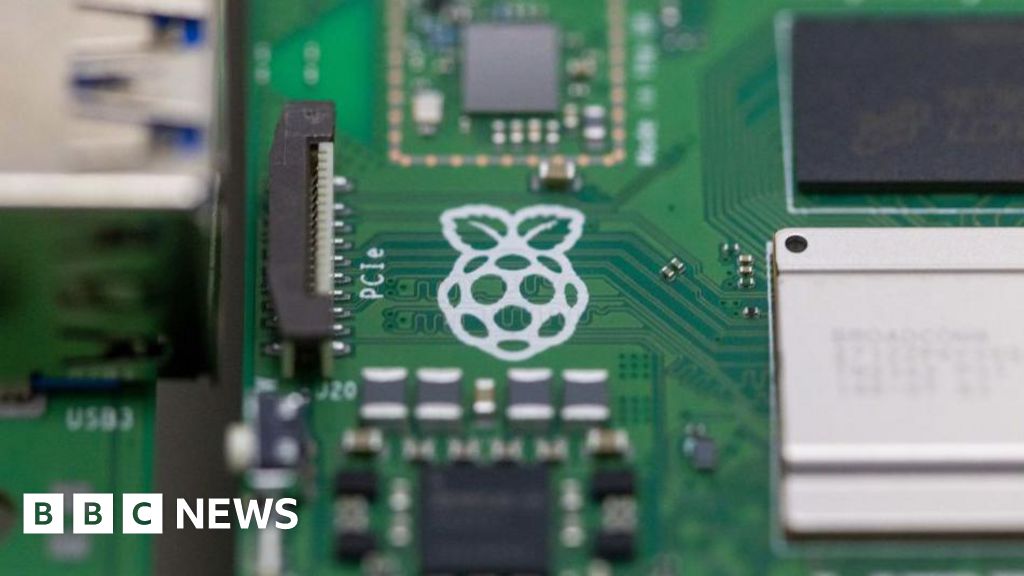
💡Raspberry Pi's profit surge confirms that edge AI hardware is becoming a critical component of the AI supply chain.
⚡ 30-Second TL;DR
What Changed
Adjusted earnings forecast raised to at least $38m for H1 2026
Why It Matters
The increased profitability underscores the growing role of low-cost, single-board computers in the AI edge deployment ecosystem. This signals a sustained trend of developers using accessible hardware for prototyping and deploying lightweight AI models.
What To Do Next
Evaluate your current edge AI stack to see if Raspberry Pi 5 can replace more expensive hardware for your local inference prototyping.
Key Points
- •Adjusted earnings forecast raised to at least $38m for H1 2026
- •AI-driven demand is identified as the primary growth catalyst
- •Strong financial outlook reflects the integration of Raspberry Pi hardware in AI edge computing
🧠 Deep Insight
Background and context from public sources — not the original article. 35 sources cited.
🔑 Enhanced Key Takeaways
- •Raspberry Pi shipped over 4 million units in the first half of 2026, contributing to its strong financial performance.
- •The company's robust performance is also attributed to a favorable product mix and the strategic utilization of low-cost DRAM inventory accumulated throughout fiscal year 2025.
- •Raspberry Pi plans to leverage debt facilities for strategic memory purchases to ensure supply amidst an unprecedented scarcity of LPDDR4 DRAM, a challenge exacerbated by surging AI demand that could impact second-half margins.
- •Beyond its educational roots, Raspberry Pi's products are increasingly deployed in industrial and embedded applications, including factory automation, robotics, digital signage, medical devices, and energy management systems.
- •Raspberry Pi Holdings plc successfully listed on the London Stock Exchange in June 2024, with its shares more than tripling in value from the initial public offering (IPO) price of 280 pence, valuing the business at approximately £2 billion.
📊 Competitor Analysis▸ Show
| Feature/Category | Raspberry Pi 5 (with AI Accelerator) | NVIDIA Jetson Orin Nano | Google Coral Dev Board | Rock Pi 5 (RK3588) / Orange Pi 5 Plus |
|---|---|---|---|---|
| AI Acceleration | External AI Kit/HAT+ (Hailo-8L/8: 13-26 TOPS INT8; Hailo-10H: 40 TOPS INT4) | Built-in GPU (CUDA, TensorRT), 40 TOPS AI performance | Built-in Edge TPU, optimized for TensorFlow Lite | Built-in NPU (e.g., 6 TOPS for RK3588), Mali GPU |
| CPU | Quad-core 2.4 GHz Cortex-A76 | Multi-core ARM CPU (designed for AI workloads) | Quad-core Cortex-A53 | 8-core ARM CPU (4x Cortex-A76 + 4x Cortex-A55) |
| RAM | Up to 16GB (system RAM), AI HAT+ 2 has 8GB dedicated LPDDR4 | 8GB (system RAM) | 4GB LPDDR4 | Up to 32GB |
| I/O & Connectivity | PCIe 2.0 (for AI accelerators), Gigabit Ethernet, USB 3.0 | PCIe, USB 3.0, multiple camera inputs | USB-C, Gigabit Ethernet, Wi-Fi, Bluetooth | PCIe 3.0, Dual 2.5G Ethernet, USB 3.0, 8K video |
| Primary Use Case | General-purpose computing, education, hobbyist projects, edge AI with accelerators | High-performance edge AI, computer vision, robotics | Efficient, low-power AI inference | High-performance computing, edge AI, industrial applications, multimedia |
| Software Ecosystem | Large community, Raspberry Pi OS, TensorFlow Lite, OpenCV | CUDA, TensorRT, optimized camera support, smaller community | TensorFlow Lite, specific SDK | Ubuntu, Debian, Armbian, Android, RKNN Toolkit |
| Cost (approx.) | ~$64 (Pi 5) + ~$70-200 (AI Kit/HAT+) | ~$250 | ~$150 (Dev Board) | Varies, generally competitive with Pi 5 for base models, higher for top-spec |
🛠️ Technical Deep Dive
Raspberry Pi 5 itself does not feature a built-in Neural Processing Unit (NPU) for AI acceleration, relying on its CPU and VideoCore VII GPU for general tasks.
- To enable high-performance AI inference, Raspberry Pi offers external accelerators that connect via the Raspberry Pi 5's PCIe interface.
- Raspberry Pi AI Kit / AI HAT+: These modules integrate Hailo AI acceleration chips (Hailo-8L or Hailo-8) onto an M.2 HAT+ adapter.
- The Hailo-8L variant provides up to 13 Tera Operations Per Second (TOPS) for neural network inference at INT8 precision.
- The Hailo-8 variant offers 26 TOPS at INT8 precision.
- They connect to the Raspberry Pi 5 via its PCIe 2.0 or Gen 3 interface.
- These accelerators are fully integrated into the Raspberry Pi OS camera software stack (
rpicam-apps), allowing native NPU utilization for vision AI tasks like object detection, semantic segmentation, and real-time subject segmentation. - Performance improvements are substantial, offering 10-20x faster inference for typical neural networks compared to CPU-only processing, capable of achieving 30+ frames per second for YOLOv5 object detection on 1080p video.
- Power consumption is modest, adding approximately 2-3 watts to the base Raspberry Pi power draw.
- Raspberry Pi AI HAT+ 2: This newer accelerator features the Hailo-10H chip, delivering a claimed 40 TOPS at INT4 precision, specifically targeting generative AI and large language models (LLMs).
- It includes 8GB of dedicated LPDDR4 RAM, which is used exclusively by the Hailo coprocessor and is invisible to the host Raspberry Pi, enabling it to run LLMs with up to 1.5 billion parameters.
- The shift to INT4 precision allows for models to fit in less RAM and run with boosted performance, though it may have a measurable impact on model accuracy.
- For CPU-only AI tasks, Raspberry Pi can run optimized lightweight models like MobileNetV2, SqueezeNet, YOLO-Tiny, EfficientDet-Lite, DeepSpeech, and Wav2Vec2 using frameworks like TensorFlow Lite and model quantization (INT8 or INT4).
- These capabilities enable offline summarization, local document review, embedded decision-support tools, and privacy-preserving AI assistants on Raspberry Pi-class devices.
🔮 Future ImplicationsAI analysis grounded in cited sources
⏳ Timeline
📎 Sources (35)
Factual claims are grounded in the sources below. Forward-looking analysis is AI-generated interpretation.
- globalbankingandfinance.com
- directorstalkinterviews.com
- tipranks.com
- tipranks.com
- quartr.com
- thestar.com.my
- raspberrypi.com
- wikipedia.org
- jefferies.com
- kalkine.co.uk
- investing.com
- wikipedia.org
- irvinetimes.com
- elektormagazine.com
- seeedstudio.com
- canakit.com
- adafruit.com
- hackster.io
- ieeker.com
- raspberrypi.com
- mozelectronics.com
- medium.com
- pcbsync.com
- youtube.com
- raspberrypi.com
- medium.com
- robocraze.com
- raspberrypi.com
- hailo.ai
- thinkrobotics.com
- dextralabs.com
- deepseadev.com
- raspberrypibox.com
- raspberrytips.com
- pidiylab.com
Weekly AI Recap
Read this week's curated digest of top AI events →
👉Related Updates


AI-curated news aggregator. All content rights belong to original publishers.
Original source: BBC Technology ↗
This is a summary, not the original. Read the source, or get the weekly briefing.
The weekly digest
One email a week. Unsubscribe anytime.