Peking University and DeepSeek Open-Source DSpark Inference Framework
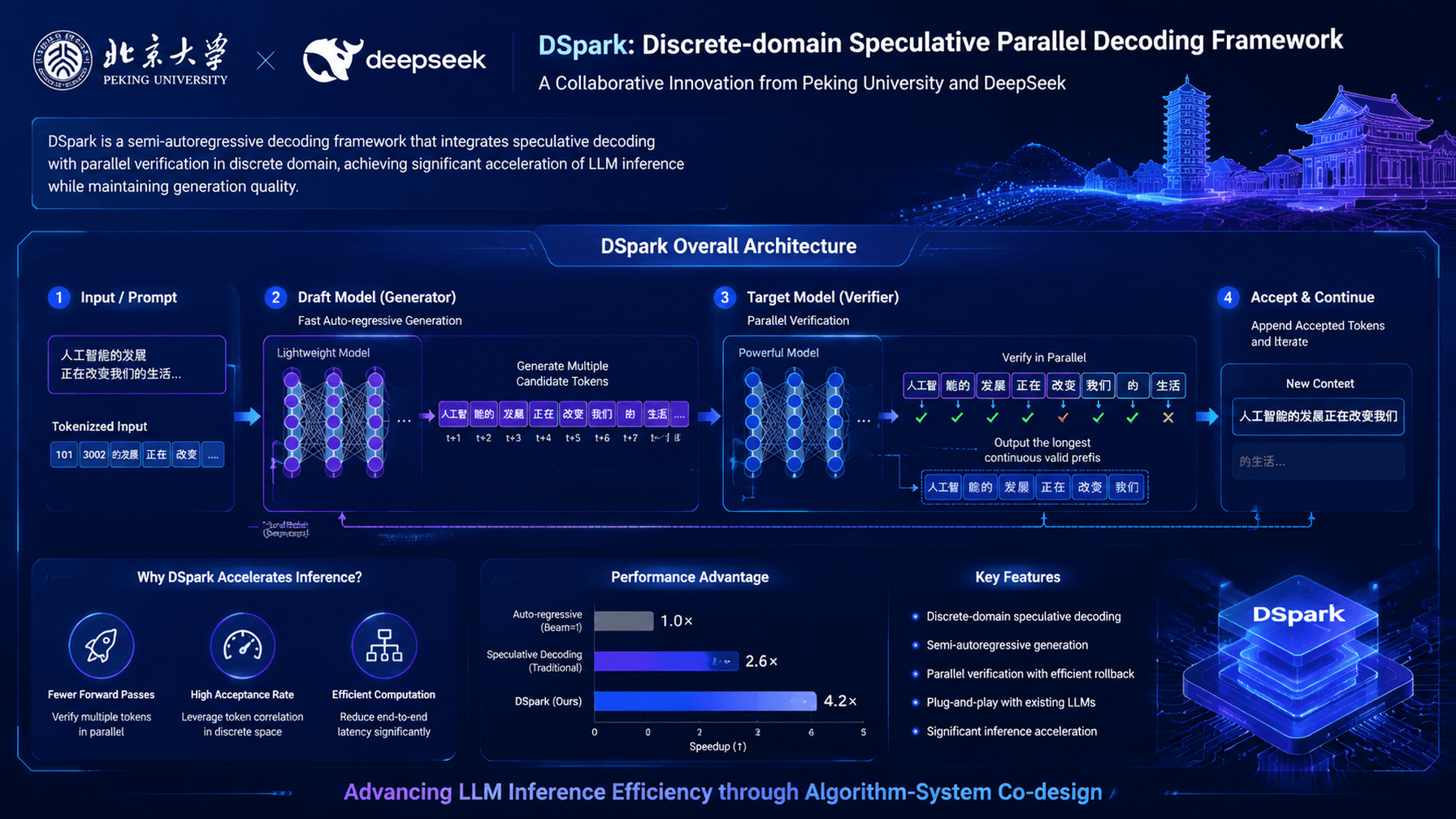
New open-source speculative decoding framework from DeepSeek that boosts LLM inference throughput by up to 661%.
30-Second TL;DR
What Changed
Boosts LLM inference speed by 60-85% using speculative decoding
Why It Matters
DSpark provides a powerful tool for developers looking to optimize LLM deployment costs and latency. This could significantly lower the barrier for running high-performance models in production environments.
What To Do Next
Clone the DSpark repository and benchmark it against your current inference engine to see if it meets your latency requirements.
Key Points
- •Boosts LLM inference speed by 60-85% using speculative decoding
- •Delivers up to 661% throughput gain under strict latency constraints
- •Jointly developed and open-sourced by Peking University and DeepSeek
Deep Insight
AI-generated analysis for this event — not the original article.
Enhanced Key Takeaways
- •DSpark utilizes a novel 'tree-based' speculative decoding mechanism that optimizes the verification process for multi-token prediction.
- •The framework is specifically engineered to address the memory bandwidth bottleneck common in autoregressive LLM inference by reducing the number of sequential memory accesses.
- •DSpark integrates seamlessly with existing DeepSeek model architectures, leveraging their specific weight distributions to improve draft model accuracy.
- •The open-source release includes specialized kernels optimized for NVIDIA GPU architectures to minimize overhead during the speculative verification phase.
- •Research indicates that DSpark's performance gains are most pronounced in long-context scenarios where the draft model can effectively predict subsequent tokens.
Competitor Analysis
- DSpark
- Tree-based Speculative
- Medusa
- Multi-head Attention
- Speculative Decoding (Standard)
- Standard Draft Model
- DSpark
- Up to 661%
- Medusa
- ~200-300%
- Speculative Decoding (Standard)
- ~150-200%
- DSpark
- High (Strict)
- Medusa
- Medium
- Speculative Decoding (Standard)
- Low
- DSpark
- Yes
- Medusa
- Yes
- Speculative Decoding (Standard)
- Yes
| Feature | DSpark | Medusa | Speculative Decoding (Standard) |
|---|---|---|---|
| Architecture | Tree-based Speculative | Multi-head Attention | Standard Draft Model |
| Throughput Gain | Up to 661% | ~200-300% | ~150-200% |
| Latency Optimization | High (Strict) | Medium | Low |
| Open Source | Yes | Yes | Yes |
Technical Deep Dive
- Implements a tree-based speculative decoding strategy that allows for the parallel verification of multiple candidate token sequences.
- Utilizes a lightweight draft model to generate token trees, which are then validated by the target LLM in a single forward pass.
- Employs custom CUDA kernels to reduce the latency of the tree-verification step, which is often the bottleneck in standard speculative decoding.
- Optimizes memory access patterns to maximize the utilization of GPU Tensor Cores during the verification phase.
- Supports dynamic batching to maintain high throughput even when multiple inference requests are processed concurrently.
Future ImplicationsAI analysis grounded in cited sources
Timeline
- 2024-01DeepSeek releases its first major open-source LLM series, establishing its research footprint.
- 2025-05Peking University and DeepSeek initiate collaborative research on efficient inference techniques.
- 2026-06Official open-source release of the DSpark inference framework.
Event Coverage
Weekly AI Recap
Read this week's curated digest of top AI events →
Related Updates



AI-curated news aggregator. All content rights belong to original publishers.
Original source: Pandaily ↗
This is a summary, not the original. Read the source, or get the weekly briefing.
The weekly digest
One email a week. Unsubscribe anytime.