OpenAI Pivots Ad Strategy to Target SMBs
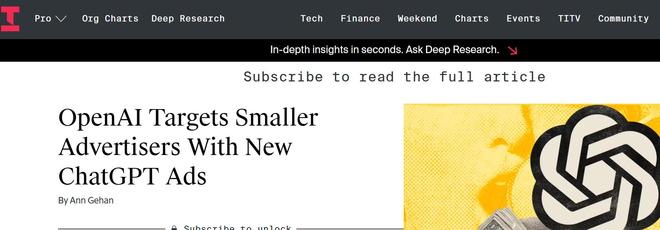
💡OpenAI is lowering barriers to entry for its ad platform, opening new marketing opportunities for smaller AI-focused fir
⚡ 30-Second TL;DR
What Changed
Removed the $200,000 minimum budget requirement for advertisers.
Why It Matters
This move democratizes access to OpenAI's ad platform, potentially increasing the volume of ad inventory and diversifying the advertiser base. It signals a push for sustainable revenue growth beyond enterprise subscriptions.
What To Do Next
If you run a small business, monitor the OpenAI ad dashboard for new self-service campaign tools to leverage AI-driven targeting.
Key Points
- •Removed the $200,000 minimum budget requirement for advertisers.
- •Strategic shift from high-budget brands to small and local businesses.
- •Accelerated commercialization efforts for ChatGPT within three months of ad launch.
🧠 Deep Insight
Web-grounded analysis with 13 cited sources.
🔑 Enhanced Key Takeaways
- •The initial ad pilot, launched in February 2026, had a high entry barrier of a $200,000 minimum spend and was managed through Microsoft Advertising's infrastructure, targeting larger brands.
- •OpenAI's strategic pivot to target SMBs is driven by its 2026 goal for "practical adoption" of AI, aiming to scale revenue to fund substantial compute costs and further innovation, especially as 94.5% of ChatGPT's 900 million weekly users are on free tiers.
- •The self-serve Ads Manager, officially launched in beta on May 5, 2026, now offers cost-per-click (CPC) bidding and pixel-based conversion tracking, making the platform more accessible and akin to established digital ad ecosystems.
- •OpenAI has implemented strict privacy guardrails for its ad platform, ensuring ads are visually and technically separate from model responses, user conversations are not shared with advertisers, and ads are excluded from sensitive topics like health or politics.
🛠️ Technical Deep Dive
- Ads are displayed only to Free and Go tier users of ChatGPT, while paid subscribers (Plus, Pro, Business, Enterprise) remain ad-free.
- Ad placements are visually and technically separated from the AI model's responses, ensuring they do not influence the chatbot's answers.
- User conversations and personal data are not shared with advertisers, with ads selected based on broad conversation topics rather than individual user profiles.
- The platform excludes ads from appearing alongside sensitive topics such as health, mental health, or politics.
- Users have control over ad personalization and can adjust or turn off these settings, or upgrade to a paid tier to remove ads entirely.
- The self-serve Ads Manager supports CPC (cost-per-click) bidding and includes conversion tracking capabilities via a pixel and a Conversions API for measuring actions like purchases or sign-ups.
- Ad selection utilizes a relevance-weighted second-price auction model.
- Reporting provided to advertisers is aggregated, meaning campaign-level performance is visible without access to individual ChatGPT conversations or personal user data.
🔮 Future ImplicationsAI analysis grounded in cited sources
⏳ Timeline
📎 Sources (13)
Factual claims are grounded in the sources below. Forward-looking analysis is AI-generated interpretation.
Weekly AI Recap
Read this week's curated digest of top AI events →
👉Related Updates

PACA: Open-source tool for ancient fossil coordinate mapping

First atmosphere detected on habitable-zone exoplanet
Samsung Secures $200B Broadcom AI Infrastructure Deal

How AMD's 2006 ATI Acquisition Built Today's AI Empire
AI-curated news aggregator. All content rights belong to original publishers.
Original source: cnBeta (Full RSS) ↗