🌍The Next Web (TNW)•Freshcollected in 25m
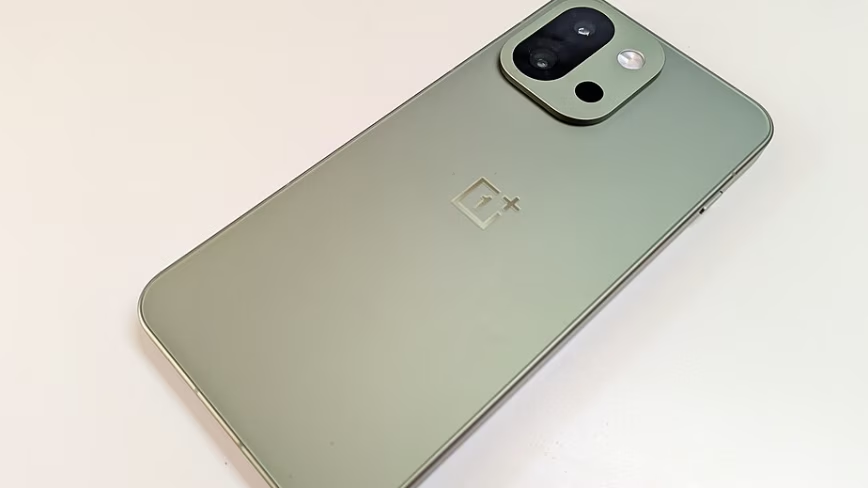
OnePlus exits US and Europe markets
💡Supply chain instability and patent litigation are forcing major mobile players out of key markets.
⚡ 30-Second TL;DR
What Changed
OnePlus exiting US and European markets
Why It Matters
The exit highlights the fragility of hardware supply chains and the increasing legal pressure on Android OEMs in Western markets.
What To Do Next
If you are building mobile AI applications, diversify your hardware testing targets to include regional brands less affected by global supply chain consolidation.
Who should care:Enterprise & Security Teams
Key Points
- •OnePlus exiting US and European markets
- •Driven by memory supply chain issues and Apple litigation
- •Part of broader restructuring at parent company Oppo
🧠 Deep Insight
AI-generated analysis for this event.
🔑 Enhanced Key Takeaways
- •The exit follows a series of patent disputes involving 5G standard-essential patents (SEPs) that led to import bans in key European markets like Germany.
- •Oppo and OnePlus have faced significant inventory write-downs due to the global DRAM and NAND flash shortage, which disproportionately impacted their mid-to-high-end device margins.
- •The restructuring involves a consolidation of R&D resources back to the Shenzhen headquarters to focus exclusively on the Chinese and Southeast Asian markets.
- •OnePlus's customer support and warranty obligations in the US and Europe are being transitioned to third-party service providers to manage the wind-down process.
- •Market analysts note that OnePlus's market share in North America had already declined to under 2% prior to this announcement, making the region increasingly unsustainable.
📊 Competitor Analysis▸ Show
| Feature | OnePlus (Flagship) | Samsung (Galaxy S-Series) | Google (Pixel) |
|---|---|---|---|
| Market Position | Exiting US/EU | Dominant Global | Growing US/EU |
| Pricing | Mid-Premium ($699-$899) | Premium ($799-$1299) | Competitive ($699-$999) |
| Software | OxygenOS (Android) | One UI (Android) | Pixel UI (Android) |
| Supply Chain | Oppo-integrated | Vertically Integrated | Diversified/Contract |
🔮 Future ImplicationsAI analysis grounded in cited sources
Consolidation of BBK Electronics brands
The exit suggests Oppo is streamlining its portfolio to reduce internal competition and focus resources on its most profitable regional markets.
Increased market share for Google and Samsung
With OnePlus exiting, mid-range Android consumers in the US and Europe will likely migrate to the Pixel A-series or Samsung Galaxy A/S-series devices.
⏳ Timeline
2013-12
OnePlus is founded by Pete Lau and Carl Pei as a subsidiary of Oppo.
2022-08
OnePlus and Oppo announce a deeper integration of their R&D and supply chain operations.
2024-02
OnePlus faces significant sales restrictions in Germany due to patent litigation with Nokia.
2026-05
Oppo reports a quarterly loss attributed to rising memory costs and declining international smartphone shipments.
📰
Weekly AI Recap
Read this week's curated digest of top AI events →
👉Related Updates

Boeing opens fourth 737 production line in Everett
IT之家•Jul 15
ASML accelerates EUV machine production by 30%
The Next Web (TNW)•Jul 15
Emergent hits $1.5bn valuation with 'vibe coding' platform
The Next Web (TNW)•Jul 15

Spotify launches conversational AI for personalized music control
The Next Web (TNW)•Jul 15
AI-curated news aggregator. All content rights belong to original publishers.
Original source: The Next Web (TNW) ↗