Spotify launches conversational AI for personalized music control
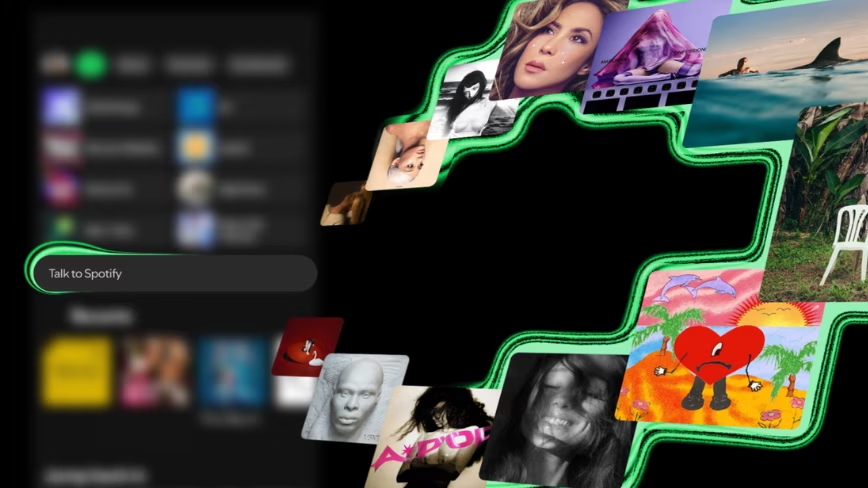
💡See how Spotify is replacing traditional search bars with conversational AI to improve user engagement.
⚡ 30-Second TL;DR
What Changed
Users can type or speak to control playback and explore listening history.
Why It Matters
This integration signals a major shift in UI/UX design for media apps, moving from static menus to intent-based conversational interfaces.
What To Do Next
Analyze how Spotify handles intent recognition to improve your own app's natural language command interface.
Key Points
- •Users can type or speak to control playback and explore listening history.
- •The feature is currently available to Premium users aged 18+ in the US, Ireland, and Sweden.
- •The AI supports both music discovery and contextual playback requests.
🧠 Deep Insight
AI-generated analysis for this event.
🔑 Enhanced Key Takeaways
- •The conversational AI utilizes a proprietary Large Language Model (LLM) fine-tuned on Spotify's extensive 'Taste Profile' data to ensure recommendations align with individual user listening habits.
- •Spotify has integrated 'Safety Guardrails' specifically designed to prevent the AI from generating offensive content or engaging in non-music-related conversational tangents.
- •The feature leverages real-time metadata processing, allowing the AI to understand complex, multi-layered requests such as 'play something for a rainy morning that sounds like 90s shoegaze'.
- •This rollout is part of Spotify's broader 'Project Echo' initiative, which aims to transition the platform from a search-based interface to an intent-based discovery engine.
- •The AI interface includes a feedback mechanism where users can 'thumbs up' or 'thumbs down' specific AI-generated suggestions, which is used to reinforce the model's personalization accuracy.
📊 Competitor Analysis▸ Show
| Feature | Spotify (Conversational AI) | Apple Music (Siri Integration) | YouTube Music (Gemini Integration) |
|---|---|---|---|
| Primary Input | Natural Language / Contextual | Voice Command / Basic Intent | Natural Language / Query-based |
| Personalization | Deep Taste Profile Integration | Ecosystem-wide Data | Search & Watch History |
| Availability | Premium (Beta) | All Users | Premium/Free (Varies) |
🛠️ Technical Deep Dive
- Architecture: Employs a hybrid model combining a transformer-based LLM for intent recognition with a vector database for real-time music retrieval.
- Latency Optimization: Uses edge-computing nodes to process voice-to-text requests locally before sending intent tokens to the cloud, reducing perceived latency.
- Context Window: The model maintains a short-term memory of the current session's conversation history to allow for follow-up questions without repeating context.
- Integration: Connects directly to the Spotify Graph API to map natural language entities to specific tracks, albums, and artist IDs.
🔮 Future ImplicationsAI analysis grounded in cited sources
⏳ Timeline
Weekly AI Recap
Read this week's curated digest of top AI events →
👉Related Updates
Same topic
Explore #conversational-ai
Same product
More on spotify-conversational-ai
Same source
Latest from The Next Web (TNW)

Modeling Conflicting Rule Sets with XGBoost and LLMs

Emergent hits $1.5bn valuation with 'vibe coding' platform

OnePlus exits US and Europe markets

South Korea to provide free AI access to all citizens
AI-curated news aggregator. All content rights belong to original publishers.
Original source: The Next Web (TNW) ↗