🌍The Next Web (TNW)•Freshcollected in 8m
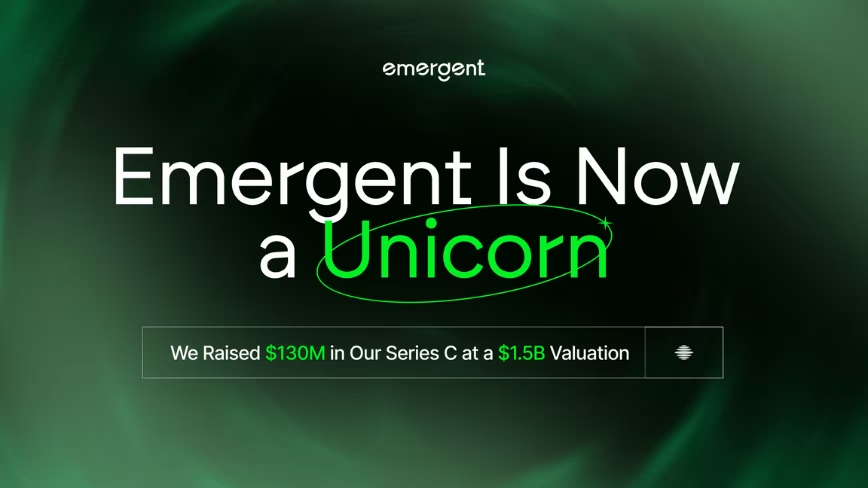
Emergent hits $1.5bn valuation with 'vibe coding' platform
💡Discover how 'vibe coding' is driving unicorn-level valuations by automating the translation of business logic to code.
⚡ 30-Second TL;DR
What Changed
Emergent achieved unicorn status within 12 months of operation.
Why It Matters
The rise of 'vibe coding' platforms suggests a shift toward high-level abstraction in software development, potentially reducing the barrier for non-technical founders.
What To Do Next
Evaluate your current development stack to see if 'vibe coding' abstractions can accelerate your MVP iteration speed.
Who should care:Founders & Product Leaders
Key Points
- •Emergent achieved unicorn status within 12 months of operation.
- •The platform promotes 'vibe coding' as a method to bridge business logic and software execution.
- •Founder Mukund Jha emphasizes that businesses need functional software translation over generic software tools.
🧠 Deep Insight
AI-generated analysis for this event.
🔑 Enhanced Key Takeaways
- •Emergent's 'vibe coding' architecture utilizes a proprietary latent-space mapping engine that interprets natural language intent into structured operational schemas without requiring traditional syntax.
- •The company secured its $1.5 billion valuation in a Series B funding round led by Andreessen Horowitz, with participation from existing seed investors.
- •Mukund Jha, previously a co-founder of the AI-powered search engine Neeva, leveraged his background in large-scale information retrieval to build Emergent's core inference engine.
- •The platform differentiates itself by maintaining a 'live-sync' capability, where changes in business operational workflows automatically trigger real-time code refactoring in the backend.
- •Emergent has reported a 400% year-over-year growth in enterprise seat adoption, primarily targeting mid-market logistics and supply chain firms.
📊 Competitor Analysis▸ Show
| Feature | Emergent | Retool | Cursor |
|---|---|---|---|
| Primary Interface | Natural Language 'Vibe' | Drag-and-Drop UI | IDE-Integrated AI |
| Target User | Operations Managers | Software Engineers | Software Engineers |
| Core Value Prop | Workflow-to-Software | Internal Tool Building | Codebase Acceleration |
| Pricing Model | Usage-based Enterprise | Per-seat Subscription | Per-seat Subscription |
🛠️ Technical Deep Dive
- Emergent utilizes a custom-trained Transformer architecture optimized for operational logic rather than general-purpose code generation.
- The system employs a 'Semantic Bridge' layer that maps unstructured business process descriptions to a graph-based representation of software dependencies.
- It features a deterministic execution environment that sandboxes generated code to ensure compliance with enterprise security protocols.
- The platform supports multi-modal input, allowing users to upload process documentation, screen recordings, or voice memos to define software requirements.
🔮 Future ImplicationsAI analysis grounded in cited sources
Emergent will face significant regulatory scrutiny regarding software liability.
The abstraction of code generation from human oversight creates potential legal ambiguity when automated workflows fail in critical infrastructure environments.
The 'vibe coding' paradigm will trigger a consolidation phase in the low-code/no-code market.
Traditional low-code platforms will be forced to acquire or integrate similar natural-language-to-logic engines to remain competitive against Emergent's rapid adoption.
⏳ Timeline
2025-06
Emergent officially launches with a focus on operational workflow automation.
2025-11
Company secures Series A funding to scale its proprietary inference engine.
2026-04
Emergent releases its 'Vibe Coding' API for enterprise integration partners.
2026-07
Emergent achieves unicorn status with a $1.5 billion valuation following Series B.
📰
Weekly AI Recap
Read this week's curated digest of top AI events →
👉Related Updates
Spotify launches conversational AI for personalized music control
The Next Web (TNW)•Jul 15

OnePlus exits US and Europe markets
The Next Web (TNW)•Jul 15

South Korea to provide free AI access to all citizens
The Next Web (TNW)•Jul 15
Reflection AI signs $1bn compute deal with Nebius
The Next Web (TNW)•Jul 15
AI-curated news aggregator. All content rights belong to original publishers.
Original source: The Next Web (TNW) ↗