OASIS 1 AI Ring: A New Voice Input Interface
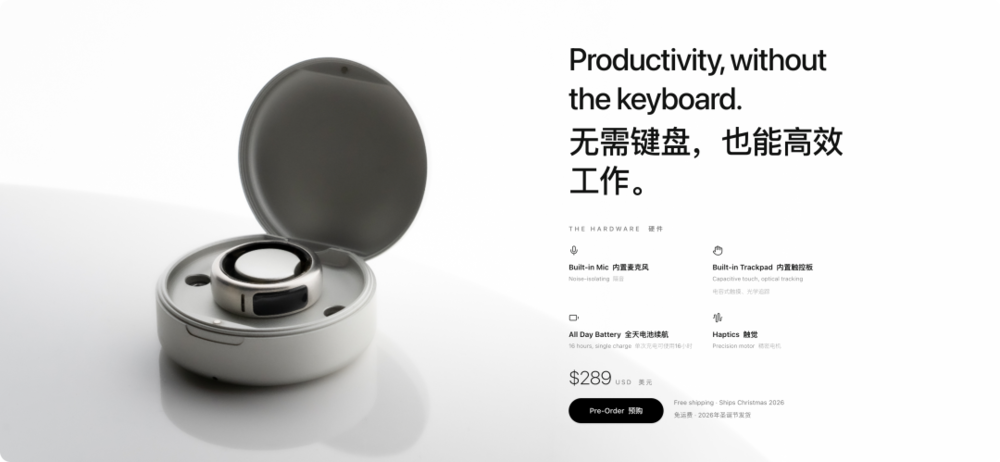
💡A bold attempt to replace the keyboard with wearable AI hardware. Is 'voice-first' the future of productivity?
⚡ 30-Second TL;DR
What Changed
Features integrated microphone for low-frequency voice capture and AI dictation.
Why It Matters
This hardware represents a shift in AI interaction design, moving input interfaces from screens/keyboards to wearable, intent-based natural language devices.
What To Do Next
Explore the Wispr Flow API to integrate voice-to-structured-text capabilities into your own productivity applications.
Key Points
- •Features integrated microphone for low-frequency voice capture and AI dictation.
- •Includes a 2D touch surface for gesture-based control and error correction.
- •Targets 'post-keyboard' office environments where voice input is preferred.
- •Battery life is limited to 16 hours, raising concerns about daily usability.
🧠 Deep Insight
AI-generated analysis for this event — not the original article.
🔑 Enhanced Key Takeaways
- •The device utilizes bone conduction or near-field acoustic sensors to isolate user speech from ambient noise, specifically targeting 'subvocal' or low-volume dictation.
- •OASIS 1 is developed by a startup that leverages a proprietary 'Whisper-to-Text' neural engine optimized for local processing to reduce latency compared to cloud-only solutions.
- •The titanium chassis is rated for IP68 water and dust resistance, positioning it as a durable wearable rather than a fragile office accessory.
- •The device employs a multi-modal sensor fusion approach, combining the 2D touch surface with an internal IMU (Inertial Measurement Unit) to track subtle finger gestures for cursor control.
- •Integration with Wispr Flow is part of a broader ecosystem strategy to provide a cross-platform 'AI layer' that functions across mobile and desktop operating systems without requiring native app support.
📊 Competitor Analysis▸ Show
| Feature | OASIS 1 | Wispr Ring | Oura Ring (Gen 4) |
|---|---|---|---|
| Primary Focus | Voice/Dictation | Voice/Dictation | Health Tracking |
| Price | $289 | ~$300 (Est) | $349+ |
| Input Method | Voice + 2D Touch | Voice + Gesture | N/A (Passive) |
| Battery Life | 16 Hours | 18-24 Hours | 7 Days |
🛠️ Technical Deep Dive
- Microphone Array: Utilizes a MEMS-based low-frequency acoustic sensor designed to capture vibrations from the finger or hand, minimizing external noise interference.
- Connectivity: Bluetooth 5.4 Low Energy (LE) with support for HID (Human Interface Device) profiles to ensure compatibility with standard OS input drivers.
- Processing: On-device lightweight transformer model for initial voice-to-text tokenization, offloading complex semantic processing to the paired smartphone or PC.
- Gesture Engine: Uses a 6-axis IMU combined with capacitive touch sensing to map finger movements to specific UI actions like scrolling, clicking, and text selection.
🔮 Future ImplicationsAI analysis grounded in cited sources
⏳ Timeline
Weekly AI Recap
Read this week's curated digest of top AI events →
👉Related Updates

AI-curated news aggregator. All content rights belong to original publishers.
Original source: 虎嗅 ↗
This is a summary, not the original. Read the source, or get the weekly briefing.
Weekly AI briefing
One email a week. Unsubscribe anytime.