NVIDIA’s Next Bet: Physical AI and Robotics
💡NVIDIA’s physical AI stack is converging with China’s rapidly scaling humanoid robotics ecosystem.
⚡ 30-Second TL;DR
What Changed
Madison Huang leads product and technical marketing for NVIDIA’s physical AI portfolio, including Omniverse, Cosmos, Isaac, and the GR00T humanoid robotics foundation model.
Why It Matters
NVIDIA’s strategy suggests that physical AI will depend on an ecosystem combining GPUs, simulation, synthetic data, foundation models, and robot manufacturers. For AI builders, China’s dense manufacturing base and large commercial deployment scenarios could become an important testbed for embodied AI systems.
What To Do Next
Prototype a robot-learning workflow in NVIDIA Isaac Sim, then compare synthetic-data performance with a small set of real-world demonstrations before selecting a humanoid robotics platform.
Key Points
- •Madison Huang leads product and technical marketing for NVIDIA’s physical AI portfolio, including Omniverse, Cosmos, Isaac, and the GR00T humanoid robotics foundation model.
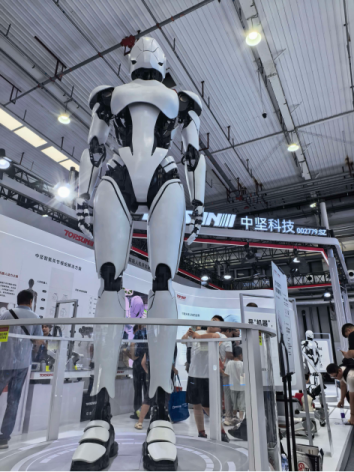
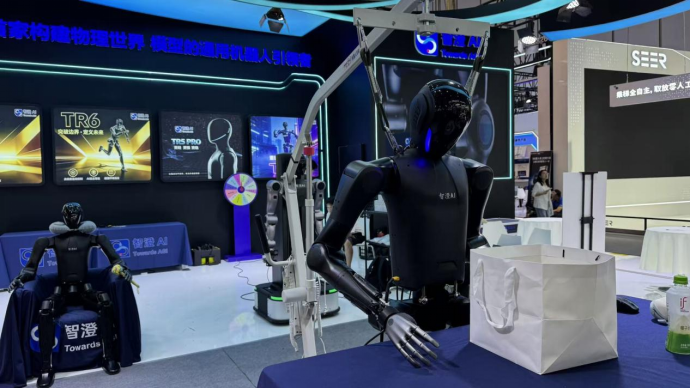
- •Her Beijing visit covered Unitree, Dobot, Galbot, UBTECH, Kepler Robotics, and JD.com, with demonstrations spanning embodied intelligence, simulation, data collection, and real-world robot operations.
- •China’s humanoid robotics sector is accelerating, with Unitree listing on the STAR Market and more than 50 robotics companies reportedly preparing Hong Kong listings.
- •The competitive focus is shifting from robot hardware and rapid manufacturing toward general-purpose robot intelligence that can follow instructions in unfamiliar environments.
🧠 Deep Insight
Background and context from public sources — not the original article. 12 sources cited.
🔑 Enhanced Key Takeaways
- •NVIDIA launched the 'Physical AI Data Factory Blueprint' to mitigate the scarcity of real-world robotics training data by utilizing synthetic data generation within Omniverse.
- •The company introduced the 'Newton' physics engine at SIGGRAPH 2026, an open-source, GPU-accelerated tool designed to enhance sim-to-real transfer by simulating complex contact and friction.
- •NVIDIA's 'Cosmos 3' world foundation model serves as an omnimodal architecture that unifies physical reasoning with action generation, specifically optimized for Blackwell-series server infrastructure.
- •NVIDIA defines its robotics strategy through 'The Three Computers' framework, which integrates DGX training servers, Omniverse simulation environments, and Jetson edge computing hardware.
- •Beyond humanoid startups, NVIDIA has expanded its industrial footprint by securing strategic partnerships with established robotics incumbents including ABB, FANUC, KUKA, and Yaskawa.
📊 Competitor Analysis▸ Show
| Feature | NVIDIA (Physical AI) | Hyperscaler Custom Silicon (Google/Amazon/MS) | AMD (Instinct/Versal) |
|---|---|---|---|
| Primary Focus | Full-stack (Silicon to Simulation) | Internal cloud/inference optimization | High-performance compute/FPGA integration |
| Simulation | Omniverse (Industry Standard) | Proprietary/Internal tools | Limited ecosystem support |
| Edge Hardware | Jetson Thor (Humanoid-specific) | Minimal/Cloud-centric | Adaptive SoCs (Versal) |
| Market Position | Dominant (86-90% AI GPU share) | Emerging (Vertical integration) | Challenger (Open ecosystem) |
🛠️ Technical Deep Dive
- Cosmos 3: An omnimodal world foundation model capable of physical reasoning and action generation, optimized for Blackwell architecture.
- Newton Physics Engine: Built on NVIDIA Warp, providing GPU-accelerated simulation for rigid and soft body dynamics.
- Jetson Thor: A specialized SoC architecture designed specifically for the compute-intensive requirements of humanoid robot brains.
- Isaac Lab: A modular framework for robot learning and reinforcement learning workflows.
- Isaac Perceptor: A dedicated software stack for autonomous navigation and spatial awareness in dynamic environments.
🔮 Future ImplicationsAI analysis grounded in cited sources
⏳ Timeline
📎 Sources (12)
Factual claims are grounded in the sources below. Forward-looking analysis is AI-generated interpretation.
Weekly AI Recap
Read this week's curated digest of top AI events →
👉Related Updates


AI-curated news aggregator. All content rights belong to original publishers.
Original source: 虎嗅 ↗
This is a summary, not the original. Read the source, or get the weekly briefing.
Weekly AI briefing
One email a week. Unsubscribe anytime.