NVIDIA Spotlights Local AI on RTX PCs & DGX Spark
💡NVIDIA's agent computers run open models locally—no cloud dependency for AI devs.
⚡ 30-Second TL;DR
What Changed
NVIDIA highlights RTX PCs and DGX Spark at GTC for local AI.
Why It Matters
This enables AI practitioners to deploy powerful models locally, reducing latency and cloud costs while enhancing privacy. It democratizes access to advanced AI agents for developers and researchers without heavy infrastructure.
What To Do Next
Test DGX Spark specs on NVIDIA site to prototype local AI agents.
Key Points
- •NVIDIA highlights RTX PCs and DGX Spark at GTC for local AI.
- •Supports running latest open models and AI agents on personal devices.
- •Introduces agent computers paradigm driven by generative AI like OpenClaw.
- •DGX Spark positioned as desktop AI supercomputer.
🧠 Deep Insight
Background and context from public sources — not the original article. 7 sources cited.
🔑 Enhanced Key Takeaways
- •DGX Spark features 128GB of unified LPDDR5x system memory, enabling local execution of AI models up to 200 billion parameters and fine-tuning up to 70 billion parameters.[1][3][5]
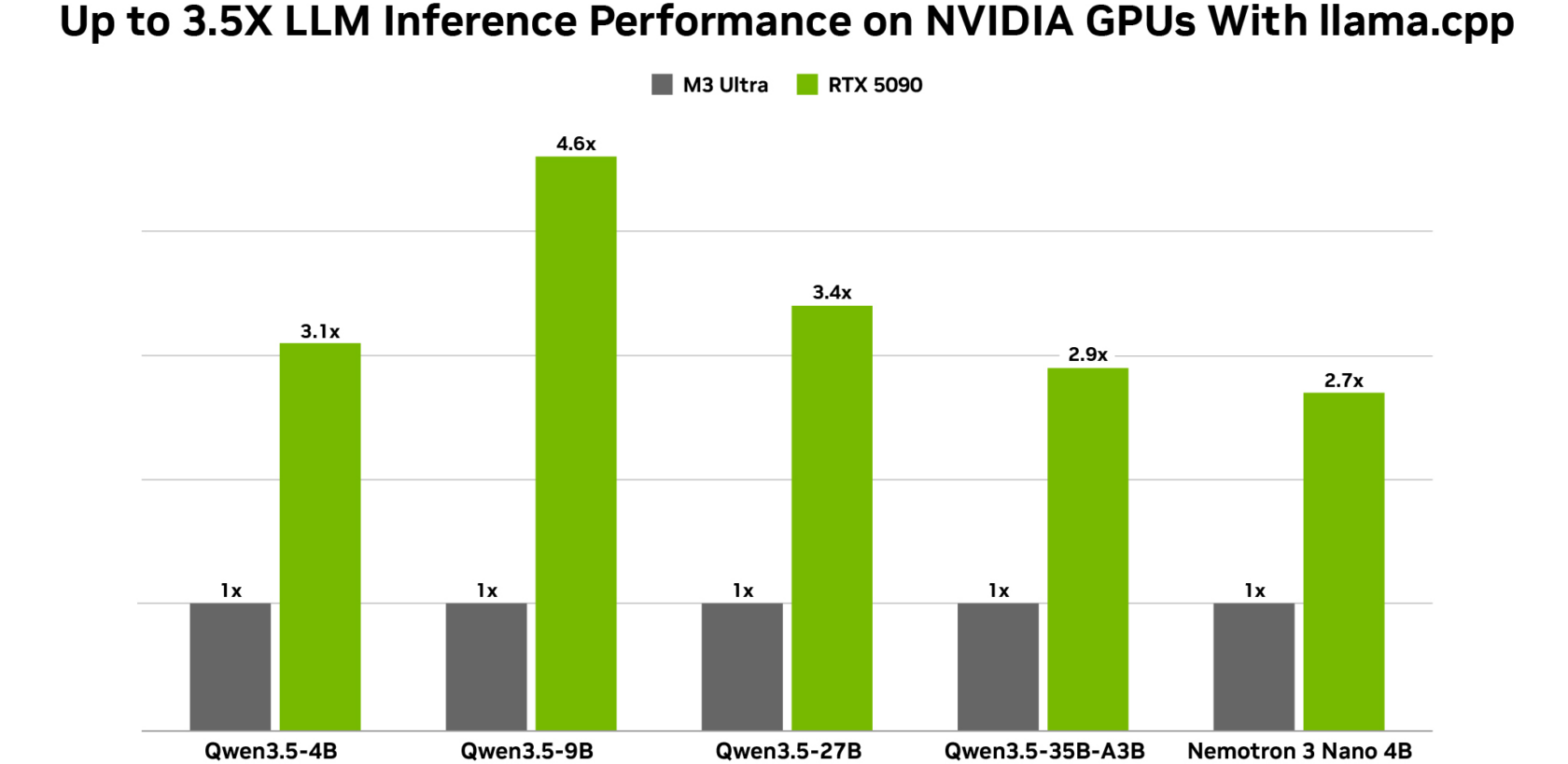
- •NVIDIA introduced NemoClaw, a set of optimizations for the OpenClaw agent framework, and new open models like Nemotron 3 Nano 4B, Nemotron 3 Super 120B, Mistral Small 4 (119B parameters), and Qwen 3.5 series with vision support and 262k context window.[1][7]
- •DGX Spark Founders Edition is priced at $3,999 with 4TB SSD, powered by Blackwell architecture with fifth-generation Tensor Cores delivering up to 1 petaFLOP of AI performance in FP4.[3][5]
- •DGX Spark supports creator workflows via ComfyUI optimizations for image/video generation and upscaling, and frameworks like Isaac, Metropolis, Holoscan for robotics and vision.[2][5]
🛠️ Technical Deep Dive
- •DGX Spark: 128GB unified LPDDR5x memory (shared CPU/GPU), Blackwell GPU with 5th-gen Tensor Cores (FP4 support), 1 petaFLOP AI performance, preloaded NVIDIA AI software stack including vLLM, TRT-LLM, containerized workflows.[3][5]
- •Supports models like Mistral Small 4 (119B total, 6-8B active parameters for chat/coding/agents), Qwen 3.5 (27B/9B/4B with vision, multi-token prediction, 262k context), Nemotron series up to 120B on RTX 5090 or DGX Spark.[1]
- •NemoClaw: NVIDIA optimizations for OpenClaw agents, enabling local inference on RTX PCs/laptops/PRO GPUs, addressing token costs/security/privacy for personal file/app integration.[1][7]
- •Enables full local AI dev cycles: prototyping to deployment consistency with CUDA stack, fine-tuning up to 70B params, multimodal processing.[2][3][5]
🔮 Future ImplicationsAI analysis grounded in cited sources
⏳ Timeline
📎 Sources (7)
Factual claims are grounded in the sources below. Forward-looking analysis is AI-generated interpretation.
- blogs.nvidia.com — Rtx AI Garage Gtc 2026 Nemoclaw
- igorslab.de — Dgx Spark at Ces 2026 Local Ki Development Between Desktop Edge and Professional Standards
- signal65.com — Nvidia Dgx Spark First Look a Personal AI Supercomputer on Your Desk
- ejscomputers.com — Nvidia S New AI Pcs and Rtx Upgrades What They Mean for Gamers and Pc Enthusiasts
- NVIDIA — Dgx Spark
- investor.nvidia.com — Default
- investor.nvidia.com — Default
Weekly AI Recap
Read this week's curated digest of top AI events →
👉Related Updates

AI-curated news aggregator. All content rights belong to original publishers.
Original source: NVIDIA Blog ↗
This is a summary, not the original. Read the source, or get the weekly briefing.
Weekly AI briefing
One email a week. Unsubscribe anytime.