Nvidia GTC: Trillion Revenue, LPU, Space Chips
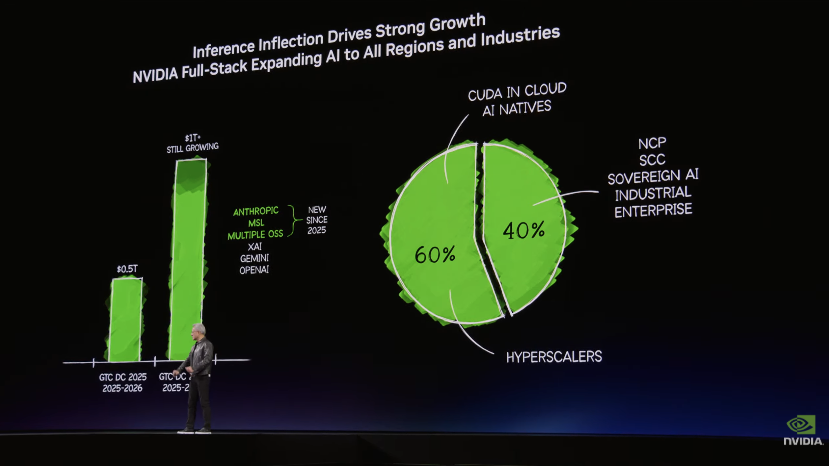
💡Nvidia eyes trillion AI chip revenue + new LPU/space tech – scale your infra now!
⚡ 30-Second TL;DR
What Changed
Trillion-dollar revenue projection for compute chips
Why It Matters
Reinforces Nvidia's AI dominance, signaling explosive demand for AI infrastructure. Practitioners face accelerating compute needs and new hardware options for scaling deployments.
What To Do Next
Watch Nvidia GTC keynote replay to evaluate LPU for your next AI training cluster.
Key Points
- •Trillion-dollar revenue projection for compute chips
- •New LPU architecture introduced
- •Space chips for satellite computing
- •One-click 'shrimp farming' AI deployment tool
🧠 Deep Insight
Background and context from public sources — not the original article. 13 sources cited.
🔑 Enhanced Key Takeaways
- •Nvidia announced Vera Rubin platform as a full-stack system with seven new chips, five rack-scale systems, and a supercomputer for agentic AI, including Vera CPU and BlueField-4 STX storage[1][8].
- •DLSS 5 introduces 3D-guided neural rendering for real-time photorealistic 4K performance on local hardware, enhancing gaming and graphics[3][5][8].
- •Feynman architecture roadmap for 2028 features GPU, LPU (LP40), Rosa CPU, paired with BlueField-5, CX10, Kyber networking, and Spectrum optics[3][8].
- •Nvidia highlighted AI Factories as the largest infrastructure rollout, supported by DSX tools for automation and simulation[3].
🛠️ Technical Deep Dive
- •Vera Rubin includes Vera CPU for super high single-thread AI performance and BlueField-4 STX storage architecture, optimized as a vertically integrated system[8].
- •Feynman platform pairs LP40 LPU with BlueField-5, CX10 networking via Kyber for scale-up (copper/co-packaged optics) and Spectrum-class for scale-out, advancing compute, memory, storage, networking, and security[8].
- •DLSS 5 uses 3D-guided neural rendering to blend raw compute and AI for ultra-realistic 3D graphics in games[3][5].
- •Nvidia Dynamo is an open-source software for scaling AI models and customizing data centers[1].
🔮 Future ImplicationsAI analysis grounded in cited sources
⏳ Timeline
📎 Sources (13)
Factual claims are grounded in the sources below. Forward-looking analysis is AI-generated interpretation.
- tomsguide.com — Nvidia Gtc 2026 Live
- Tom's Hardware — Nvidia Gtc 2026 Keynote Live Blog Jensen Huang
- techradar.com — Nvidia Gtc 2026 Live Coverage All the News and Updates As It Happens
- TechCrunch — Nvidia Gtc How to Watch Jensen Huang 2026 Keynote
- abc7news.com — 18721595
- servethehome.com — Nvidia Gtc 2026 Keynote Live Coverage
- analyticsinsight.net — Nvidia Gtc 2026 Keynote Major Announcements on AI Gaming Cpus and Computing
- blogs.nvidia.com — Gtc 2026 News
- youtube.com — Watch
- NVIDIA — Keynote
- youtube.com — Watch
- youtube.com — Watch
- NVIDIA — Session Catalog
Weekly AI Recap
Read this week's curated digest of top AI events →
👉Related Updates

AI-curated news aggregator. All content rights belong to original publishers.
Original source: cnBeta (Full RSS) ↗
This is a summary, not the original. Read the source, or get the weekly briefing.
Weekly AI briefing
One email a week. Unsubscribe anytime.