NVIDIA Expands Global Humanoid Robot Partnerships
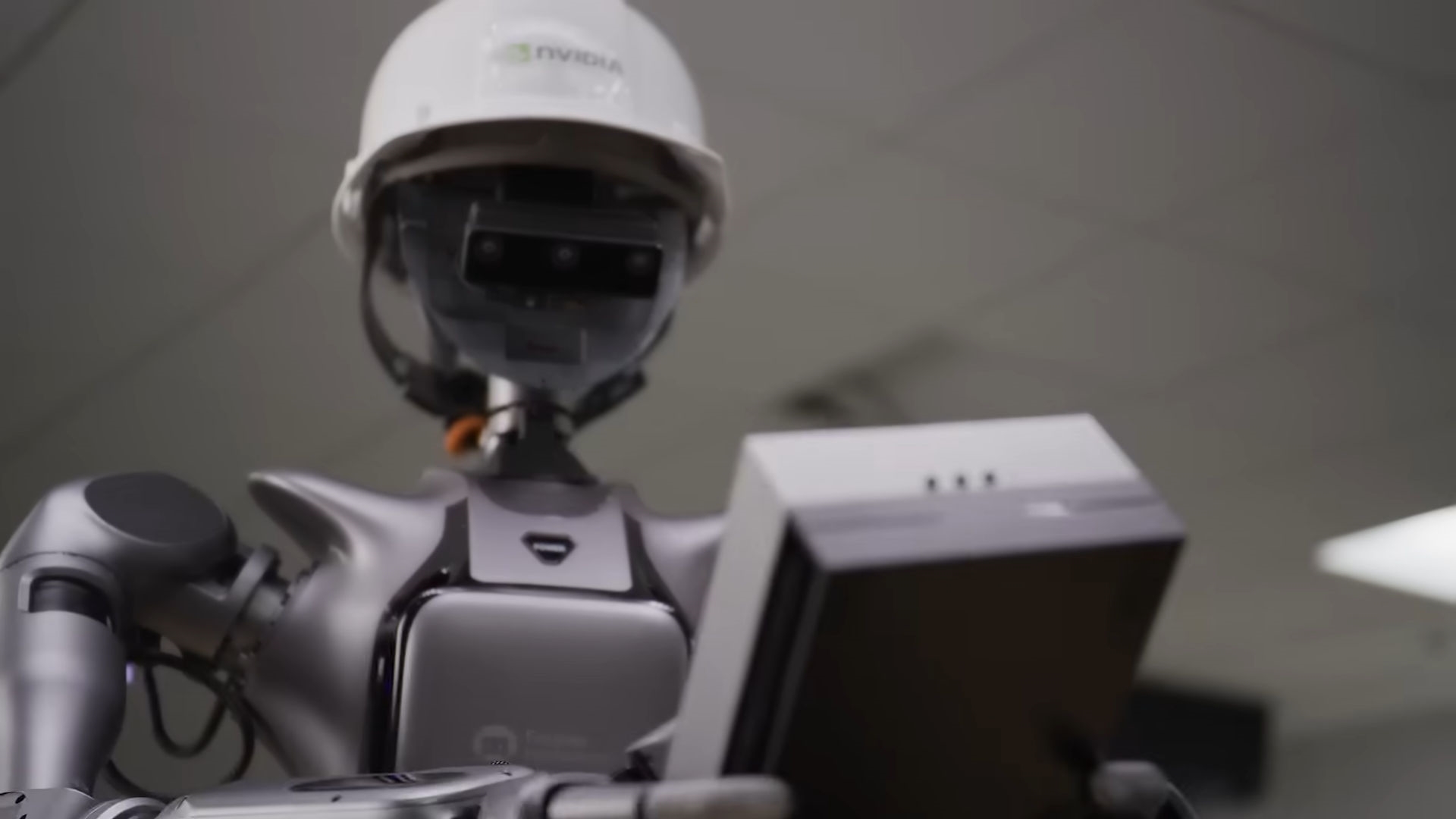
💡NVIDIA is building the standard OS for humanoid robots; learn how to align your hardware with their ecosystem.
⚡ 30-Second TL;DR
What Changed
NVIDIA is expanding its robotics ecosystem beyond China's Unitree.
Why It Matters
This signals NVIDIA's intent to dominate the embodied AI infrastructure layer by standardizing the development environment for humanoid robotics globally.
What To Do Next
Explore the NVIDIA Isaac SDK documentation to understand how to integrate your robot hardware with their standardized simulation environment.
Key Points
- •NVIDIA is expanding its robotics ecosystem beyond China's Unitree.
- •Focus on creating standardized platforms for global research institutions.
- •Strategic move to accelerate embodied AI development through hardware-software integration.
🧠 Deep Insight
Background and context from public sources — not the original article. 27 sources cited.
🔑 Enhanced Key Takeaways
- •NVIDIA is partnering with China's Unitree and Singapore-based Sharpa to develop a standardized H2+ humanoid robot reference design for academic research, integrating Unitree's H2 body, Sharpa's Wave hands, and NVIDIA's Jetson AGX Thor T5000 for computing.
- •The standardized robotics platforms will incorporate advanced security features, including Secure Boot and Confidential Computing, leveraging NVIDIA's Blackwell chips to ensure that only verified software can run on the machines and sensitive data remains protected during processing.
- •Leading global research institutions, such as Stanford University, the University of California San Diego, Ai2, and ETH Zurich, are among the first confirmed adopters of NVIDIA's Isaac GR00T Reference Humanoid Robot platform.
- •NVIDIA's strategy extends beyond merely supplying chips, aiming to become a comprehensive humanoid development platform provider by offering an integrated ecosystem that covers data collection, AI model training, and real-world robot deployment.
- •The initiative includes the NVIDIA Isaac GR00T platform, an open reference for general-purpose humanoid robots, which encompasses open data, foundational models, simulation frameworks like Isaac Sim and Isaac Lab, middleware, CUDA-X accelerated runtime libraries, and Jetson Thor for real-time inference and control.
🛠️ Technical Deep Dive
- NVIDIA Jetson AGX Thor T5000: The onboard computing platform, built on the Blackwell GPU architecture.
- AI Compute: Delivers up to 2070 FP4 TFLOPS (or 1035 FP8 TFLOPS), offering 7.5x higher AI compute than NVIDIA AGX Orin.
- Memory: Features 128 GB LPDDR5X unified memory with a bandwidth of 273-276 GB/s.
- CPU: Integrates a 14-core Arm Neoverse-V3AE CPU.
- Power: Power consumption is configurable between 40 W and 130 W.
- Key Features: Includes Blackwell Multi-Instance GPU (MIG) technology, a new Transformer engine architecture, and capabilities for high-speed sensor processing with 4x 25 GbE networking, a camera offload engine, and a Holoscan Sensor Bridge.
- Storage: Comes with an integrated 1TB NVMe SSD.
- NVIDIA Isaac Platform: A comprehensive suite for AI robotics development.
- Isaac GR00T: An open reference platform and foundational model for general-purpose humanoid robots, enabling natural language understanding, human demonstration mimicry, and task learning. It is trained on a diverse dataset including real, synthetic, and internet-scale video data.
- Isaac Sim: A scalable, physically accurate robotics simulation application built on NVIDIA Omniverse, utilizing RTX for photorealistic rendering and PhysX for precise physics, crucial for synthetic data generation, testing, and training.
- Isaac Lab: An extension of Isaac Sim, specifically designed for reinforcement learning (RL) in robotics, leveraging NVIDIA Warp for highly parallel simulations to accelerate the learning of complex motor skills.
- Isaac ROS: Provides hardware-accelerated ROS 2 packages optimized for perception, navigation, and manipulation tasks.
- Security: Incorporates robust security measures such as Secure Boot and Confidential Computing, enabled by the Blackwell architecture.
- NVIDIA's Three-Computer Architecture for Physical AI: This approach distributes workloads across three distinct computing platforms: NVIDIA DGX AI supercomputers for model training, NVIDIA Omniverse and Cosmos running on NVIDIA RTX PRO Servers for simulation, and NVIDIA Jetson AGX Thor for on-robot inference.
🔮 Future ImplicationsAI analysis grounded in cited sources
⏳ Timeline
📎 Sources (27)
Factual claims are grounded in the sources below. Forward-looking analysis is AI-generated interpretation.
- finimize.com
- klsescreener.com
- gizmochina.com
- nvidia.com
- digitaltoday.co.kr
- itp.net
- futunn.com
- stocktitan.net
- nvidia.com
- nvidia.com
- nvidia.com
- nvidia.com
- tannatechbiz.com
- edomtech.com
- thinkrobotics.com
- substack.com
- vercel.app
- introl.com
- thehumanoid.ai
- nvidia.com
- nvidia.com
- vercel.app
- nvidia.com
- nvidia.com
- youtube.com
- wikipedia.org
- kucoin.com
Weekly AI Recap
Read this week's curated digest of top AI events →
👉Related Updates

AI-curated news aggregator. All content rights belong to original publishers.
Original source: cnBeta (Full RSS) ↗
This is a summary, not the original. Read the source, or get the weekly briefing.
The weekly digest
One email a week. Unsubscribe anytime.