Nvidia Builds AI Safety Team for Trust
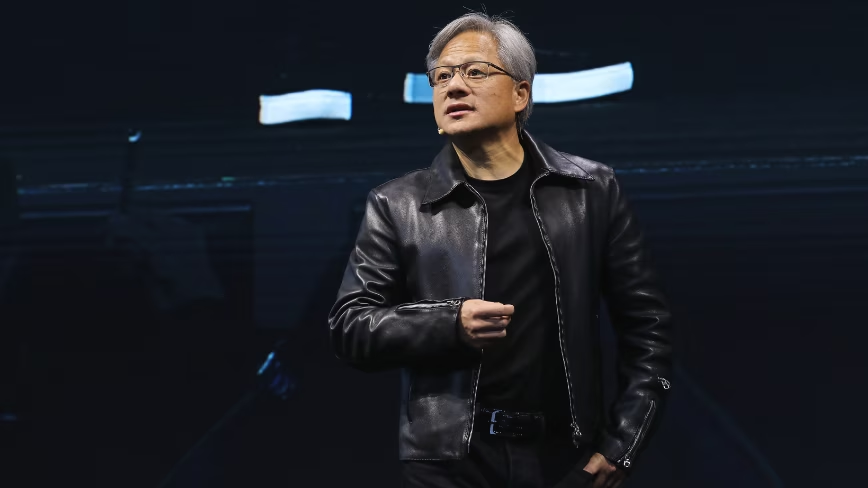
Nvidia’s hiring reveals why AI safety is becoming a deployment and revenue strategy.
30-Second TL;DR
What Changed
Nvidia has posted multiple listings for an AI safety and security engineering team.
Why It Matters
Nvidia’s investment could raise expectations for safety engineering across the AI infrastructure industry. Treating trust as a commercial requirement may also push model and platform vendors to provide stronger security evidence and operational controls.
What To Do Next
Add documented safety evaluations, threat modeling, and access controls to your next AI deployment plan so enterprise buyers can verify system trustworthiness.
Key Points
- •Nvidia has posted multiple listings for an AI safety and security engineering team.
- •The team’s focus is positioned around trust, not only theoretical AI risk.
- •Nvidia appears to view safety and security as factors that can unlock enterprise AI adoption.
Deep Insight
AI-generated analysis for this event — not the original article.
Enhanced Key Takeaways
- •Nvidia's safety initiative aligns with the 'NVIDIA NeMo' framework, which includes guardrails designed to filter inputs and outputs for toxicity, bias, and security vulnerabilities.
- •The hiring push is closely tied to the 'NVIDIA AI Enterprise' software suite, where safety features are being marketed as a premium, value-added layer for corporate clients.
- •Nvidia has actively participated in the U.S. AI Safety Institute Consortium (AISIC), signaling a strategic shift toward aligning internal engineering with emerging federal safety standards.
- •The company is prioritizing 'Red Teaming' capabilities, specifically looking for engineers to simulate adversarial attacks against large language models (LLMs) to identify prompt injection and data leakage risks.
- •This effort is part of a broader industry trend where hardware-centric companies are moving up the stack to provide 'Safety-as-a-Service' to ensure their GPUs remain the preferred infrastructure for regulated industries like healthcare and finance.
Competitor Analysis
- Nvidia (NeMo Guardrails)
- Infrastructure/Hardware-level safety
- Google (AI Safety/Secure AI Framework)
- Cloud/Model-level safety
- Microsoft (Responsible AI Standard)
- Policy/Application-level safety
- Nvidia (NeMo Guardrails)
- Deeply tied to GPU/CUDA stack
- Google (AI Safety/Secure AI Framework)
- Integrated into Vertex AI/Gemini
- Microsoft (Responsible AI Standard)
- Integrated into Azure AI/Copilot
- Nvidia (NeMo Guardrails)
- Enterprise trust for on-prem/hybrid
- Google (AI Safety/Secure AI Framework)
- Cloud-native security
- Microsoft (Responsible AI Standard)
- Enterprise governance/compliance
| Feature | Nvidia (NeMo Guardrails) | Google (AI Safety/Secure AI Framework) | Microsoft (Responsible AI Standard) |
|---|---|---|---|
| Primary Focus | Infrastructure/Hardware-level safety | Cloud/Model-level safety | Policy/Application-level safety |
| Integration | Deeply tied to GPU/CUDA stack | Integrated into Vertex AI/Gemini | Integrated into Azure AI/Copilot |
| Market Positioning | Enterprise trust for on-prem/hybrid | Cloud-native security | Enterprise governance/compliance |
Technical Deep Dive
- Implementation of NeMo Guardrails involves a three-layer architecture: Input Rails (filtering user prompts), Dialog Rails (managing conversation flow), and Output Rails (validating model responses).
- Utilization of 'Canary' tokens and adversarial testing datasets to detect model hallucinations and jailbreak attempts during the inference phase.
- Integration with NVIDIA NIM (NVIDIA Inference Microservices) to deploy safety-hardened containers that enforce security policies at the API gateway level.
- Focus on 'Constitutional AI' principles where models are trained or prompted to adhere to a specific set of safety guidelines defined by the enterprise user.
Future ImplicationsAI analysis grounded in cited sources
Timeline
- 2023-03Nvidia announces NeMo Guardrails as an open-source toolkit for developers.
- 2023-07Nvidia joins major tech companies in a White House commitment to voluntary AI safety standards.
- 2024-02Nvidia joins the U.S. AI Safety Institute Consortium (AISIC) to help establish safety benchmarks.
- 2025-05Nvidia expands its AI Enterprise software suite to include enhanced security and compliance modules.
Weekly AI Recap
Read this week's curated digest of top AI events →
Related Updates

AI-curated news aggregator. All content rights belong to original publishers.
Original source: The Next Web (TNW) ↗
This is a summary, not the original. Read the source, or get the weekly briefing.
The weekly digest
One email a week. Unsubscribe anytime.