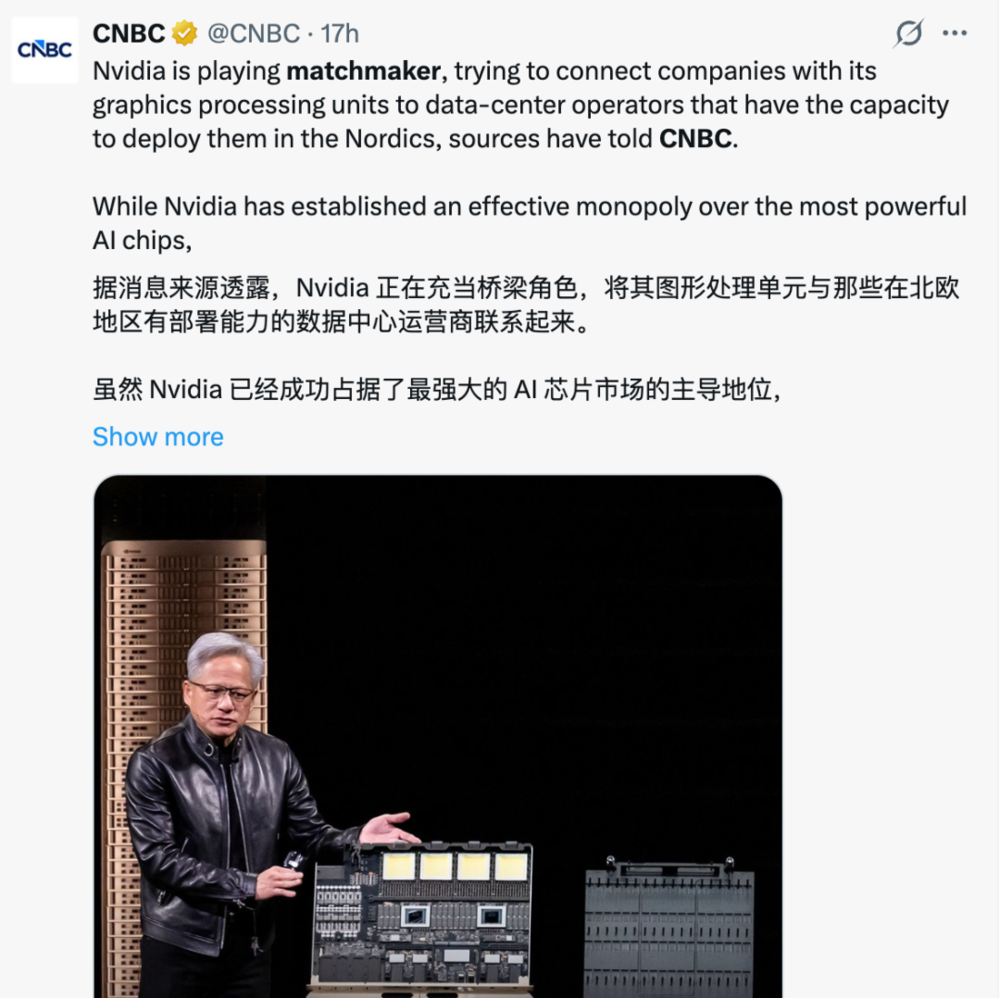
NVIDIA Becomes AI Infrastructure Matchmaker
💡GPU availability is no longer enough—learn why power, land, and ready-to-use data centers now determine AI scale.
⚡ 30-Second TL;DR
What Changed
NVIDIA is introducing GPU customers to data-center operators in the Nordics, including potential pre-commitment deals for future power and capacity.
Why It Matters
AI infrastructure competition is shifting from acquiring GPUs to securing deployable capacity. By controlling customer introductions, financing, and deployment sites, NVIDIA can increase GPU utilization, reinforce its software ecosystem, and potentially lock in multi-year demand.
What To Do Next
Before ordering your next GPU cluster, build an LPS deployment checklist covering grid capacity, cooling, fiber connectivity, permits, and confirmed rack availability.
Key Points
- •NVIDIA is introducing GPU customers to data-center operators in the Nordics, including potential pre-commitment deals for future power and capacity.
- •NVIDIA defines the critical data-center requirements as LPS: Land, Power, and Shell, covering sites, electricity, buildings, cooling, and network infrastructure.
- •NVIDIA reportedly guaranteed up to $105 billion for OpenAI’s lease of the PORTS-Pike data-center campus in Ohio.
- •The company is also working with Apollo, Blackstone, KKR, and other financial institutions to mobilize more than $500 billion for AI infrastructure.
- •Nordic regions offer abundant low-carbon power and cooler climates, but grid-connection queues remain a major bottleneck, with Norway’s pending data-center capacity requests reaching about 4.4 GW.
🧠 Deep Insight
Background and context from public sources — not the original article. 15 sources cited.
🔑 Enhanced Key Takeaways
- •NVIDIA's strategy shifted in 2025 from merely certifying data centers as 'DGX-Ready' to proactively designing the entire AI infrastructure stack, encompassing new power standards like its 800 VDC architecture and modular construction blueprints for 'AI Factories'.
- •NVIDIA is directly investing in AI infrastructure projects to mitigate bottlenecks faced by customers in securing power and constructing facilities, thereby ensuring sustained demand for its GPUs.
- •The reported $105 billion commitment for OpenAI's PORTS-Pike data center in Ohio is a financing guarantee for the land, power, and shell (LPS) buildout, complemented by NVIDIA's $1.5 billion investment in SB Energy, the entity responsible for building, owning, and operating the facility.
- •The PORTS-Pike data center in Ohio is contractually obligated to exclusively utilize NVIDIA AI hardware under a 20-year lease to OpenAI, effectively precluding competitors such as AMD and Broadcom from deploying their solutions at this site.
- •NVIDIA's 'matchmaking' initiatives extend beyond the Nordic region, actively brokering connections between AI infrastructure developers and GPU-holding enterprises in the U.S. and Asia.
🛠️ Technical Deep Dive
- NVIDIA's 'AI Factory' is a specialized computing infrastructure optimized for the entire AI lifecycle, including data ingestion, preprocessing, model training, fine-tuning, inference, and orchestration, with intelligence measured by token throughput.
- These factories leverage NVIDIA Blackwell GPUs, Spectrum-X networking, BlueField DPUs, and validated software stacks.
- A key technical focus is the implementation of an 800 VDC power distribution architecture to support higher-density AI systems and enable upgrades without complete data center redesign.
- The NVIDIA DSX platform serves as a comprehensive blueprint, integrating compute, power, cooling, and facility design to optimize performance and reduce costs for scalable AI factory deployments.
- NVIDIA AI Enterprise is an end-to-end software suite designed to accelerate enterprise and agentic AI from development to production.
- NVIDIA DGX Cloud is the company's internal cloud environment for large-scale AI operations, used for developing foundational models and validating system architectures, and runs across various Cloud Service Providers (CSPs) and NVIDIA Cloud Partners.
- The NVIDIA DSX OS functions as the operating layer for AI factories, facilitating infrastructure online deployment, runtime consistency, and automated fleet health management.
- NVIDIA acquired Run.ai in April 2024 to enhance its GPU workload management and orchestration capabilities, utilizing a Kubernetes-based platform.
- AI factories unify five critical layers: energy, chips, infrastructure, models, and applications, with economic performance defined by metrics like tokens per second, tokens per watt, and cost per token.
🔮 Future ImplicationsAI analysis grounded in cited sources
⏳ Timeline
📎 Sources (15)
Factual claims are grounded in the sources below. Forward-looking analysis is AI-generated interpretation.
Weekly AI Recap
Read this week's curated digest of top AI events →
👉Related Updates
AI-curated news aggregator. All content rights belong to original publishers.
Original source: 虎嗅 ↗
This is a summary, not the original. Read the source, or get the weekly briefing.
Weekly AI briefing
One email a week. Unsubscribe anytime.