NASA Satellite Uses Space Junk Instead of GPS
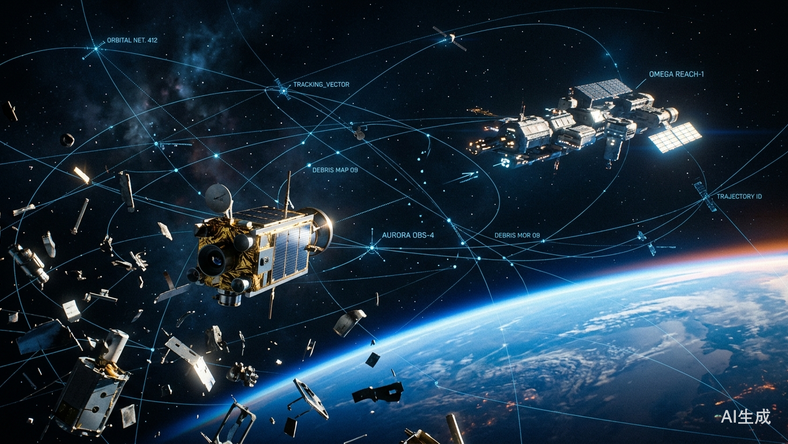
💡NASA shows how edge AI can navigate without GPS—and outperform a centralized catalog using live observations.
⚡ 30-Second TL;DR
What Changed
FALCON stands for Fast Autonomous Lost-in-space Catalog-based Optical Navigation.
Why It Matters
The experiment demonstrates how edge autonomy can reduce dependence on centralized infrastructure and correct stale or inaccurate planning data in real time. The same pattern is relevant to AI systems operating in rapidly changing environments where local observations may outperform a static global plan.
What To Do Next
Prototype a local-observation fallback for your AI system that compares live sensor or user data against its central plan and automatically flags prediction errors.
Key Points
- •FALCON stands for Fast Autonomous Lost-in-space Catalog-based Optical Navigation.
- •The satellite uses a star-tracker camera to identify passing spacecraft and orbital debris as reference landmarks.
- •It compares observations against a catalog of roughly 20,000 space objects and their predicted orbits.
- •Over three days, FALCON autonomously updated the trajectories of more than 200 objects without ground personnel.
- •For observed objects, the onboard corrections were more accurate than the original ground-generated catalog data.
🧠 Deep Insight
Background and context from public sources — not the original article. 8 sources cited.
🔑 Enhanced Key Takeaways
- •The FALCON system was developed as a collaborative flight experiment between NASA and EraDrive, a startup originating from Stanford University.
- •This demonstration marks the first instance of a spacecraft utilizing relative optical navigation against a catalog of non-cooperative space objects to perform self-orbit determination.
- •The technology is specifically designed to address navigation challenges for deep-space missions near the Moon and Mars where traditional GPS infrastructure is absent.
- •Beyond pure navigation, the system provides a dual-use capability for enhanced space traffic management and automated collision avoidance maneuvers.
- •The Starling mission, which hosted the FALCON experiment, utilizes a swarm-based architecture to validate these autonomous capabilities in a multi-satellite environment.
🛠️ Technical Deep Dive
- Utilizes existing star-tracker hardware to capture optical data of non-cooperative space objects.
- Employs a pre-loaded onboard catalog containing orbital parameters for approximately 20,000 tracked space objects.
- Implements autonomous algorithms to perform cross-referencing between observed optical landmarks and cataloged trajectory predictions.
- Executes onboard state estimation to refine orbital position without requiring uplinked telemetry from ground-based tracking stations.
🔮 Future ImplicationsAI analysis grounded in cited sources
⏳ Timeline
📎 Sources (8)
Factual claims are grounded in the sources below. Forward-looking analysis is AI-generated interpretation.
Weekly AI Recap
Read this week's curated digest of top AI events →
👉Related Updates


AI-curated news aggregator. All content rights belong to original publishers.
Original source: 虎嗅 ↗
This is a summary, not the original. Read the source, or get the weekly briefing.
Weekly AI briefing
One email a week. Unsubscribe anytime.