🇨🇳cnBeta (Full RSS)•Stalecollected in 84m
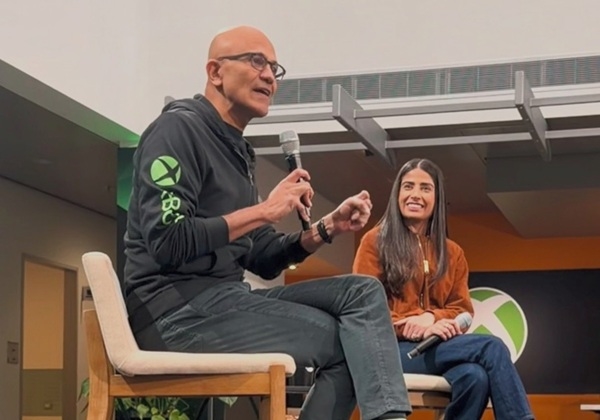
MS Gaming Slumps, Cloud Surges on AI Bets
💡MSFT $190B AI capex boom eases doubts—scale Azure workloads with new capacity.
⚡ 30-Second TL;DR
What Changed
Gaming segment revenue keeps declining
Why It Matters
Highlights cloud/AI resilience amid gaming woes; huge capex signals expanded AI compute capacity for developers.
What To Do Next
Check Azure AI capacity and pricing updates leveraging the $190B infra spend.
Who should care:Enterprise & Security Teams
Key Points
- •Gaming segment revenue keeps declining
- •Cloud business grows strongly, offsetting losses
- •Capex jumps 61% to $190B for AI infrastructure
- •Reduces worries over Microsoft AI strategy
🧠 Deep Insight
AI-generated analysis for this event — not the original article.
🔑 Enhanced Key Takeaways
- •Microsoft's gaming decline is primarily attributed to a cyclical downturn in hardware sales for the Xbox Series X/S consoles, which are late in their lifecycle, despite growth in Game Pass subscription revenue.
- •The massive $190B capital expenditure is heavily weighted toward the construction of 'AI supercomputer' data centers and the procurement of next-generation Blackwell-architecture GPUs from NVIDIA to meet Azure demand.
- •Investors are showing increased scrutiny regarding the 'time-to-value' for AI investments, forcing Microsoft to prioritize operational efficiency and energy-efficient cooling infrastructure to maintain cloud margins.
📊 Competitor Analysis▸ Show
| Feature | Microsoft (Azure AI) | Amazon (AWS Bedrock) | Google (Vertex AI) |
|---|---|---|---|
| Primary Model | OpenAI GPT-4o/o1 | Claude 3.5/Titan | Gemini 1.5 Pro |
| Infrastructure | Custom Maia chips + NVIDIA | Custom Trainium/Inferentia | Custom TPU v5p |
| Market Focus | Enterprise/Office Integration | Developer/Scalability | Data/Multimodal Research |
🛠️ Technical Deep Dive
- Deployment of custom-designed Microsoft Maia 100 AI accelerators to reduce dependency on third-party silicon.
- Implementation of liquid cooling solutions in new data center builds to support high-density racks exceeding 100kW per rack.
- Integration of InfiniBand networking fabrics to minimize latency in large-scale distributed training clusters for frontier models.
🔮 Future ImplicationsAI analysis grounded in cited sources
Microsoft will achieve a 20% increase in Azure AI revenue by Q4 2026.
The massive capital investment in GPU capacity is designed to alleviate current supply-side bottlenecks that have limited customer onboarding.
Gaming segment revenue will stabilize by early 2027.
The expected launch of next-generation hardware and a shift toward cloud-native gaming experiences will likely offset the current console hardware sales slump.
⏳ Timeline
2023-01
Microsoft announces multi-billion dollar investment in OpenAI.
2023-10
Microsoft completes the $68.7 billion acquisition of Activision Blizzard.
2024-11
Microsoft launches Azure AI infrastructure expansion initiative.
2025-05
Microsoft reports record-breaking cloud revenue growth driven by AI services.
2026-02
Microsoft announces shift in gaming strategy to focus on multi-platform releases.
📰
Weekly AI Recap
Read this week's curated digest of top AI events →
👉Related Updates

AI-curated news aggregator. All content rights belong to original publishers.
Original source: cnBeta (Full RSS) ↗
This is a summary, not the original. Read the source, or get the weekly briefing.
Weekly AI briefing
One email a week. Unsubscribe anytime.