MoSense Raises Millions for Full-Body Robot Tactile Skin
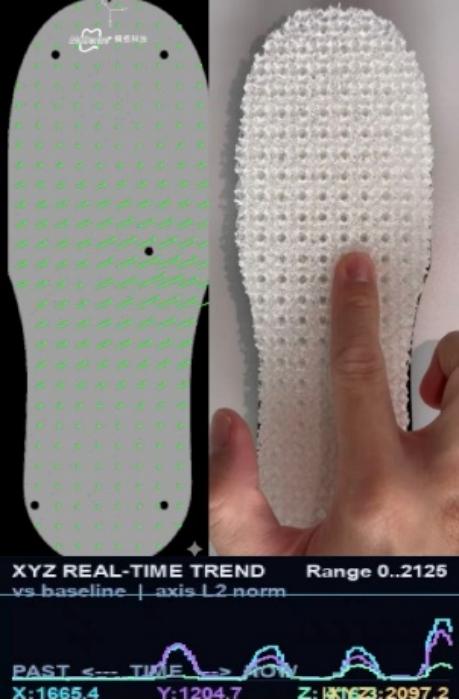
💡New tactile sensing hardware combined with world models to solve the Sim-to-Real gap for humanoid robots.
⚡ 30-Second TL;DR
What Changed
MoSkin provides full-body tactile sensing including force, temperature, vibration, and slip.
Why It Matters
This technology addresses a critical bottleneck in embodied AI by providing robots with the physical feedback necessary for complex, real-world tasks like elderly care or logistics.
What To Do Next
Evaluate integrating full-body tactile feedback into your robot's world model training pipeline to improve Sim-to-Real performance.
Key Points
- •MoSkin provides full-body tactile sensing including force, temperature, vibration, and slip.
- •Uses electromagnetic meta-material technology to convert physical boundaries into 6D force fields.
- •Integrates a world-action-tactile prediction model to improve real-world generalization.
- •Backed by Sequoia China, Gaoling Ventures, and Agibot.
🧠 Deep Insight
AI-generated analysis for this event.
🔑 Enhanced Key Takeaways
- •MoSense's core team originates from top-tier research institutions including Tsinghua University and the Chinese University of Hong Kong, focusing on soft robotics and haptic perception.
- •The company's electromagnetic meta-material approach allows for high-density sensor arrays that can be manufactured at a lower cost compared to traditional capacitive or piezoresistive tactile skins.
- •MoSkin is designed with a modular architecture, enabling it to be retrofitted onto existing humanoid platforms like Agibot's series without requiring complete chassis redesigns.
- •The world-model-based algorithm utilizes self-supervised learning on tactile-visual datasets to predict object properties before physical contact is fully established.
- •The funding round was specifically earmarked for establishing a pilot production line to transition from laboratory-scale prototypes to mass-manufacturable tactile skins.
📊 Competitor Analysis▸ Show
| Competitor | Technology Focus | Key Advantage | Pricing/Status |
|---|---|---|---|
| GelSight | Optical-based tactile sensing | Extremely high spatial resolution | Commercial / Premium |
| Wonik Robotics | Allegro Hand integration | Proven industrial reliability | Commercial / High |
| SynTouch | Bio-mimetic (fluid-based) | Human-like texture perception | Commercial / Niche |
| MoSense | Electromagnetic meta-material | Full-body scalability & cost | Seed / Emerging |
🛠️ Technical Deep Dive
- Sensor Architecture: Employs a multi-layer electromagnetic meta-material film that detects deformation via changes in magnetic flux density.
- Sensing Modalities: Capable of sub-millimeter spatial resolution for vibration detection and millisecond-level latency for slip detection.
- Model Architecture: Implements a Transformer-based world model that fuses tactile temporal sequences with visual inputs to generate action-conditioned tactile predictions.
- Data Processing: Utilizes on-skin edge computing modules to reduce the bandwidth load on the robot's central processing unit (CPU/GPU).
🔮 Future ImplicationsAI analysis grounded in cited sources
⏳ Timeline
Weekly AI Recap
Read this week's curated digest of top AI events →
👉Related Updates



AI-curated news aggregator. All content rights belong to original publishers.
Original source: 36氪 ↗