MORPHI’s Long-Horizon Robot Debuts
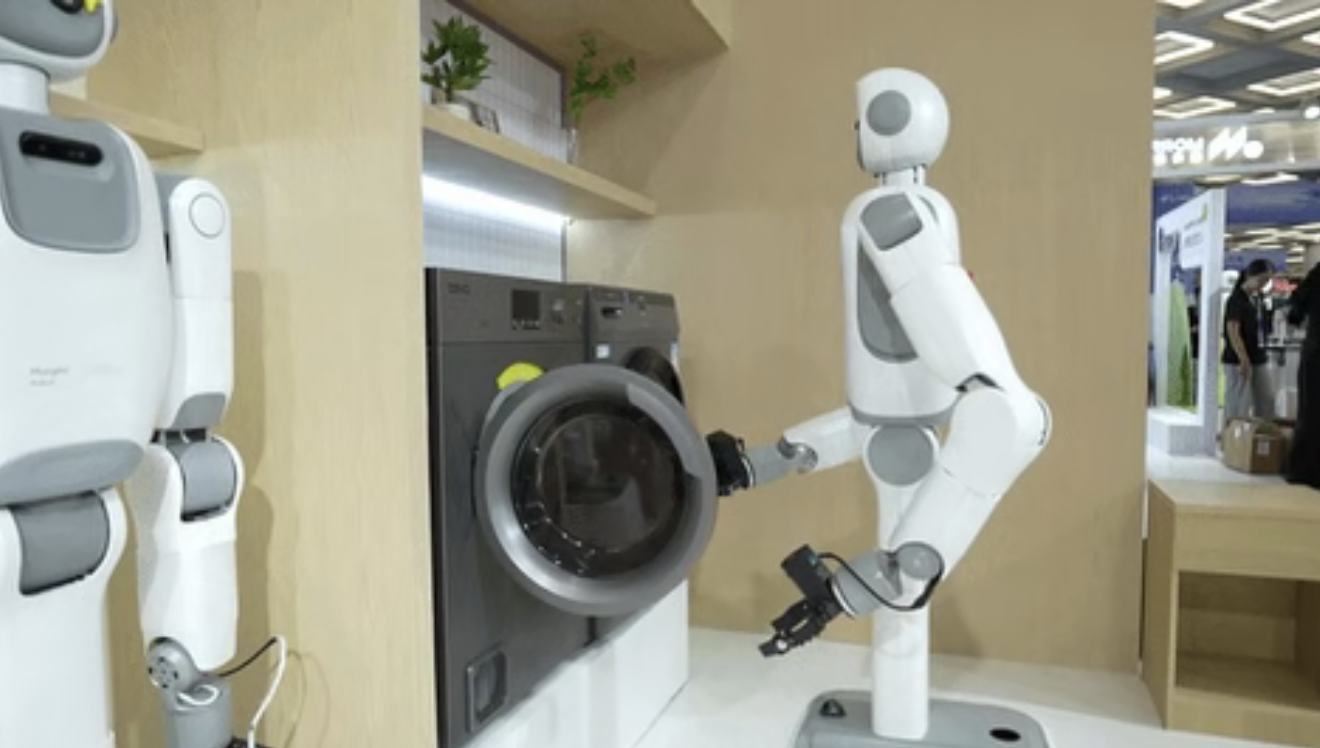
💡MORPHI’s robot completes 70–80 household actions autonomously, offering a concrete test of long-horizon embodied AI.
⚡ 30-Second TL;DR
What Changed
KINO autonomously cleaned a living room, checked a refrigerator, operated a dryer and folded clothes in one continuous demonstration.
Why It Matters
MORPHI’s demonstration shifts embodied-AI evaluation from short manipulation clips toward reliable completion of long, multi-step tasks. Its edge-native control approach could reduce dependence on cloud latency, but the company still needs to prove generalization beyond curated household scenarios.
What To Do Next
Benchmark your robot agent on uninterrupted multi-step tasks and measure completion rate, recovery behavior, and edge-to-cloud latency rather than demo length alone.
Key Points
- •KINO autonomously cleaned a living room, checked a refrigerator, operated a dryer and folded clothes in one continuous demonstration.
- •MORPHI chose a wheeled platform and grippers instead of a bipedal humanoid with dexterous hands.
- •The company’s MoRA embodied model puts System 1 intelligence directly in the execution layer for edge control.
- •MORPHI has more than 150 employees and plans to deliver 1,000 robots next year.
🧠 Deep Insight
Background and context from public sources — not the original article. 9 sources cited.
🔑 Enhanced Key Takeaways
- •MORPHI was founded in late 2025, making the KINO debut a rapid development cycle of approximately eight months.
- •The company is led by Qingqiu Huang, a former AI lead at Huawei’s Intelligent Driving (ADS) department, and logistics veteran Gao Wenli.
- •MORPHI officially unveiled the KINO robot at the World Robot Conference (WRC) in Beijing on August 19, 2026.
- •The company’s design philosophy explicitly prioritizes 'intelligence in the arms' over bipedal locomotion, favoring wheeled platforms to maximize stability and efficiency in household environments.
- •MORPHI is part of a broader 2026 industry shift where startups like Astribot and Galbot are moving away from simple 'pick-and-place' demonstrations toward multi-step, agentic household service tasks.
📊 Competitor Analysis▸ Show
| Feature | MORPHI KINO | Astribot S1 | Galbot |
|---|---|---|---|
| Mobility | Wheeled | Wheeled | Wheeled |
| Primary Focus | Long-horizon household tasks | High-speed dexterous manipulation | Service/Retail scenarios |
| Architecture | MoRA (Edge-native) | Cloud-integrated | Vision-Language-Action |
| Pricing | N/A | N/A | N/A |
🛠️ Technical Deep Dive
- MoRA Architecture: An agentic-native framework that embeds System 1 intelligence directly into the robot's execution layer to minimize latency between reasoning and physical action.
- Edge Control: Decentralized processing model that allows for autonomous replanning without constant reliance on cloud-based command streams.
- Hardware Configuration: Utilizes a specialized wheeled base for navigation and simplified grippers optimized for household object interaction rather than human-mimetic dexterous hands.
🔮 Future ImplicationsAI analysis grounded in cited sources
⏳ Timeline
📎 Sources (9)
Factual claims are grounded in the sources below. Forward-looking analysis is AI-generated interpretation.
Weekly AI Recap
Read this week's curated digest of top AI events →
👉Related Updates

AI-curated news aggregator. All content rights belong to original publishers.
Original source: 极客公园 ↗
This is a summary, not the original. Read the source, or get the weekly briefing.
Weekly AI briefing
One email a week. Unsubscribe anytime.