Morgan Stanley doubles China humanoid robot forecast
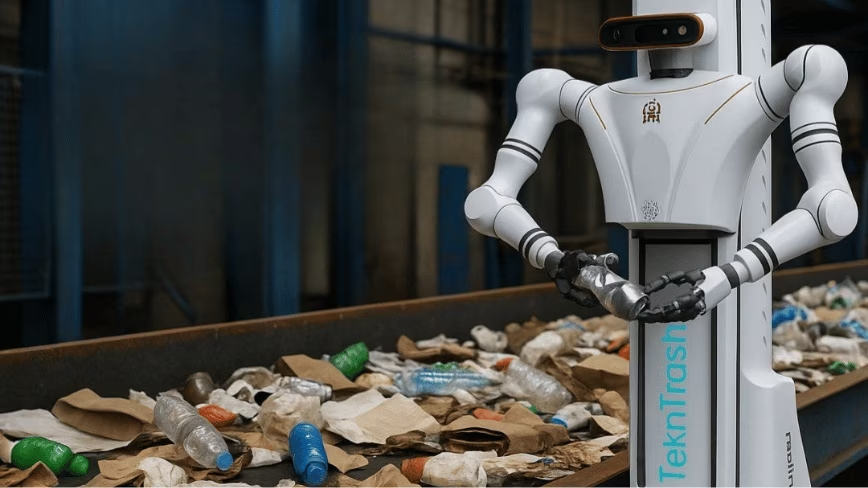
💡Rapid adoption of humanoid robots in China signals a major shift toward real-world embodied AI deployment.
⚡ 30-Second TL;DR
What Changed
2024 shipment forecast increased to 50,000 units
Why It Matters
The rapid scaling of humanoid robots suggests that embodied AI is reaching a commercial tipping point, which will drive demand for specialized hardware and navigation software.
What To Do Next
If you are in robotics, focus on developing robust SLAM or navigation algorithms that can handle unstructured commercial environments.
Key Points
- •2024 shipment forecast increased to 50,000 units
- •Robots moving from demos to real-world factory/restaurant use
- •Significant scaling of embodied AI deployment in China
🧠 Deep Insight
AI-generated analysis for this event — not the original article.
🔑 Enhanced Key Takeaways
- •The surge in shipment forecasts is largely attributed to the rapid localization of supply chains, reducing the cost of key components like harmonic drives and sensors by over 30% since 2023.
- •Chinese government policy, specifically the 'Robot + Application' action plan, has provided direct subsidies for manufacturers integrating humanoid robots into automotive assembly lines.
- •Major Chinese tech conglomerates, including Xiaomi and UBTECH, have shifted focus from general-purpose research to specialized 'task-specific' humanoid models optimized for repetitive industrial tasks.
- •The integration of Large Vision-Language Models (LVLMs) into robot control stacks has enabled these units to perform complex, unstructured tasks in restaurants without needing pre-programmed paths.
- •Morgan Stanley's analysis highlights that the 'embodied AI' ecosystem in China is benefiting from a unique data-sharing initiative between robotics firms and manufacturing hubs, accelerating reinforcement learning cycles.
📊 Competitor Analysis▸ Show
| Feature | Tesla (Optimus) | UBTECH (Walker S) | Figure AI (Figure 02) |
|---|---|---|---|
| Primary Market | Automotive/General | Industrial/Automotive | Logistics/General |
| Control Stack | End-to-end Neural Net | Hybrid (AI + Logic) | End-to-end Neural Net |
| Deployment Status | Internal Pilot | Commercial Pilot | Commercial Pilot |
| Key Advantage | Manufacturing Scale | Supply Chain Integration | Foundation Model Speed |
🛠️ Technical Deep Dive
- Control Architecture: Transitioning from traditional PID controllers to end-to-end transformer-based policies that map visual input directly to joint torques.
- Actuation: Adoption of integrated joint modules combining brushless DC motors, strain wave gearing, and absolute encoders to improve torque density.
- Perception: Multi-modal sensor fusion utilizing LiDAR for SLAM and depth cameras for semantic scene understanding, processed on-board via edge AI accelerators.
- Training: Heavy reliance on Sim-to-Real transfer learning, utilizing NVIDIA Isaac Sim or similar physics engines to generate synthetic training data for complex manipulation tasks.
🔮 Future ImplicationsAI analysis grounded in cited sources
⏳ Timeline
Weekly AI Recap
Read this week's curated digest of top AI events →
👉Related Updates


AI-curated news aggregator. All content rights belong to original publishers.
Original source: The Next Web (TNW) ↗
This is a summary, not the original. Read the source, or get the weekly briefing.
The weekly digest
One email a week. Unsubscribe anytime.