Moore Threads Eyes Hong Kong Listing
💡China’s GPU challenger has 56 billion yuan in liquidity—but rising inventory, debt, and software risk remain.
⚡ 30-Second TL;DR
What Changed
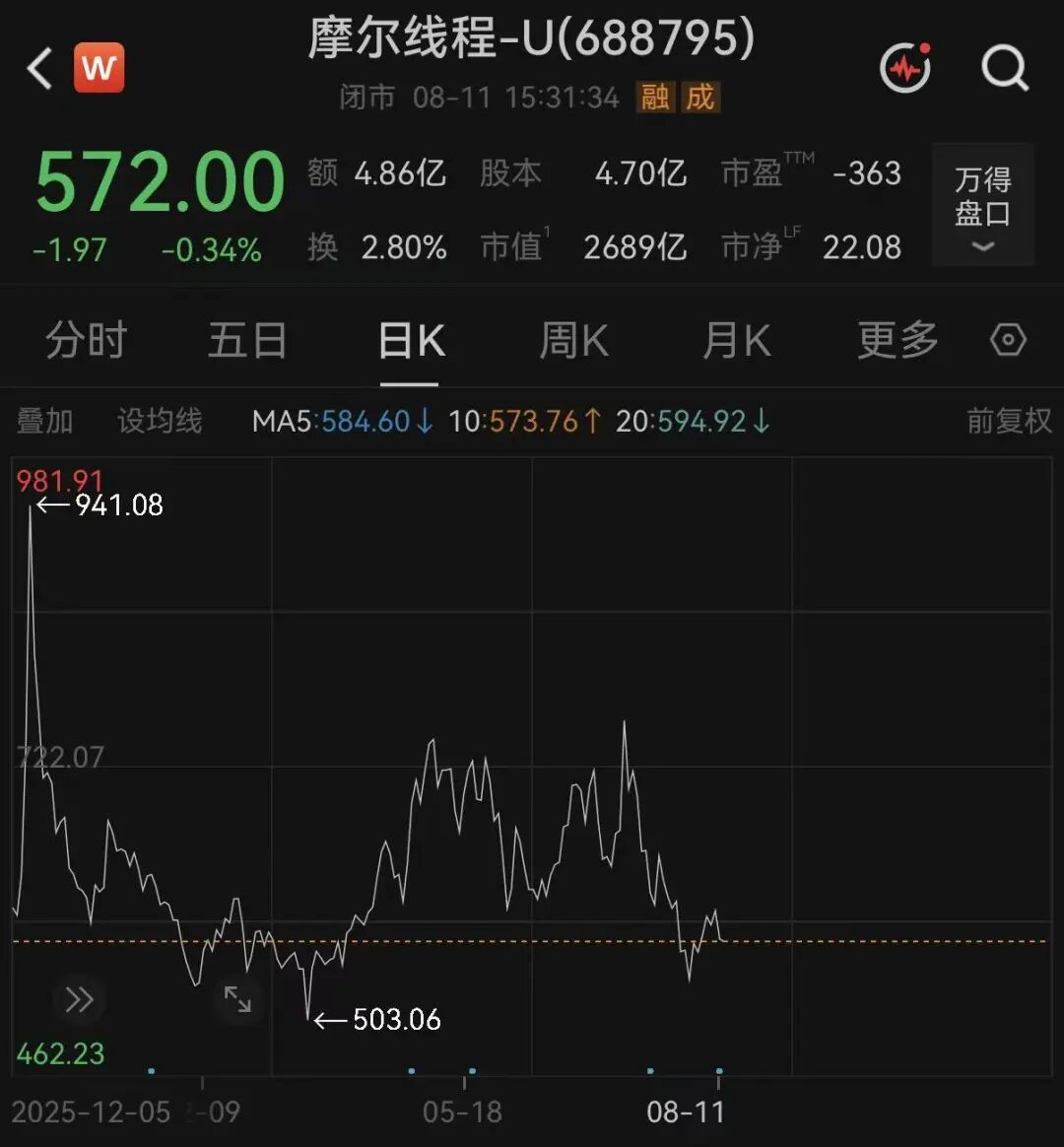
First-half revenue reached 1.736 billion yuan, up 147% year over year.
Why It Matters
The story highlights the capital intensity and supply-chain risks facing China’s GPU challengers. For AI infrastructure builders, Moore Threads’ progress will affect the availability of domestic alternatives, but its profitability, software ecosystem, inventory turnover, and large-scale delivery remain unresolved.
What To Do Next
Benchmark your inference and training workloads on Moore Threads hardware with MUSA compatibility before committing to it as a production GPU alternative.
Key Points
- •First-half revenue reached 1.736 billion yuan, up 147% year over year.
- •Adjusted for non-recurring gains, the company still posted a 151 million yuan loss.
- •Cash and cash-management products totaled approximately 5.625 billion yuan.
- •Inventory rose from 1.332 billion to 3.55 billion yuan, while operating cash flow was negative 2.169 billion yuan.
- •Moore Threads plans an H-share listing less than a year after its 75.76 billion yuan-equivalent-equivalent? A-share fundraising, ahead of a 39.55% lock-up expiration.
🧠 Deep Insight
AI-generated analysis for this event.
🔑 Enhanced Key Takeaways
- •Moore Threads' H-share application is widely interpreted by analysts as a strategic move to hedge against potential further tightening of US export controls on high-end semiconductor manufacturing equipment and IP access.
- •The company's significant inventory buildup is largely attributed to the aggressive stockpiling of HBM (High Bandwidth Memory) and advanced packaging capacity to ensure production continuity amidst geopolitical volatility.
- •The upcoming lock-up expiration involves a significant portion of shares held by early-stage venture capital investors who are seeking liquidity, putting pressure on the company to demonstrate international market valuation.
- •Moore Threads has been actively expanding its 'MUSA' architecture ecosystem, recently securing partnerships with major Chinese state-owned cloud providers to integrate their GPUs into domestic AI training clusters.
- •The negative operating cash flow is exacerbated by the company's heavy R&D investment in software stack optimization, specifically targeting CUDA compatibility to lower the barrier for developers migrating from NVIDIA platforms.
📊 Competitor Analysis▸ Show
| Feature | Moore Threads (MUSA) | NVIDIA (H20/B20) | Huawei (Ascend) |
|---|---|---|---|
| Market Focus | Domestic AI/Graphics | Global AI/HPC | Domestic AI/Cloud |
| Software Stack | MUSA (CUDA-compatible) | CUDA (Industry Std) | CANN (Proprietary) |
| Supply Chain | Domestic/Foundry-dependent | TSMC-dependent | Domestic/SMIC-dependent |
| Pricing | Competitive/Subsidized | Premium/Restricted | Enterprise/Bundled |
🛠️ Technical Deep Dive
- MUSA Architecture: A unified architecture designed to handle both graphics rendering and general-purpose parallel computing (GPGPU).
- Software Stack: Features the MUSIFY toolchain, which aims to automate the translation of CUDA kernels to MUSA instructions to reduce porting friction.
- Memory Strategy: Utilizes advanced packaging techniques to integrate high-speed memory, though it faces challenges in achieving the same bandwidth-per-watt as NVIDIA's latest HBM3e implementations.
- AI Optimization: Focuses on FP8 and INT8 precision acceleration to optimize performance for large language model (LLM) inference tasks within the constraints of domestic manufacturing nodes.
🔮 Future ImplicationsAI analysis grounded in cited sources
⏳ Timeline
Weekly AI Recap
Read this week's curated digest of top AI events →
👉Related Updates


AI-curated news aggregator. All content rights belong to original publishers.
Original source: 虎嗅 ↗