Meta Data Centers Fuel Energy, Jobs, Sustainability
💡Meta's blueprint for funding AI data centers sustainably—key for scaling compute without grid strain
⚡ 30-Second TL;DR
What Changed
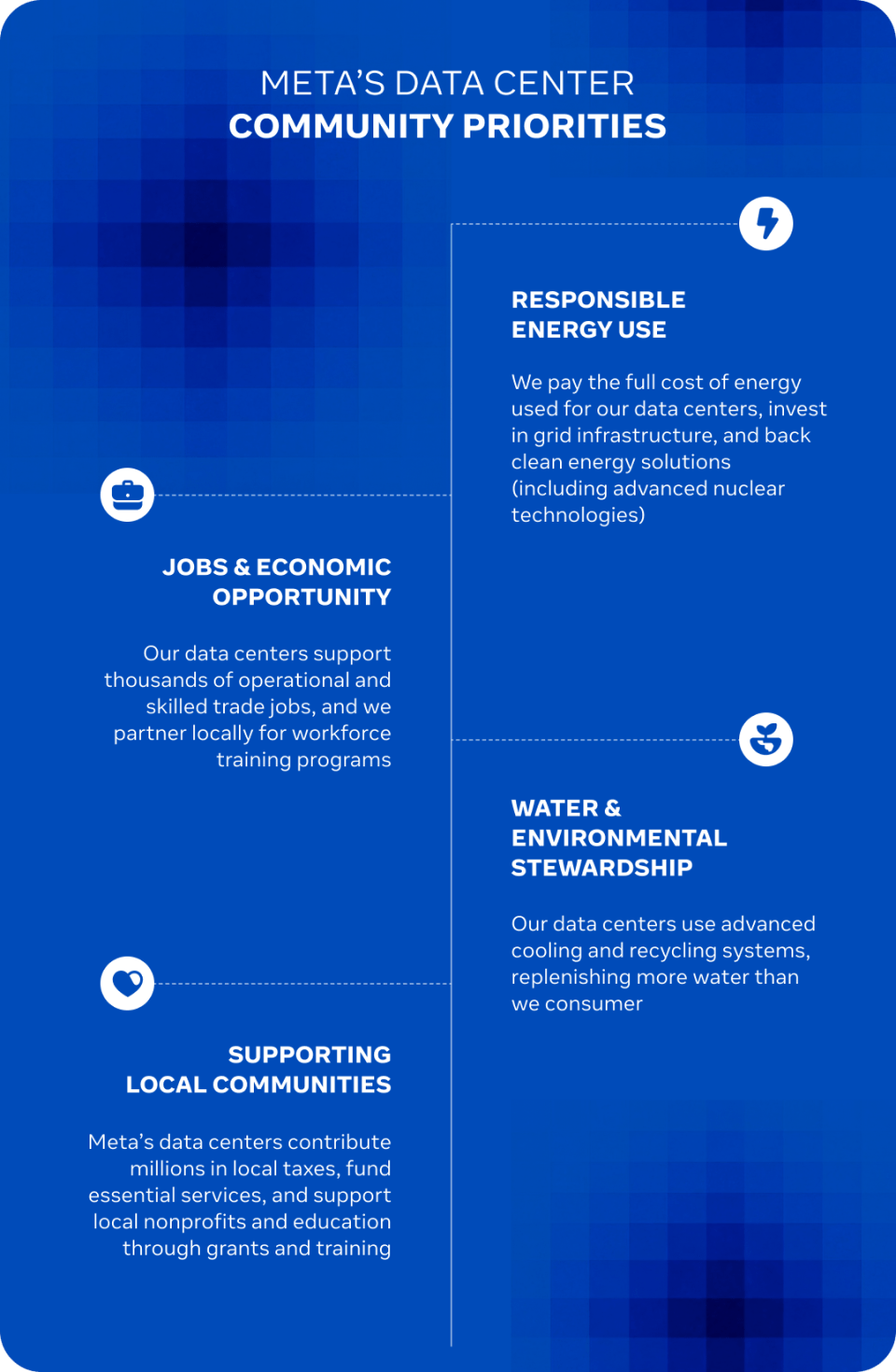
Pays full energy costs and funds hundreds of millions in grid upgrades annually
Why It Matters
Meta's approach sets a model for sustainable AI infrastructure scaling, stabilizing grids and economies in host regions. It reassures AI practitioners of reliable, non-subsidized compute growth amid rising demands.
What To Do Next
Study Meta's utility agreements to negotiate similar power deals for your AI cluster deployments.
Key Points
- •Pays full energy costs and funds hundreds of millions in grid upgrades annually
- •Plans energy needs years ahead with utilities via large load tariffs
- •Operates world's most efficient data centers with emergency demand support
- •Supports jobs, workforce training, water efficiency, and local nonprofits
🧠 Deep Insight
Background and context from public sources — not the original article. 10 sources cited.
🔑 Enhanced Key Takeaways
- •Meta signed three nuclear energy deals totaling up to 6.6 GW to provide reliable 24/7 clean power for AI data centers, addressing the intermittency of renewables.[1]
- •Meta's clean energy projects will add nearly 29 GW to grids across seven countries and 27 U.S. states, with almost 12 GW already operational, including support for up to 7.7 GW of U.S. nuclear capacity.[5]
- •Meta's direct emissions from data center energy use increased 223% since 2019, with overall carbon footprint rising 20% to 8.2 million tCO2e due to AI demands, despite Scope 1+2 reductions.[1][2]
📊 Competitor Analysis▸ Show
| Operator | PUE Benchmark | Renewable Energy Goal |
|---|---|---|
| Meta | 1.08 | Net-zero by 2030 |
| 1.10 | 24/7 carbon-free by 2030 | |
| Microsoft | Targeting 1.125 by 2025 | Carbon-negative by 2030 |
| Amazon | N/A | 100% renewable by 2025 |
🛠️ Technical Deep Dive
- •Meta uses AI-powered digital twin models for data center cooling systems to optimize energy efficiency, capacity planning, and water project prioritization.[5]
- •Initiated the Open Compute Project in 2011, sharing hundreds of open-source innovations in energy and water-efficient computing hardware over 15 years.[5]
- •Prioritizes post-consumer recycled plastics and metals (copper, aluminum, steel) in server racks and IT hardware to reduce embedded carbon in supply chain.[6]
🔮 Future ImplicationsAI analysis grounded in cited sources
⏳ Timeline
📎 Sources (10)
Factual claims are grounded in the sources below. Forward-looking analysis is AI-generated interpretation.
- carboncredits.com — Meta Signs Three Nuclear Deals of Up to 6 6 Gw to Fuel AI Data Center Growth
- asyousow.org — 15 Meta Disclose Climate Transition Plan Data Centers
- about.fb.com — Meta Data Centers Drive Economic Growth Across US
- datacenters.atmeta.com — Sustainability
- datacenters.atmeta.com — Energy
- sustainability.atmeta.com — Data Centers
- energydigital.com — How Meta Is Powering AI Data Centres with Renewable Energy
- iaeimagazine.org — How Much Electricity Does a Data Center Use Complete 2025 Analysis
- datacenterdynamics.com — Meta Estimates 2026 Capex to Be Between 115 135bn
- all4energy.org — Meta Data Center to Cause Entergy Bill Increase
Weekly AI Recap
Read this week's curated digest of top AI events →
👉Related Updates

AI-curated news aggregator. All content rights belong to original publishers.
Original source: Meta Newsroom ↗
This is a summary, not the original. Read the source, or get the weekly briefing.
Weekly AI briefing
One email a week. Unsubscribe anytime.