Leaked Parts Hint at Black Apple Vision Pro
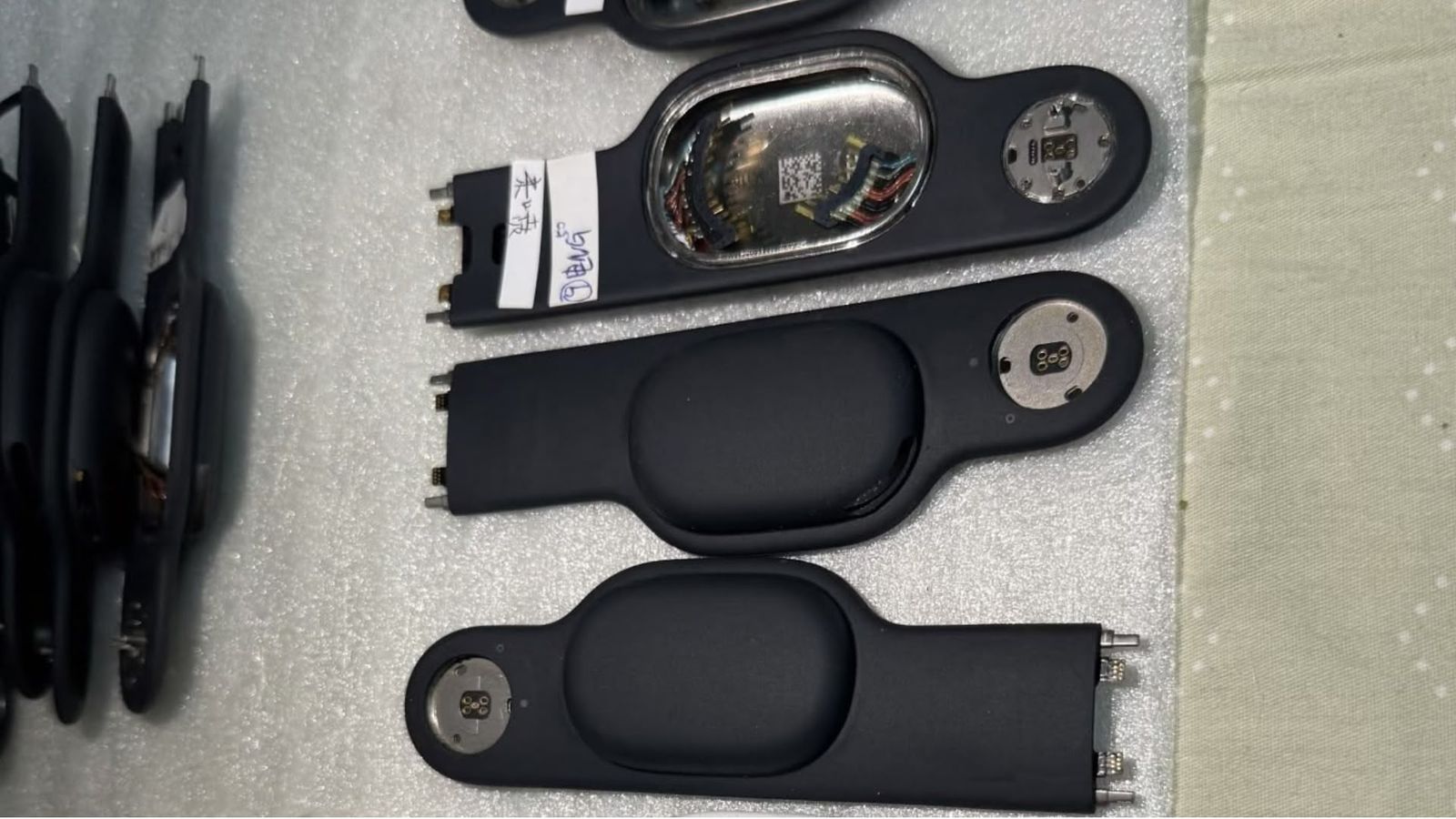
💡First look at potential hardware design shifts for the next generation of Apple's spatial computing device.
⚡ 30-Second TL;DR
What Changed
Leaked components reveal a potential 'all-black' color scheme for future Apple Vision hardware.
Why It Matters
A new color option for the Vision Pro suggests Apple is preparing for a hardware refresh to stimulate consumer interest. It indicates a focus on aesthetic diversification for future spatial computing iterations.
What To Do Next
If you are building spatial apps, monitor the hardware refresh cycle to ensure your UI/UX design remains compatible with potential new form factors.
Key Points
- •Leaked components reveal a potential 'all-black' color scheme for future Apple Vision hardware.
- •The parts, including power and audio modules, match the form factor of the current Vision Pro.
- •Industry speculation suggests these components belong to the upcoming second-generation model.
🧠 Deep Insight
Web-grounded analysis with 22 cited sources.
🔑 Enhanced Key Takeaways
- •The leaked components, including power headbands and audio modules in a dark finish, are attributed to an X account @LusiRoy8 and are consistent with earlier prototype leaks from collector Kosutami, which also showed 'Midnight-colored' Vision hardware.
- •Previous leaks suggested Apple was testing a thinner and lighter headset, internally called 'Vision Air,' featuring a Midnight-colored exterior and reduced weight achieved by using titanium for structural components and the battery enclosure.
- •Despite the leaks, some industry reports indicate that Apple may have paused development on certain Vision headsets to prioritize AI-powered smart glasses, suggesting a potential delay of two or more years for a true Vision Pro successor.
- •The current Apple Vision Pro received a hardware refresh in October 2025, incorporating an M5 chip and a new Dual Knit Band to improve comfort, though this was not considered a full second-generation model.
- •Rumors for a second-generation Apple Vision Pro (Vision Pro 2) include significant internal upgrades such as an M4, M5, or even M6 chip, an enhanced Neural Engine for AI tasks, and a redesigned, more comfortable head strap to alleviate the original model's weight issues.
📊 Competitor Analysis▸ Show
Competitor Analysis: Apple Vision Pro vs. XR Headsets
| Feature/Aspect | Apple Vision Pro (M5) | Meta Quest 3 | Varjo XR-4 | Pimax Crystal | VITURE Luma Pro (AR Glasses) |
|---|---|---|---|---|---|
| Price | US$3,499 (base) | US$499 (base) | High-end, professional (similar to AVP or higher) | High-end (similar to AVP) | US$499 |
| Processor | Apple M5 chip + R1 coprocessor | Qualcomm Snapdragon XR2 Gen 2 | High-end PC tethered (implied by performance) | High-end PC tethered (implied by performance) | N/A (relies on connected device) |
| Display | Dual Micro-OLED, 3660x3200 per eye, up to 120Hz | Dual LCD, 2064x2208 per eye, up to 120Hz | Higher resolution than AVP (on paper) | High resolution, tethered | Micro-OLED, 1920x1200 per eye, 120Hz |
| Field of View (FoV) | ~100 degrees | ~110 degrees | High (implied by professional focus) | High (implied by professional focus) | N/A (virtual screen extension) |
| Weight (Headset) | 750-800g (M5) + 353g external battery | 515g | Heavier than AVP (implied by specs) | Heavier than AVP (implied by specs) | 80g |
| Primary Use Case | Spatial Computing, productivity, media consumption | Gaming, social experiences, general VR | Professional, enterprise, simulations | Enthusiast VR, PC VR | Portable large screen, media, gaming, second monitor |
| Operating System | visionOS | Meta Horizon OS (Android-based) | Proprietary/Windows-based | Proprietary/Windows-based | N/A (device-agnostic) |
🛠️ Technical Deep Dive
- The original Apple Vision Pro (M2 variant) features dual micro-OLED displays with 23 million pixels, offering a resolution of approximately 3660x3200 per eye, and supports refresh rates of 90Hz, 96Hz, and 100Hz.
- It is powered by an Apple M2 chip (8-core CPU, 10-core GPU, 16-core Neural Engine) alongside a dedicated Apple R1 coprocessor for real-time sensor processing, achieving a 12-millisecond photon-to-photon latency.
- The M5 chip update, released in October 2025, upgraded the CPU to 10 cores (4 super, 6 efficiency) and included Neural Accelerators and hardware-accelerated ray tracing, increasing the maximum refresh rate to 120Hz and allowing for 10% more pixels to be rendered.
- Audio is delivered via dual-driver 'audio pods' positioned near each ear, supporting Spatial Audio with dynamic head tracking and personalized audio, and featuring a six-microphone array with directional beamforming.
- The device uses an external battery pack (weighing 353g) connected via a proprietary 12-pin connector, providing up to 2.5 hours of video watching or 2 hours of general use.
- Input relies on hand gesture recognition, eye tracking, and voice commands, with four internal eye-tracking cameras and six external world-facing tracking cameras.
- The headset's weight ranges from 600-650g for the M2 model and 750-800g for the M5 model, excluding the external battery, with comfort being a significant user feedback point.
🔮 Future ImplicationsAI analysis grounded in cited sources
⏳ Timeline
📎 Sources (22)
Factual claims are grounded in the sources below. Forward-looking analysis is AI-generated interpretation.
Weekly AI Recap
Read this week's curated digest of top AI events →
👉Related Updates
Same topic
Explore #spatial-computing
Same product
More on apple-vision-pro
Same source
Latest from cnBeta (Full RSS)

PACA: Open-source tool for ancient fossil coordinate mapping
First atmosphere detected on habitable-zone exoplanet
Samsung Secures $200B Broadcom AI Infrastructure Deal

How AMD's 2006 ATI Acquisition Built Today's AI Empire
AI-curated news aggregator. All content rights belong to original publishers.
Original source: cnBeta (Full RSS) ↗