Jumio’s Sub-100ms Fraud Feature Store
💡Get a proven AWS architecture for sub-100ms fraud features and major annual cost savings.
⚡ 30-Second TL;DR
What Changed
Centralize online and real-time features for fraud detection workloads.
Why It Matters
The case study demonstrates that real-time feature infrastructure can support latency-sensitive fraud decisions at scale. Its cost savings and centralized design may be relevant to teams consolidating fragmented ML pipelines.
What To Do Next
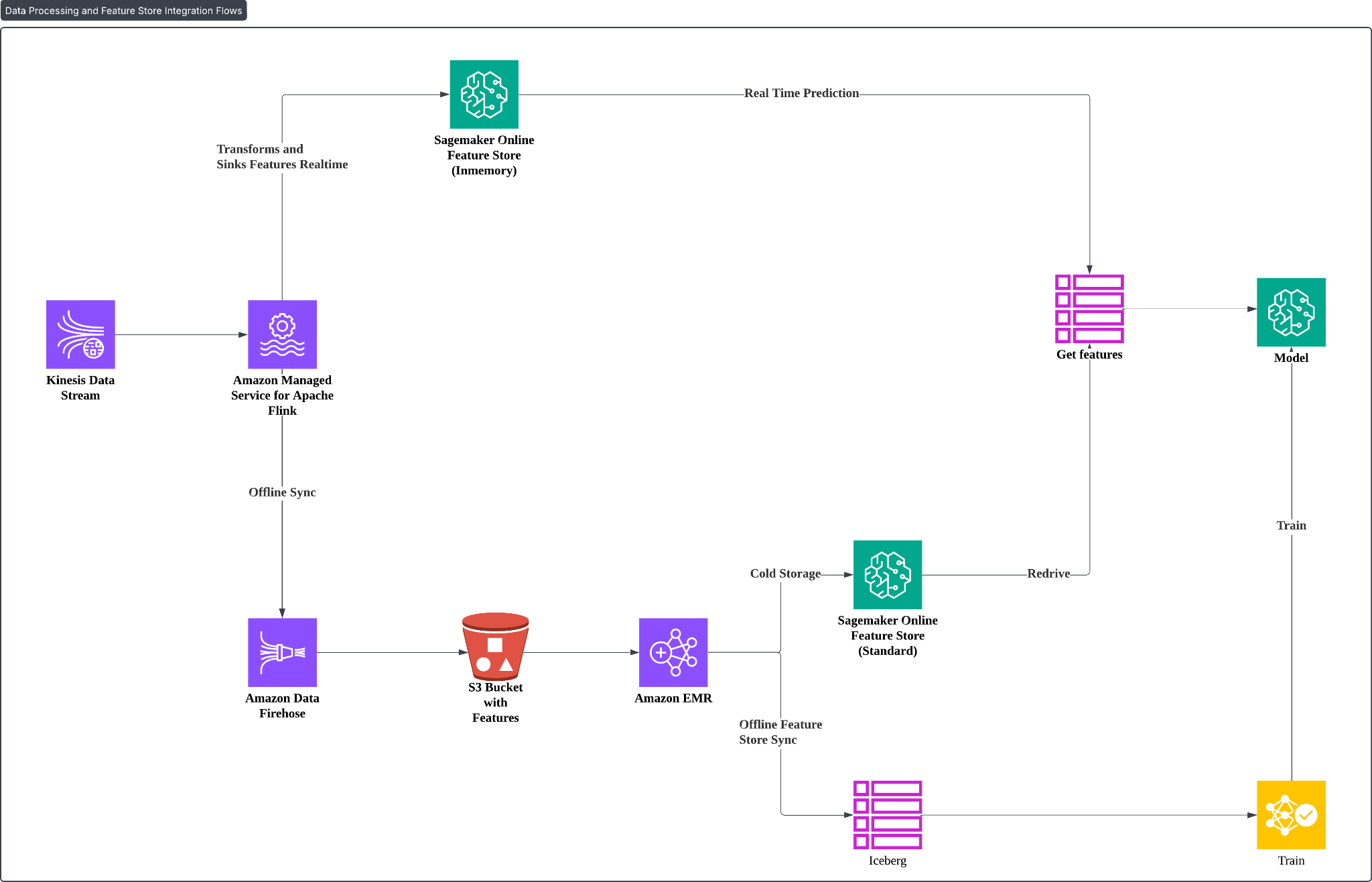
Benchmark your fraud model’s online feature latency and map its streaming pipeline to Kinesis Data Streams, Apache Flink, and SageMaker Feature Store.
Key Points
- •Centralize online and real-time features for fraud detection workloads.
- •Use Apache Flink and Kinesis Data Streams to process streaming feature updates.
- •Serve features in under 100 milliseconds while reducing annual costs by approximately $120,000.
🧠 Deep Insight
AI-generated analysis for this event.
🔑 Enhanced Key Takeaways
- •Jumio transitioned from a fragmented, siloed feature engineering process where data was duplicated across multiple environments to a unified Amazon SageMaker Feature Store architecture.
- •The implementation leverages Flink's stateful processing capabilities to calculate complex fraud signals, such as velocity checks (e.g., number of transactions from a single IP in the last hour), in near real-time.
- •By adopting a centralized feature store, Jumio significantly reduced the 'training-serving skew,' ensuring that the exact same feature logic used during model training is applied during inference.
- •The cost savings of $120,000 were primarily driven by the decommissioning of legacy, over-provisioned self-managed database clusters that were previously used to cache feature data.
- •The architecture utilizes Amazon Kinesis Data Streams as the primary ingestion layer, enabling the system to handle high-throughput bursts of identity verification requests without latency degradation.
📊 Competitor Analysis▸ Show
| Feature | Jumio (AWS Architecture) | Tecton | Feast (Open Source) |
|---|---|---|---|
| Deployment | Managed AWS Native | Managed/SaaS | Self-Managed |
| Latency | Sub-100ms | Sub-10ms (P99) | Varies (Infrastructure dependent) |
| Primary Use Case | Fraud/Identity | Enterprise ML Ops | Data Engineering Teams |
| Pricing | Consumption-based (AWS) | Tiered Subscription | Free (Infrastructure costs) |
🛠️ Technical Deep Dive
- Data Ingestion: Raw event data flows into Amazon Kinesis Data Streams, acting as the backbone for real-time event processing.
- Stream Processing: Amazon Managed Service for Apache Flink performs windowed aggregations and stateful transformations to compute fraud features.
- Feature Storage: Processed features are written to Amazon SageMaker Feature Store, which provides both an Online Store (low-latency retrieval) and an Offline Store (S3-based for training).
- Inference Path: The fraud detection model queries the SageMaker Online Store via low-latency API calls, retrieving pre-computed features in milliseconds.
- Consistency: The system enforces a single source of truth for feature definitions, preventing discrepancies between the training pipeline and the production inference service.
🔮 Future ImplicationsAI analysis grounded in cited sources
⏳ Timeline
Weekly AI Recap
Read this week's curated digest of top AI events →
👉Related Updates


AI-curated news aggregator. All content rights belong to original publishers.
Original source: AWS Machine Learning Blog ↗