Multi-Agent Insurance Document Classification
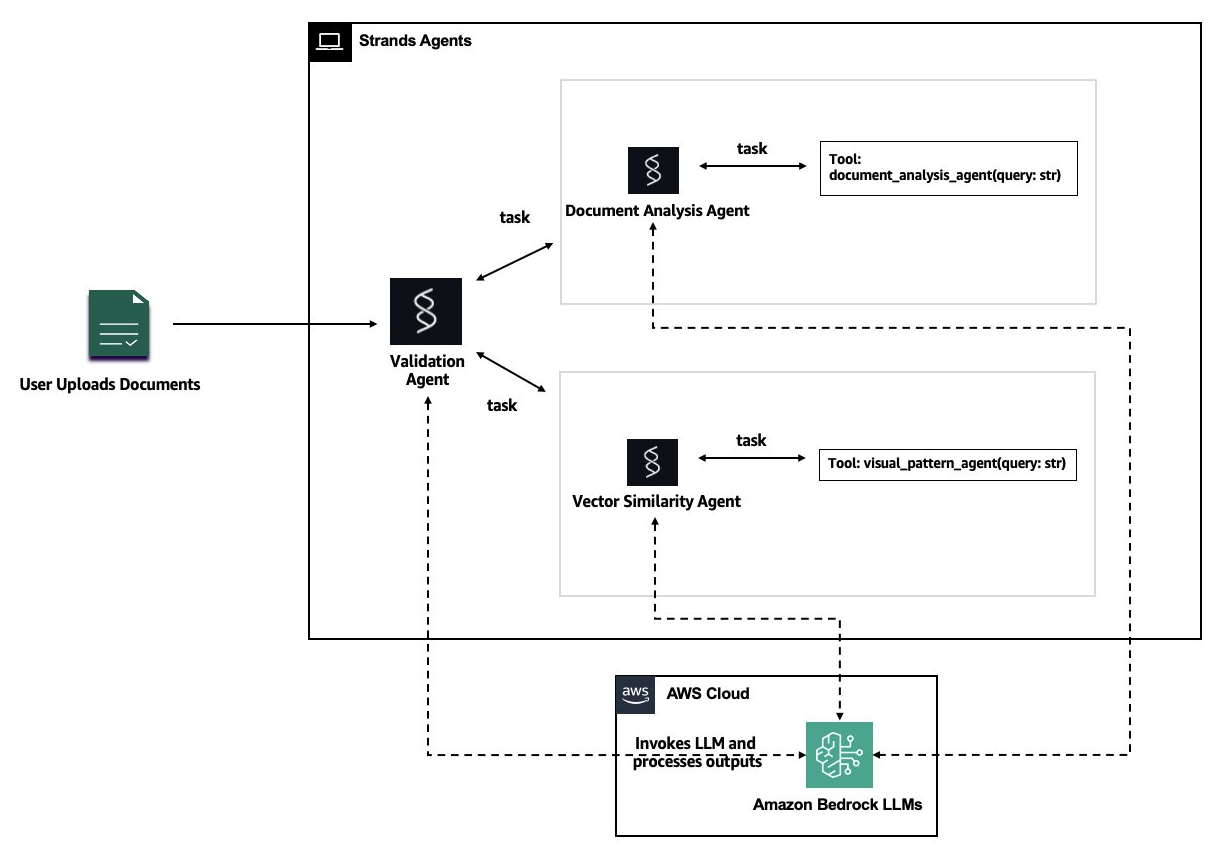
💡See how text reasoning and visual embeddings work together to classify difficult insurance documents.
⚡ 30-Second TL;DR
What Changed
Use three specialized agents to classify insurance documents such as policies and affidavits.
Why It Matters
The architecture could improve classification accuracy for document types where layout and visual structure carry important signals. It also provides a reusable pattern for combining multi-agent reasoning with multimodal retrieval in regulated workflows.
What To Do Next
Build a small labeled set of your document classes and benchmark a Strands Agents workflow using Claude Haiku 4.5 plus Amazon Titan Multimodal Embeddings.
Key Points
- •Use three specialized agents to classify insurance documents such as policies and affidavits.
- •Combine textual analysis powered by Claude Haiku 4.5 with visual similarity retrieval.
- •Apply vector-prompt classification with Amazon Titan Multimodal Embeddings on Amazon Bedrock.
🧠 Deep Insight
AI-generated analysis for this event.
🔑 Enhanced Key Takeaways
- •The system utilizes a 'Human-in-the-loop' (HITL) workflow pattern, allowing agents to escalate ambiguous document classifications to human reviewers for ground-truth verification.
- •The architecture leverages Amazon Bedrock's Knowledge Bases to maintain a dynamic vector store of document templates, reducing the need for frequent model fine-tuning.
- •The Strands Agents SDK implementation specifically utilizes a 'ReAct' (Reasoning and Acting) framework to manage agent orchestration and state persistence across multi-step classification tasks.
- •The solution incorporates a confidence-score thresholding mechanism where documents falling below a 0.85 similarity score are automatically routed to a specialized 'Exception Handling' agent.
- •Integration with Amazon Textract is used as a pre-processing layer to extract structured key-value pairs from raw PDFs before passing them to the Claude Haiku 4.5 reasoning engine.
📊 Competitor Analysis▸ Show
| Feature | AWS Multi-Agent System | Google Cloud Document AI | Microsoft Azure AI Document Intelligence |
|---|---|---|---|
| Orchestration | Strands Agents SDK | Vertex AI Agent Builder | Semantic Kernel |
| Vision Model | Titan Multimodal Embeddings | Gemini 1.5 Pro | GPT-4o |
| Pricing Model | Pay-per-token/request | Pay-per-page | Pay-per-page/unit |
| Primary Strength | Multi-agent modularity | Pre-trained industry models | Enterprise ecosystem integration |
🛠️ Technical Deep Dive
- Architecture: Employs a hierarchical agent structure consisting of a Router Agent, a Textual Analysis Agent, and a Visual Verification Agent.
- Embedding Strategy: Uses Amazon Titan Multimodal Embeddings (v1) to map document images into a 1024-dimensional vector space for cosine similarity matching.
- State Management: Utilizes Amazon DynamoDB to store agent conversation history and document metadata, ensuring idempotency during multi-agent handoffs.
- Latency Optimization: Implements asynchronous processing for visual similarity searches, allowing textual analysis to proceed in parallel with vector retrieval.
🔮 Future ImplicationsAI analysis grounded in cited sources
⏳ Timeline
Weekly AI Recap
Read this week's curated digest of top AI events →
👉Related Updates

AI-curated news aggregator. All content rights belong to original publishers.
Original source: AWS Machine Learning Blog ↗