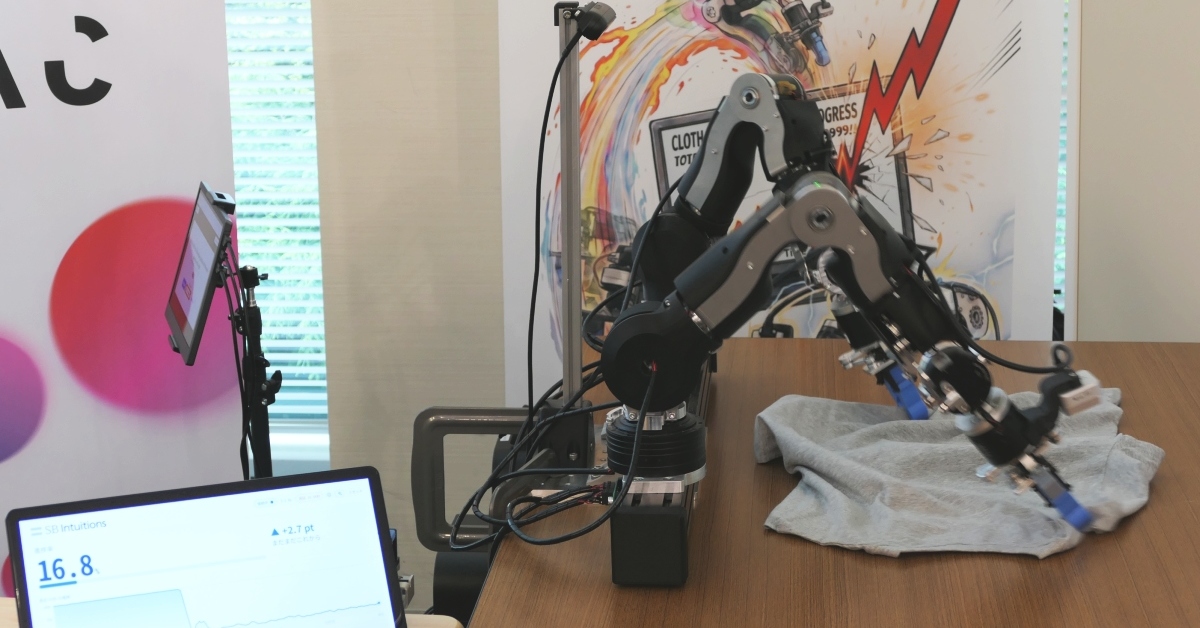
Jiuwen Symbiosis: Giving AI Agents a Physical Body
💡Learn how AI agents are moving beyond screens to interact with the physical world through embodied intelligence.
⚡ 30-Second TL;DR
What Changed
Focuses on embodied AI development for physical world interaction
Why It Matters
This approach signals a shift toward more capable, autonomous agents that can manipulate physical environments rather than just processing text or data.
What To Do Next
Research current embodied AI frameworks like NVIDIA Isaac or ROS 2 to understand how to integrate LLMs with robotic control systems.
Key Points
- •Focuses on embodied AI development for physical world interaction
- •Bridges the gap between digital agents and hardware execution
- •Aims to build next-generation intelligent systems for real-world tasks
🧠 Deep Insight
Background and context from public sources — not the original article. 10 sources cited.
🔑 Enhanced Key Takeaways
- •Jiuwen Symbiosis is an open-source initiative, with the openJiuwen team deciding to open-source the project to foster an open collaborative ecosystem for physical AI.
- •The project aims to enable robots to learn 'how' to perform tasks through trial and error, allowing for timely error correction and experience accumulation, ultimately leading to self-evolution, rather than relying on traditional 'what' instructions.
- •Jiuwen Symbiosis employs a cloud-edge collaborative architecture, where complex planning and large-scale inference are handled by Large Language Models (LLM) and Vision-Language Models (VLM) in the cloud, while real-time perception and execution occur at the edge.
- •The system is optimized for heterogeneous computing environments, leveraging Ascend for high-TOPS AI inference tasks like object detection and multimodal perception, and Kunpeng CPUs for critical functions such as tool scheduling, task orchestration, and robot control logic to ensure low-latency and high-reliability execution.
- •Jiuwen Symbiosis is envisioned as a transparent Agent for Physics, an extensible framework for physical AI, and a crucial bridge connecting large models with the practical world of robotics.
🛠️ Technical Deep Dive
- Architecture: Cloud-edge collaborative architecture, separating large-scale inference and complex planning (cloud-side LLM/VLM) from real-time perception and execution (edge-side).
- Hardware Optimization: Optimized for heterogeneous computing, specifically utilizing Ascend for AI inference capabilities (e.g., object detection, visual understanding, multimodal perception) and Kunpeng CPUs for managing tool scheduling, task orchestration, state management, and robot control logic.
- Resource Management: Designed to offload planning workloads to Ascend NPUs and execute Agent Runtime, Memory, Workspace, and Tool Calling logic on Kunpeng CPUs, thereby mitigating bottlenecks commonly found in traditional GPU-centric solutions.
- Perception Model: Features a lightweight visual perception model that can be deployed on local edge devices, characterized by low video memory consumption.
- Output Compatibility: Ensures that its output results are fully compatible with mainstream detection formats, facilitating direct integration with Ascend-compatible and other ecosystem-compatible models for subsequent tasks.
- Open-source Platform: Built upon the openJiuwen open-source agent platform, which provides SDK capabilities for AI Agent development, running, optimization, and evolution.
- Development Tools: Includes openJiuwen agent-studio, offering zero-code and low-code visual development, workflow orchestration, and unified management for models, knowledge bases, and plugins.
- Advanced Features (from openJiuwen/JiuwenSwarm):
- High-reliability execution engine with automatic state management, supporting distributed deployment and multi-instance operation with automatic recovery.
- Full-link real-time debugging and tracing capabilities for monitoring task execution paths.
- Textual-Gradient–Based Automatic Prompt Optimization for stable and directional prompt updates.
- Computing Infrastructure Affinity Acceleration, including KV Cache proactive coordination and unified scheduling for multi-model tiering and task routing.
- Jiuwen DeepSearch, a knowledge-enhanced deep search and research framework with chunk-level citation and traceable reasoning.
🔮 Future ImplicationsAI analysis grounded in cited sources
⏳ Timeline
📎 Sources (10)
Factual claims are grounded in the sources below. Forward-looking analysis is AI-generated interpretation.
Weekly AI Recap
Read this week's curated digest of top AI events →
👉Related Updates


AI-curated news aggregator. All content rights belong to original publishers.
Original source: 量子位 ↗
This is a summary, not the original. Read the source, or get the weekly briefing.
The weekly digest
One email a week. Unsubscribe anytime.