來源量子位•較早收集於 2h
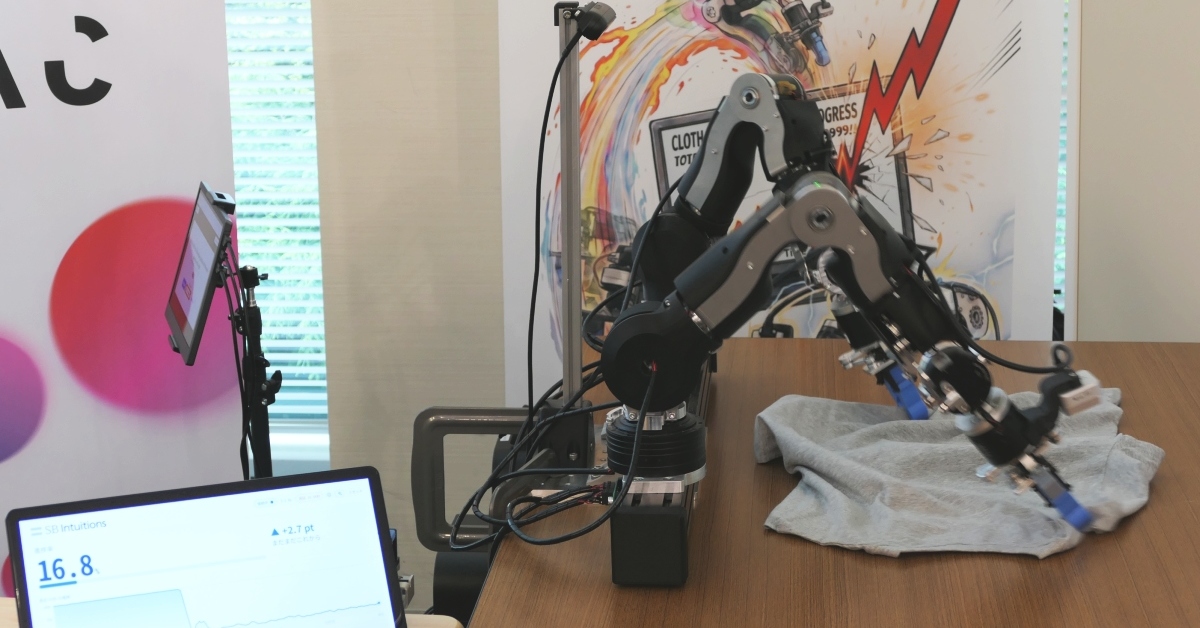
Jiuwen Symbiosis:賦予 AI Agent 實體化身
💡了解 AI Agent 如何透過具身智慧走出螢幕,開始與物理世界進行互動。
⚡ 30 秒速覽
有什麼變化
專注於物理世界互動的具身智慧(Embodied AI)開發
為什麼重要
此方法標誌著 AI 正朝向更具備自主性、能操作物理環境而非僅處理文字或數據的 Agent 發展。
下一步行動
研究現有的具身智慧框架(如 NVIDIA Isaac 或 ROS 2),了解如何將 LLM 與機器人控制系統進行整合。
誰應關注:Developers & AI Engineers
關鍵要點
- •專注於物理世界互動的具身智慧(Embodied AI)開發
- •彌合數位 Agent 與硬體執行之間的鴻溝
- •旨在構建能執行現實世界任務的下一代智慧系統
🧠 深度解析
背景與延伸:來自公開資料,非原文內容。引用 10 個來源。
🔑 增強重點摘要
- •Jiuwen Symbiosis is an open-source initiative, with the openJiuwen team deciding to open-source the project to foster an open collaborative ecosystem for physical AI.
- •The project aims to enable robots to learn 'how' to perform tasks through trial and error, allowing for timely error correction and experience accumulation, ultimately leading to self-evolution, rather than relying on traditional 'what' instructions.
- •Jiuwen Symbiosis employs a cloud-edge collaborative architecture, where complex planning and large-scale inference are handled by Large Language Models (LLM) and Vision-Language Models (VLM) in the cloud, while real-time perception and execution occur at the edge.
- •The system is optimized for heterogeneous computing environments, leveraging Ascend for high-TOPS AI inference tasks like object detection and multimodal perception, and Kunpeng CPUs for critical functions such as tool scheduling, task orchestration, and robot control logic to ensure low-latency and high-reliability execution.
- •Jiuwen Symbiosis is envisioned as a transparent Agent for Physics, an extensible framework for physical AI, and a crucial bridge connecting large models with the practical world of robotics.
🛠️ 技術深入
- Architecture: Cloud-edge collaborative architecture, separating large-scale inference and complex planning (cloud-side LLM/VLM) from real-time perception and execution (edge-side).
- Hardware Optimization: Optimized for heterogeneous computing, specifically utilizing Ascend for AI inference capabilities (e.g., object detection, visual understanding, multimodal perception) and Kunpeng CPUs for managing tool scheduling, task orchestration, state management, and robot control logic.
- Resource Management: Designed to offload planning workloads to Ascend NPUs and execute Agent Runtime, Memory, Workspace, and Tool Calling logic on Kunpeng CPUs, thereby mitigating bottlenecks commonly found in traditional GPU-centric solutions.
- Perception Model: Features a lightweight visual perception model that can be deployed on local edge devices, characterized by low video memory consumption.
- Output Compatibility: Ensures that its output results are fully compatible with mainstream detection formats, facilitating direct integration with Ascend-compatible and other ecosystem-compatible models for subsequent tasks.
- Open-source Platform: Built upon the openJiuwen open-source agent platform, which provides SDK capabilities for AI Agent development, running, optimization, and evolution.
- Development Tools: Includes openJiuwen agent-studio, offering zero-code and low-code visual development, workflow orchestration, and unified management for models, knowledge bases, and plugins.
- Advanced Features (from openJiuwen/JiuwenSwarm):
- High-reliability execution engine with automatic state management, supporting distributed deployment and multi-instance operation with automatic recovery.
- Full-link real-time debugging and tracing capabilities for monitoring task execution paths.
- Textual-Gradient–Based Automatic Prompt Optimization for stable and directional prompt updates.
- Computing Infrastructure Affinity Acceleration, including KV Cache proactive coordination and unified scheduling for multi-model tiering and task routing.
- Jiuwen DeepSearch, a knowledge-enhanced deep search and research framework with chunk-level citation and traceable reasoning.
🔮 前景展望基於引用來源的 AI 分析
Embodied AI systems like Jiuwen Symbiosis will accelerate the shift from AI that processes data passively to AI that actively learns and adapts in the physical world.
By integrating AI agents with physical bodies and enabling real-world interaction, these systems will move beyond abstract reasoning to learn and adapt through direct experience, similar to human and animal learning.
The widespread adoption of embodied AI will increasingly depend on optimized heterogeneous computing architectures and robust edge-cloud collaboration.
Real-world robotic scenarios necessitate stable closed-loop perception, cognition, planning, and execution under stringent power and bandwidth constraints, making efficient resource allocation across cloud and edge devices critical.
Embodied AI is poised to become a cornerstone in the pursuit of Artificial General Intelligence (AGI).
Integrating physical interaction capabilities with cognitive computation in real-world scenarios is widely recognized as a promising pathway to achieve AGI, as it enables AI to learn and adapt in complex, dynamic environments.
⏳ 時間線
2024-08-02
openJiuwen project begins regular weekly updates, indicating ongoing development of the underlying platform.
2025-05-27
openJiuwen's Embodied AI Survey paper is accepted by IEEE/ASME Transactions on Mechatronics, marking a significant academic milestone for the associated platform.
2026-03-31
openJiuwen releases the Physical Agent Operation System, a key component for integrating AI agents with physical systems.
2026-06-13
The 'Jiuwen Symbiosis: Giving AI Agents a Physical Body' project is publicly discussed, highlighting its focus on embodied AI development.
📎 來源 (10)
Factual claims are grounded in the sources below. Forward-looking analysis is AI-generated interpretation.
📰
AI 週報
閱讀本週精選 AI 大事摘要 →
👉相關動態

AI 策展新聞聚合。所有內容版權歸原始發布者所有。
原始來源: 量子位 ↗
每週電子報
每週一封,可隨時退訂。