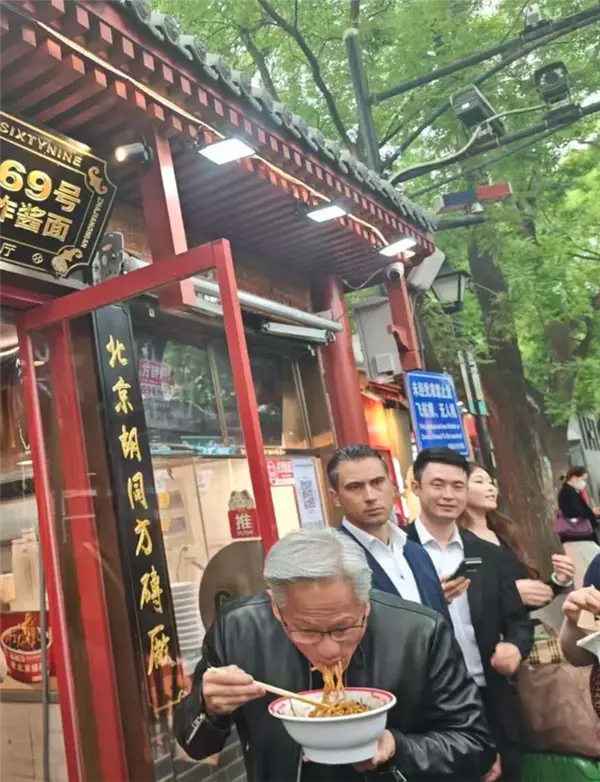
Jensen Huang's Beijing Visit Sparks Viral Marketing
💡See how AI industry leadership translates into mainstream cultural influence and brand power.
⚡ 30-Second TL;DR
What Changed
Jensen Huang's public appearance in Beijing generated significant social media engagement.
Why It Matters
While primarily a cultural event, it demonstrates the 'celebrity' status of AI hardware leaders, which can influence brand perception and market penetration in the region.
What To Do Next
Monitor brand sentiment and public perception of key AI figures in non-technical media to gauge market influence.
Key Points
- •Jensen Huang's public appearance in Beijing generated significant social media engagement.
- •Local businesses are leveraging the 'AI celebrity' status of tech leaders for marketing.
- •The event underscores the high visibility of Nvidia's leadership in the Chinese market.
🧠 Deep Insight
Web-grounded analysis with 25 cited sources.
🔑 Enhanced Key Takeaways
- •Jensen Huang's recent noodle shop visit was part of a broader, high-profile trip to China, where he also joined a US delegation led by President Donald Trump for talks with President Xi Jinping, underscoring the geopolitical significance of his presence.
- •Huang's public appearances, including eating street food and visiting local markets, are perceived as a deliberate strategy to cultivate a 'China-friendly' image and engage with Chinese authorities and customers amidst ongoing US export restrictions and intensifying local competition.
- •Despite the viral marketing success, Nvidia's market share in China's AI accelerator market has significantly declined, with some reports indicating it has fallen to 'near zero' for direct sales due to US export controls, while Chinese domestic chipmakers like Huawei are rapidly gaining market share.
- •The US Commerce Department has recently approved approximately 10 Chinese companies, including major players like Alibaba, Tencent, ByteDance, and JD.com, to purchase Nvidia's H200 chips, signaling a potential, albeit capped, reopening of the market for Nvidia's compliant products.
- •Huang has publicly contended that stringent US export restrictions could inadvertently backfire by compelling China to develop its own independent technological ecosystem, which he views as a 'horrible outcome' for America's long-term global dominance in AI.
📊 Competitor Analysis▸ Show
| Company/Vendor | China AI Accelerator Market Share (2025 Shipments) | Key Products/Strategy in China |
|---|---|---|
| Nvidia | 55% (overall market leader, but declining; direct sales 'near zero' by May 2026) | H200 chips (approved for limited sales to specific Chinese firms); previously A800/H800 (restricted); adapting products to comply with US export restrictions (e.g., 50% less computing power) |
| Huawei Technologies | ~20% (of overall market); ~50% (of domestic shipments); projected 60% of China AI market by end of 2026 | Ascend series (e.g., Ascend 950PR, Ascend 960, Ascend 970 planned); strategy involves strapping together large numbers of weaker chips to achieve computing power |
| Alibaba's T-Head | ~6.6% (of overall market); second among Chinese vendors | Developing domestic AI chips to fill void left by US restrictions |
| Baidu's Kunlunxin | ~2.9% (of overall market); jointly third among Chinese vendors | Developing domestic AI chips |
| Cambricon | ~2.9% (of overall market); jointly third among Chinese vendors | Developing domestic AI chips |
| Hygon, MetaX, Iluvatar CoreX | 5%, 4%, and 3% respectively of total Chinese vendor shipments | Chinese GPU and AI chip makers aggressively moving to fill market gaps |
🔮 Future ImplicationsAI analysis grounded in cited sources
⏳ Timeline
📎 Sources (25)
Factual claims are grounded in the sources below. Forward-looking analysis is AI-generated interpretation.
- Google Search Source
- Google Search Source
- Google Search Source
- Google Search Source
- Google Search Source
- Google Search Source
- Google Search Source
- Google Search Source
- Google Search Source
- Google Search Source
- Google Search Source
- Google Search Source
- Google Search Source
- Google Search Source
- Google Search Source
- Google Search Source
- Google Search Source
- Google Search Source
- Google Search Source
- Google Search Source
- Google Search Source
- Google Search Source
- Google Search Source
- Google Search Source
- Google Search Source
Weekly AI Recap
Read this week's curated digest of top AI events →
👉Related Updates

Microsoft plans to transform Minecraft into a global creator platform
SpaceX Rocket Debris to Impact Moon
Apple warns of potential AI compute resource shortages
ShieldFont uses obfuscated typography to block AI scrapers
AI-curated news aggregator. All content rights belong to original publishers.
Original source: cnBeta (Full RSS) ↗