Hunyuan 4 Reveals Open-Source Model Convergence
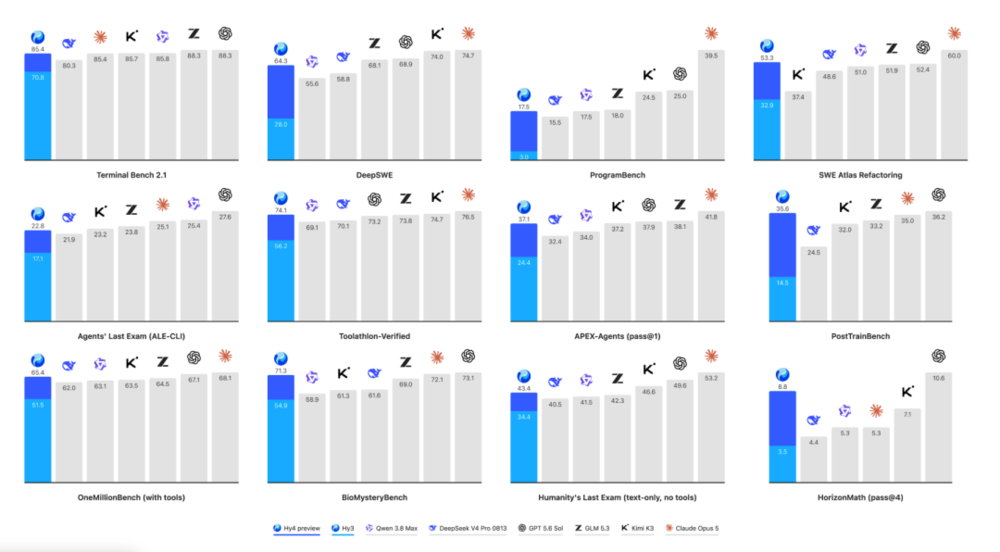
💡Hunyuan 4 shows how DeepSeek and GLM-5 innovations are becoming production-scale building blocks.
⚡ 30-Second TL;DR
What Changed
Hy4 preview uses 770B parameters and supports context windows of up to one million tokens.
Why It Matters
Hy4 indicates that frontier-model architecture is increasingly built through rapid reuse and refinement of public techniques rather than isolated breakthroughs. For AI companies, recruiting researchers with production-scale training experience may now be as important as inventing new architecture.
What To Do Next
Benchmark DeepSeek Sparse Attention and IndexCache-style token-index reuse on your longest production prompts before scaling context windows.
Key Points
- •Hy4 preview uses 770B parameters and supports context windows of up to one million tokens.
- •Its attention architecture combines DeepSeek Sparse Attention with Zhipu’s IndexCache mechanism.
- •GLM-5 core contributor Yushi Bai reportedly moved from Zhipu to Tencent Hunyuan.
- •The model was released less than four months after the previous major Hunyuan version.
- •The article argues that open-source research is rapidly eliminating proprietary model advantages.
🧠 Deep Insight
Background and context from public sources — not the original article. 13 sources cited.
🔑 Enhanced Key Takeaways
- •Hy4 Preview utilizes a Mixture-of-Experts (MoE) architecture with 49 billion active parameters out of 770 billion total.
- •The model is released under the Apache 2.0 license, allowing for broad commercial and collaborative adoption.
- •Tencent has integrated the model into its internal product suite, including WorkBuddy, CodeBuddy, Yuanbao, and ima.
- •The model launch triggered significant traffic spikes on the WorkBuddy platform, necessitating an emergency expansion of Tencent's inference cluster capacity.
- •Tencent has shifted to a 'preview-first' release cycle, targeting major model iterations every two months.
📊 Competitor Analysis▸ Show
| Feature | Hunyuan 4 (Preview) | GLM-5.3 | Kimi K3 |
|---|---|---|---|
| Architecture | 770B MoE | Proprietary | Proprietary |
| Context Window | 1M+ tokens | N/A | N/A |
| Internal Benchmark Score | 2.99 | 2.92 | 2.94 |
| License | Apache 2.0 | Proprietary | Proprietary |
🛠️ Technical Deep Dive
- Architecture: Mixture-of-Experts (MoE) with 78 layers total.
- Layer Configuration: First layer is a dense feed-forward network; layers 2-78 utilize MoE design.
- Expert Routing: 256 routed experts plus one shared expert per MoE layer.
- Parameter Density: 49 billion active parameters per token inference.
- Infrastructure: Accessible via Tencent Cloud TokenHub and OpenRouter.
🔮 Future ImplicationsAI analysis grounded in cited sources
⏳ Timeline
📎 Sources (13)
Factual claims are grounded in the sources below. Forward-looking analysis is AI-generated interpretation.
Weekly AI Recap
Read this week's curated digest of top AI events →
👉Related Updates

AI-curated news aggregator. All content rights belong to original publishers.
Original source: 虎嗅 ↗
This is a summary, not the original. Read the source, or get the weekly briefing.
Weekly AI briefing
One email a week. Unsubscribe anytime.