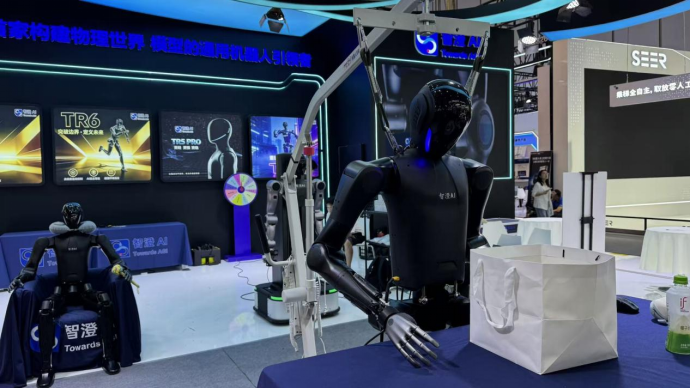
Humanoid Robot Market Enters Mass Production Era

💡Understand the supply chain bottlenecks and growth opportunities in the rapidly scaling humanoid robot market.
⚡ 30-Second TL;DR
What Changed
Order backlogs for humanoid robots have reached 2027
Why It Matters
The shift to mass production indicates that embodied AI is moving from research labs to commercial deployment. This will drive demand for standardized actuators, sensors, and motion control software.
What To Do Next
Evaluate your software stack for compatibility with standardized robotic hardware interfaces to prepare for upcoming integration projects.
Key Points
- •Order backlogs for humanoid robots have reached 2027
- •Industry is officially entering the 'mass production' phase
- •Upstream component suppliers are seeing significant revenue growth
- •Targeting 50,000 units in shipment volume
🧠 Deep Insight
AI-generated analysis for this event — not the original article.
🔑 Enhanced Key Takeaways
- •The surge in demand is primarily driven by the integration of embodied AI foundation models, which have significantly improved the robots' ability to perform complex, unstructured tasks in industrial settings.
- •Major automotive manufacturers, particularly in China and the US, have begun integrating humanoid robots into assembly lines for tasks like quality inspection and logistics, serving as the primary anchor customers for mass production.
- •The supply chain bottleneck is currently concentrated in high-torque density actuators and harmonic reducers, leading to a shift toward domestic sourcing strategies to mitigate geopolitical supply risks.
- •Standardization efforts for humanoid robot interfaces and operating systems are gaining momentum, with industry consortia working to establish common communication protocols to facilitate interoperability.
- •Government subsidies and industrial policy support in regions like Beijing and Shanghai are providing direct financial incentives for companies achieving the 50,000-unit production milestone.
📊 Competitor Analysis▸ Show
| Feature | Tesla Optimus Gen 3 | Figure AI (Figure 02) | Unitree G1 |
|---|---|---|---|
| Target Market | Automotive/General Purpose | Logistics/Manufacturing | Research/Consumer |
| Estimated Price | <$20,000 | Competitive/Enterprise | ~$16,000 |
| Key Benchmark | FSD-derived neural nets | OpenAI-powered reasoning | High-speed agility/balance |
🛠️ Technical Deep Dive
- Actuation: Utilization of integrated joint modules combining brushless DC motors, harmonic drives, and force-torque sensors for high-precision motion control.
- Perception: Multi-modal sensor fusion incorporating LiDAR, depth cameras, and tactile skin sensors to enable real-time environment mapping and object manipulation.
- Architecture: Transition from rule-based control systems to end-to-end transformer-based models that process visual and proprioceptive data for autonomous decision-making.
- Power Management: Implementation of high-density lithium-ion battery packs providing 4-8 hours of operational runtime depending on task intensity.
🔮 Future ImplicationsAI analysis grounded in cited sources
⏳ Timeline
Weekly AI Recap
Read this week's curated digest of top AI events →
👉Related Updates

AI-curated news aggregator. All content rights belong to original publishers.
Original source: 钛媒体 ↗
This is a summary, not the original. Read the source, or get the weekly briefing.
Weekly AI briefing
One email a week. Unsubscribe anytime.