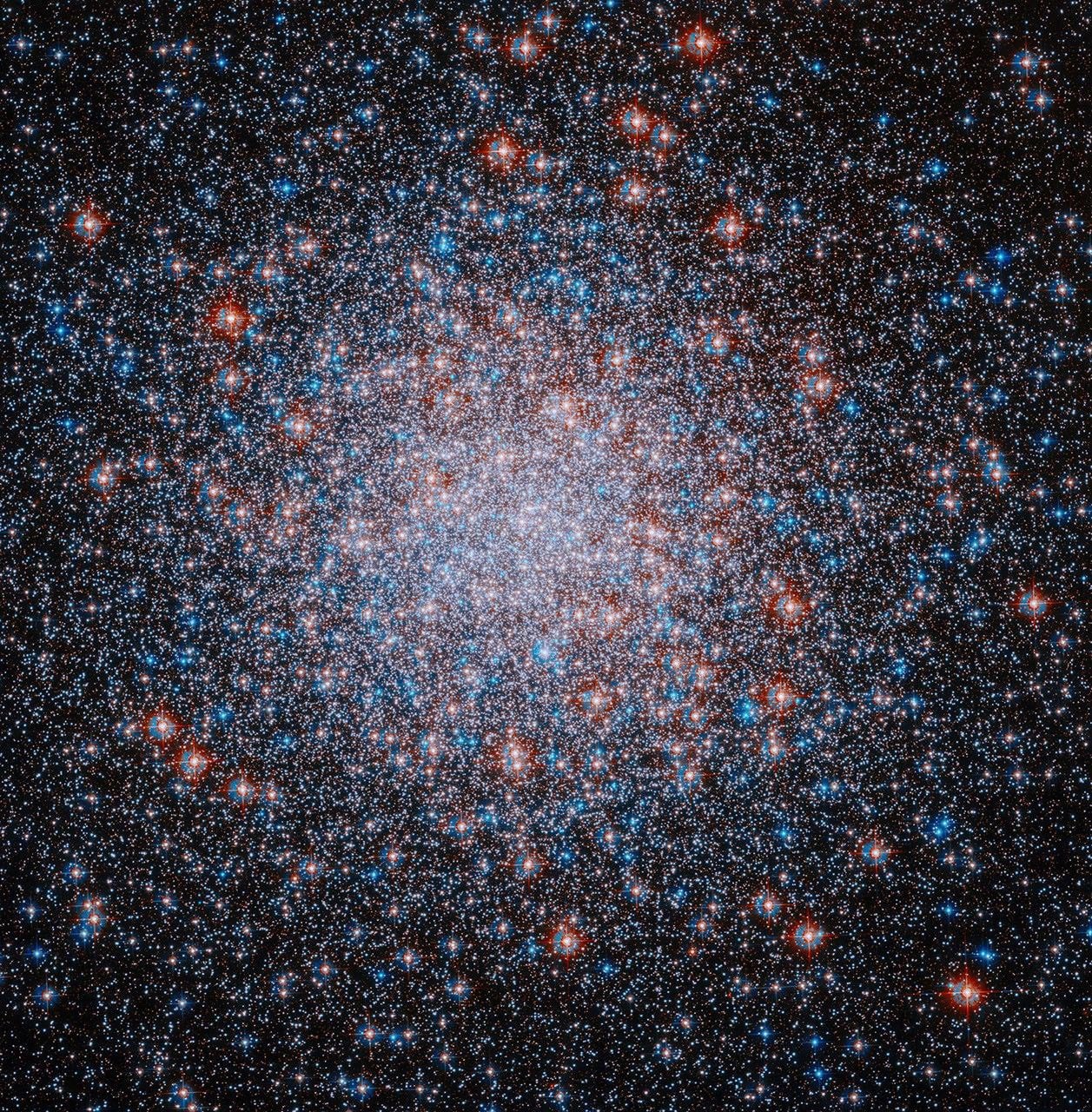
Hubble captures stunning M3 globular cluster image
💡Access high-fidelity astronomical datasets perfect for testing advanced computer vision and pattern recognition models.
⚡ 30-Second TL;DR
What Changed
M3 is one of the largest globular clusters in the Milky Way.
Why It Matters
Provides high-quality astronomical data for researchers studying stellar evolution and galactic formation.
What To Do Next
Explore the MAST (Mikulski Archive for Space Telescopes) to access raw astronomical datasets for training computer vision models.
Key Points
- •M3 is one of the largest globular clusters in the Milky Way.
- •The image contains over 500,000 individual stars.
- •Released as part of the US 250th anniversary commemoration.
🧠 Deep Insight
AI-generated analysis for this event — not the original article.
🔑 Enhanced Key Takeaways
- •M3 is located approximately 33,900 light-years away from Earth in the constellation Canes Venatici.
- •The cluster was originally discovered by Charles Messier in 1764, who initially mistook it for a nebula before William Herschel later resolved it into individual stars.
- •M3 is estimated to be roughly 8 billion years old, making it significantly older than the Sun.
- •The cluster is notable for containing an unusually high number of variable stars, specifically over 200 RR Lyrae stars, which are used as standard candles to measure cosmic distances.
- •The high-resolution imaging was achieved using Hubble's Wide Field Camera 3 (WFC3) and the Advanced Camera for Surveys (ACS), combining data from multiple filters to map stellar populations.
🛠️ Technical Deep Dive
- Instrument: Wide Field Camera 3 (WFC3) utilizes a 16-megapixel UVIS channel and a 1-megapixel IR channel for high-resolution stellar photometry.
- Data Processing: The image utilizes multi-wavelength observations, specifically combining ultraviolet, visible, and near-infrared light to differentiate stellar temperatures and evolutionary stages.
- Resolution: Hubble's angular resolution allows for the separation of individual stars within the dense core of M3, where stellar density can reach thousands of stars per cubic parsec.
- Photometric Precision: The data allows astronomers to construct precise color-magnitude diagrams (CMDs) to determine the age, metallicity, and distance of the cluster population.
🔮 Future ImplicationsAI analysis grounded in cited sources
⏳ Timeline
Weekly AI Recap
Read this week's curated digest of top AI events →
👉Related Updates



AI-curated news aggregator. All content rights belong to original publishers.
Original source: cnBeta (Full RSS) ↗
This is a summary, not the original. Read the source, or get the weekly briefing.
Weekly AI briefing
One email a week. Unsubscribe anytime.