China Leads Global AI Patent Applications
💡China’s patent lead could reshape AI competition, licensing risk, and freedom-to-operate planning.
⚡ 30-Second TL;DR
What Changed
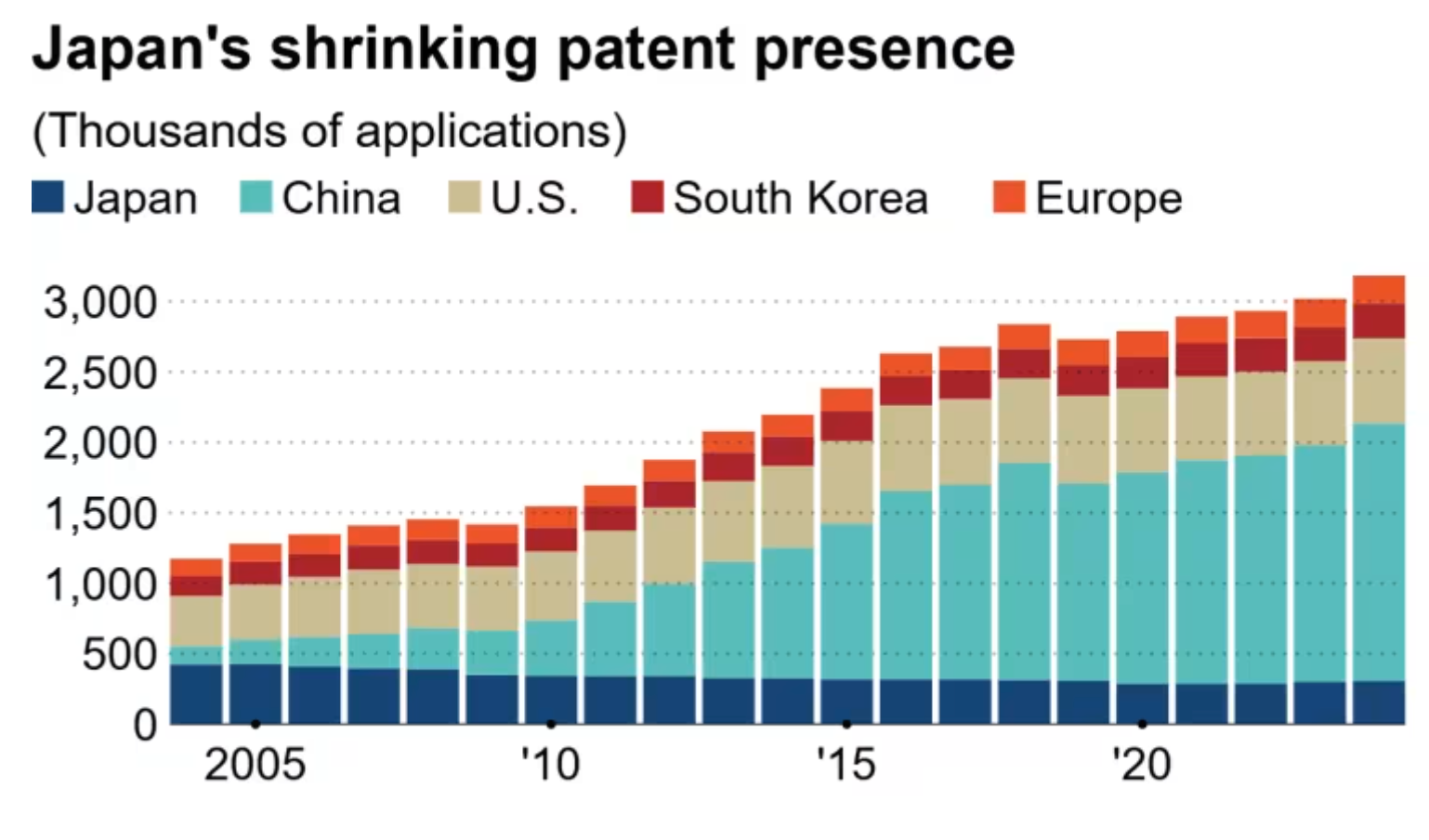
China remains the global leader in patent applications
Why It Matters
The trend underscores China’s growing influence over the AI intellectual-property landscape and intensifying competition with the United States. AI companies expanding internationally may face more complex patent-screening and freedom-to-operate requirements.
What To Do Next
Use Google Patents or WIPO Patentscope to map recent Chinese AI filings in your product category before finalizing your international roadmap.
Key Points
- •China remains the global leader in patent applications
- •AI is among the core technology areas where China ranks first
- •Global patent applications rose from 1.7 million in 2005 to 3.72 million in 2024
- •Japan’s share of global patent filings fell from 25% to 8%
🧠 Deep Insight
Background and context from public sources — not the original article. 11 sources cited.
🔑 Enhanced Key Takeaways
- •China accounted for over 70% of all Generative AI (GenAI) patents published worldwide in 2024 and 2025, demonstrating a significant lead in this specific AI subdomain.
- •The growth in GenAI patent filings has been exponential, with over 56,000 new GenAI patent families published in 2024 and 2025 alone, surpassing the total output of the preceding decade (2014-2023).
- •In 2025, Large Language Models (LLMs) emerged as the dominant category in GenAI patent volume, overtaking Generative Adversarial Networks (GANs) with approximately 14,100 LLM patent families compared to about 5,200 GAN families.
- •While China leads in the sheer volume of AI patent applications and grants, the United States is noted for retaining higher-impact AI patents, and South Korea leads in AI patents per capita, indicating different national innovation strategies.
- •Effective January 1, 2026, China implemented stricter examination standards for AI-related patent applications, emphasizing legal compliance, ethical considerations, inventive step, and detailed technical disclosure, particularly excluding inventions involving unlawful data use or algorithmic discrimination.
🛠️ Technical Deep Dive
- Generative AI (GenAI) is a primary focus, encompassing patents related to various modes, models, and industrial applications.
- Image/video generation remains the largest category within GenAI modes, with approximately 40,000 published patent families between 2014 and 2025.
- Key GenAI models driving patent activity include Large Language Models (LLMs), Generative Adversarial Networks (GANs), Diffusion models, and Variational Autoencoders (VAEs), with LLMs showing a significant surge in filings.
- Chinese AI patents are increasingly concentrated in industrial applications, particularly in the service implementation of GenAI and the development of physical AI using synthetic data.
- Specific AI subdomains seeing high patent activity include computer vision, natural language processing, and general AI models.
- China's active AI patents are being deployed in advanced, future-oriented sectors such as quantum technology, biomanufacturing, brain-computer interfaces, and sixth-generation (6G) communications.
🔮 Future ImplicationsAI analysis grounded in cited sources
⏳ Timeline
📎 Sources (11)
Factual claims are grounded in the sources below. Forward-looking analysis is AI-generated interpretation.
Weekly AI Recap
Read this week's curated digest of top AI events →
👉Related Updates


AI-curated news aggregator. All content rights belong to original publishers.
Original source: cnBeta (Full RSS) ↗
This is a summary, not the original. Read the source, or get the weekly briefing.
Weekly AI briefing
One email a week. Unsubscribe anytime.