Huawei Launches 122TB SSD Using Innovative DoB Packaging
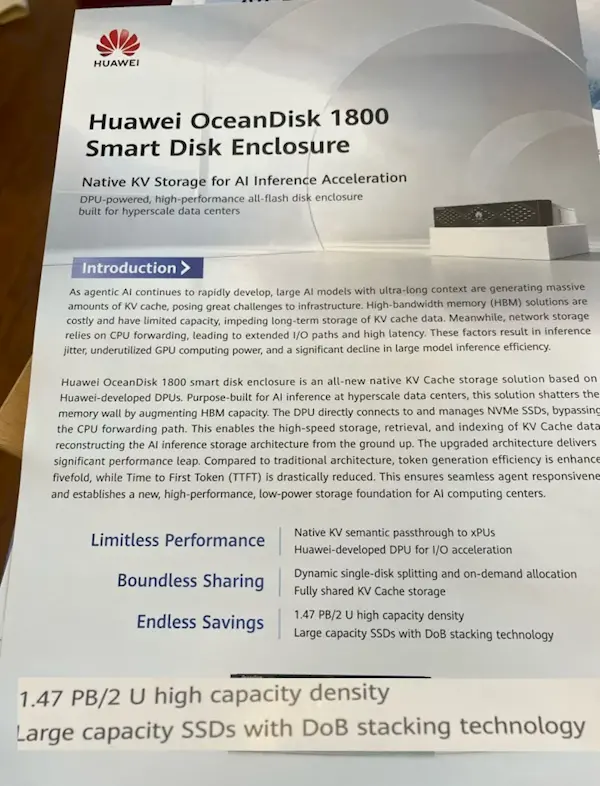
💡High-density storage is critical for LLM training; Huawei's new DoB tech offers a unique path for AI infrastructure.
⚡ 30-Second TL;DR
What Changed
Huawei's DoB (Die-on-Board) technology enables high-density storage breakthroughs.
Why It Matters
This development provides a critical domestic alternative for high-density storage in AI data centers, mitigating the impact of international technology supply chain restrictions.
What To Do Next
Evaluate the feasibility of integrating high-density DoB storage solutions into your local AI training clusters to optimize data throughput.
Key Points
- •Huawei's DoB (Die-on-Board) technology enables high-density storage breakthroughs.
- •Mass production of 61.44TB and 122.88TB SSDs is currently underway.
- •A 245TB version is currently in the planning stages for future AI infrastructure.
🧠 Deep Insight
Web-grounded analysis with 9 cited sources.
🔑 Enhanced Key Takeaways
- •Huawei's Die-on-Board (DoB) technology is a strategic response to US semiconductor restrictions, enabling the company to produce high-density SSDs without access to advanced 100+ layer 3D NAND from mainstream global suppliers.
- •DoB is a wafer-level packaging method that directly mounts NAND dies onto a PCB, achieving a 33% improvement in capacity density compared to conventional TSOP or BGA packaging, and enhancing performance and power efficiency through shorter interconnects.
- •The new high-capacity SSDs are already integrated into Huawei's OceanStor Pacific 9926 AFA scale-out storage systems, utilizing OceanDisk QLC PCIe Gen4 SSDs, demonstrating immediate application in enterprise solutions.
- •Huawei is reportedly leveraging Chinese-made NAND from suppliers like YMTC, whose Xtacking 4.0 3D NAND is currently limited to 232 layers, making DoB crucial for overcoming this density disadvantage against global leaders.
- •The 122TB capacity positions Huawei's SSDs among the highest-density enterprise storage products available globally, allowing them to rival solutions deployed by Western hyperscalers in AI data centers despite ongoing sanctions.
📊 Competitor Analysis▸ Show
| Feature/Company | Huawei (DoB SSD) | Solidigm | Samsung | Kioxia | Seagate |
|---|---|---|---|---|---|
| Max Capacity (announced/available) | 122.88TB (in production), 245TB (planned) | 122.88TB (D5-P5336), 245TB+ (planned by end 2026) | Up to 30.72TB (PM1743), 8TB (9100 Pro) | 245TB (being tested by hyperscalers) | Up to 30.72TB (Nytro 5060) |
| Key Technology | Die-on-Board (DoB) packaging | V-NAND (Solidigm D5-P5336) | 400-layer NAND (mass production), targeting 1,000 layers by 2030 | BiCS FLASH (LC9 Series) | PCIe Gen5 interface |
| Interface | PCIe Gen4 (OceanDisk QLC) | PCIe Gen4 (D5-P5336) | PCIe Gen5 (PM1743), PCIe Gen6 (PM1763 planned) | Not specified for 245TB, but generally PCIe NVMe | PCIe Gen5 (Nytro 5060) |
| Capacity Density Improvement | 33% via DoB | Not specified | Not specified | Not specified | Not specified |
| Performance (Sequential Read/Write) | Not publicly disclosed | Up to 6,800 MB/s read, 2,600 MB/s write (D5-P5336) | Up to 13,000MB/s read, 10,000MB/s write (PM1743) | Not publicly disclosed | Up to 13,000MB/s read, 10,000MB/s write (Nytro 5060) |
| Pricing | Not disclosed | Not disclosed | Not disclosed | Not disclosed | Not disclosed |
🛠️ Technical Deep Dive
- DoB (Die-on-Board) Technology: A proprietary wafer-level packaging method where semiconductor dies, specifically NAND dies, are mounted directly onto a base Printed Circuit Board (PCB).
- Sanctions Circumvention: This technology was developed to overcome restrictions on Huawei's access to advanced, high-layer-count 3D NAND chips from foreign suppliers, which are often based on US technology.
- Density Enhancement: DoB enables more flexible die stacking and shorter interconnects, resulting in a 33% improvement in capacity density compared to traditional packaging methods like TSOP (Thin Small Outline Package) or BGA (Ball Grid Array).
- NAND Flash Source: Huawei is reportedly utilizing Chinese-made NAND, such as YMTC's Xtacking 4.0 3D NAND, which currently offers up to 232 layers, a lower density than leading global manufacturers. DoB compensates for this layer-count disadvantage.
- Performance and Efficiency: The shorter interconnects facilitated by DoB are noted to improve both performance and power efficiency.
- Current Deployment: The DoB-packaged SSDs are already integrated into Huawei's OceanStor Pacific 9926 All-Flash Array (AFA) scale-out storage systems, paired with OceanDisk QLC (Quad-Level Cell) PCIe Gen4 SSDs.
- Future Development: A 245TB version, identified as the LC560 AI SSD, is in the planning stages. This future drive is designed with a 36-layer stacking process and aims for a bandwidth of 14.7GB/s, integrating an AI acceleration unit directly into the controller for simultaneous storage and computing capabilities.
- Engineering Challenges: Huawei successfully addressed challenges related to thermal management and signal integrity inherent in direct die mounting.
🔮 Future ImplicationsAI analysis grounded in cited sources
⏳ Timeline
📎 Sources (9)
Factual claims are grounded in the sources below. Forward-looking analysis is AI-generated interpretation.
Weekly AI Recap
Read this week's curated digest of top AI events →
👉Related Updates
Same topic
Explore #storage-tech
Same product
More on 122tb-ssd
Same source
Latest from cnBeta (Full RSS)

Nvidia may guarantee $250bn for OpenAI data center

PACA: Open-source tool for ancient fossil coordinate mapping

First atmosphere detected on habitable-zone exoplanet

Samsung Secures $200B Broadcom AI Infrastructure Deal
AI-curated news aggregator. All content rights belong to original publishers.
Original source: cnBeta (Full RSS) ↗