Nvidia may guarantee $250bn for OpenAI data center
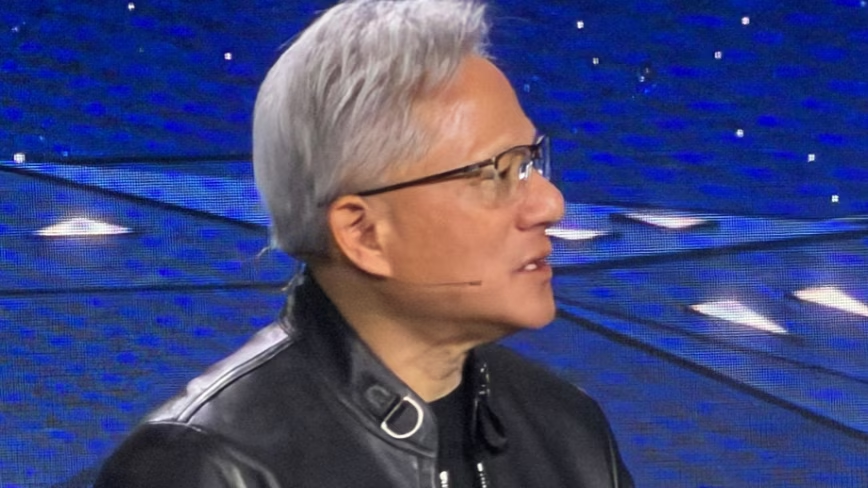
Nvidia's $250B bet on OpenAI reveals the extreme capital intensity required for next-gen AI infrastructure.
30-Second TL;DR
What Changed
Nvidia considering $250 billion in financing guarantees for OpenAI
Why It Matters
This massive capital commitment signals a shift toward 'sovereign-scale' AI infrastructure, where hardware providers become primary financial backers for their largest customers.
What To Do Next
Monitor your infrastructure scaling strategy; if you are a high-compute startup, explore long-term capacity reservation agreements with cloud providers.
Key Points
- •Nvidia considering $250 billion in financing guarantees for OpenAI
- •Project involves a 10-gigawatt data center campus in Ohio
- •SoftBank's energy subsidiary is developing the facility
- •Guarantee is essential for OpenAI to secure massive infrastructure leases
Deep Insight
AI-generated analysis for this event — not the original article.
Enhanced Key Takeaways
- •The proposed 10-gigawatt capacity represents a massive leap in scale, equivalent to the power consumption of several large cities or roughly 10-15 traditional nuclear power plants.
- •This initiative is part of a broader 'Stargate' or similar supercomputing project strategy aimed at achieving Artificial General Intelligence (AGI) by the end of the decade.
- •The involvement of SoftBank's energy arm highlights a strategic shift toward vertical integration, where AI firms are now directly securing dedicated power generation assets to bypass grid limitations.
- •Nvidia's financial guarantee model serves as a de-risking mechanism for utility providers and real estate developers, effectively acting as a 'compute-backed' credit facility.
- •The Ohio location was selected due to its favorable regulatory environment for data centers and proximity to existing high-voltage transmission infrastructure capable of supporting hyperscale loads.
Competitor Analysis
- OpenAI (Stargate/Ohio)
- Dedicated 10GW Campus
- Microsoft/OpenAI (Stargate)
- Multi-phase Supercomputer
- Google (Project Jarvis/TPU Pods)
- Distributed TPU Clusters
- Amazon (AWS AI Infrastructure)
- Cloud-native AI Scaling
- OpenAI (Stargate/Ohio)
- Nvidia Blackwell/Rubin
- Microsoft/OpenAI (Stargate)
- Nvidia/Custom Silicon
- Google (Project Jarvis/TPU Pods)
- Custom TPU v5/v6
- Amazon (AWS AI Infrastructure)
- Custom Trainium/Inferentia
- OpenAI (Stargate/Ohio)
- Direct Utility Partnership
- Microsoft/OpenAI (Stargate)
- Grid-scale PPA
- Google (Project Jarvis/TPU Pods)
- Carbon-neutral/Nuclear
- Amazon (AWS AI Infrastructure)
- Renewable/Grid-scale PPA
| Feature | OpenAI (Stargate/Ohio) | Microsoft/OpenAI (Stargate) | Google (Project Jarvis/TPU Pods) | Amazon (AWS AI Infrastructure) |
|---|---|---|---|---|
| Primary Focus | Dedicated 10GW Campus | Multi-phase Supercomputer | Distributed TPU Clusters | Cloud-native AI Scaling |
| Hardware | Nvidia Blackwell/Rubin | Nvidia/Custom Silicon | Custom TPU v5/v6 | Custom Trainium/Inferentia |
| Energy Strategy | Direct Utility Partnership | Grid-scale PPA | Carbon-neutral/Nuclear | Renewable/Grid-scale PPA |
Technical Deep Dive
- The 10-gigawatt requirement is driven by the need to power millions of next-generation GPUs (likely Blackwell or successor architectures) operating at high TDP (Thermal Design Power).
- Implementation involves liquid cooling infrastructure at an unprecedented scale to manage the heat density of racks exceeding 100kW per rack.
- The network architecture relies on ultra-low latency interconnects (NVLink/InfiniBand) to maintain synchronization across a cluster of this magnitude, minimizing the 'communication bottleneck' in distributed training.
- Power delivery systems require dedicated on-site substations and potentially micro-grid integration to ensure 99.999% uptime for continuous model training runs.
Future ImplicationsAI analysis grounded in cited sources
Timeline
- 2023-03OpenAI releases GPT-4, triggering a massive surge in demand for large-scale compute infrastructure.
- 2024-03Nvidia announces the Blackwell GPU architecture, designed specifically for the trillion-parameter model era.
- 2025-02Reports emerge regarding 'Stargate,' a multi-billion dollar supercomputer project between Microsoft and OpenAI.
- 2026-05SoftBank announces expanded investments in energy infrastructure to support AI data center growth.
Weekly AI Recap
Read this week's curated digest of top AI events →
Related Updates
AI-curated news aggregator. All content rights belong to original publishers.
Original source: The Next Web (TNW) ↗
This is a summary, not the original. Read the source, or get the weekly briefing.
The weekly digest
One email a week. Unsubscribe anytime.