Google Releases 3x Faster MTP for Gemma 4
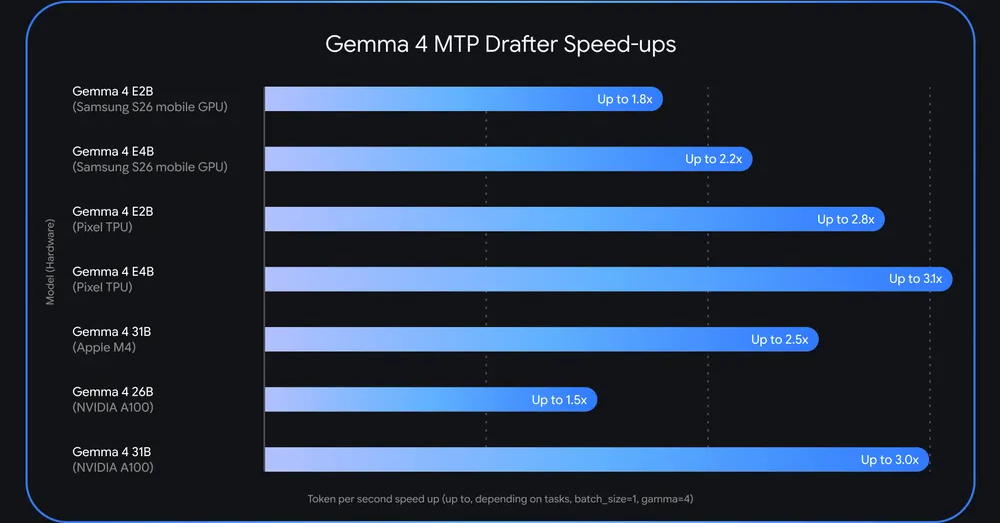
3x faster Gemma 4 inference with MTP – optimize your open LLMs now!
30-Second TL;DR
What Changed
Released MTP drafter for Gemma 4 open model
Why It Matters
This boosts Gemma 4's efficiency for real-world deployments, enabling faster inference in production without quality loss. Open-source practitioners gain a competitive edge in resource-limited settings.
What To Do Next
Integrate MTP into your Gemma 4 pipeline via vLLM or TensorRT-LLM for 3x inference speedup.
Key Points
- •Released MTP drafter for Gemma 4 open model
- •Achieves up to 3x faster text generation
- •Employs speculative decoding for parallel inference
- •Preserves generation quality
- •Compatible with major frameworks, edge-to-cloud
Deep Insight
AI-generated analysis for this event — not the original article.
Enhanced Key Takeaways
- •The MTP implementation for Gemma 4 utilizes a lightweight 'drafter' head architecture that is trained concurrently with the main model, specifically designed to predict the next k-tokens simultaneously rather than sequentially.
- •Integration with inference engines like vLLM and TensorRT-LLM is achieved through a standardized API, allowing developers to swap drafter weights without modifying the underlying model architecture.
- •Performance benchmarks indicate that the 3x speedup is most pronounced in high-throughput scenarios where the KV cache memory bandwidth is the primary bottleneck, rather than compute-bound tasks.
Competitor Analysis
- Google Gemma 4 MTP
- Multi-Token Prediction (MTP)
- Meta Llama 3 Speculative Decoding
- Standard Speculative Decoding
- Mistral Speculative Decoding
- Standard Speculative Decoding
- Google Gemma 4 MTP
- Integrated/Trained with base
- Meta Llama 3 Speculative Decoding
- External/Small model required
- Mistral Speculative Decoding
- External/Small model required
- Google Gemma 4 MTP
- Native (vLLM, TensorRT-LLM)
- Meta Llama 3 Speculative Decoding
- Broad (vLLM, HuggingFace)
- Mistral Speculative Decoding
- Broad (vLLM, HuggingFace)
- Google Gemma 4 MTP
- Up to 3x (Context dependent)
- Meta Llama 3 Speculative Decoding
- 1.5x - 2.5x
- Mistral Speculative Decoding
- 1.5x - 2.5x
| Feature | Google Gemma 4 MTP | Meta Llama 3 Speculative Decoding | Mistral Speculative Decoding |
|---|---|---|---|
| Mechanism | Multi-Token Prediction (MTP) | Standard Speculative Decoding | Standard Speculative Decoding |
| Drafter Model | Integrated/Trained with base | External/Small model required | External/Small model required |
| Framework Support | Native (vLLM, TensorRT-LLM) | Broad (vLLM, HuggingFace) | Broad (vLLM, HuggingFace) |
| Efficiency Gain | Up to 3x (Context dependent) | 1.5x - 2.5x | 1.5x - 2.5x |
Technical Deep Dive
- •Architecture: Employs a shared transformer backbone with a specialized MTP head that outputs multiple tokens in a single forward pass.
- •Training: The MTP head is trained using a multi-token loss function, forcing the model to learn dependencies between consecutive tokens during the pre-training phase.
- •Inference Logic: During speculative decoding, the drafter proposes a sequence of tokens; the main model validates these in parallel, accepting the longest prefix that matches the target distribution.
- •Memory Overhead: The MTP head adds negligible parameter count (typically <5% of total model size), ensuring minimal impact on VRAM footprint.
Future ImplicationsAI analysis grounded in cited sources
Timeline
- 2024-02Google releases the initial Gemma open model family.
- 2025-03Google announces Gemma 3 with improved architectural efficiency.
- 2026-02Google launches Gemma 4, focusing on native multi-token prediction capabilities.
- 2026-05Google releases the optimized MTP drafter for Gemma 4 to the public.
Weekly AI Recap
Read this week's curated digest of top AI events →
Related Updates
AI-curated news aggregator. All content rights belong to original publishers.
Original source: ITmedia AI+ (日本) ↗
This is a summary, not the original. Read the source, or get the weekly briefing.
The weekly digest
One email a week. Unsubscribe anytime.