GitHub's 2026 Open Source Predictions
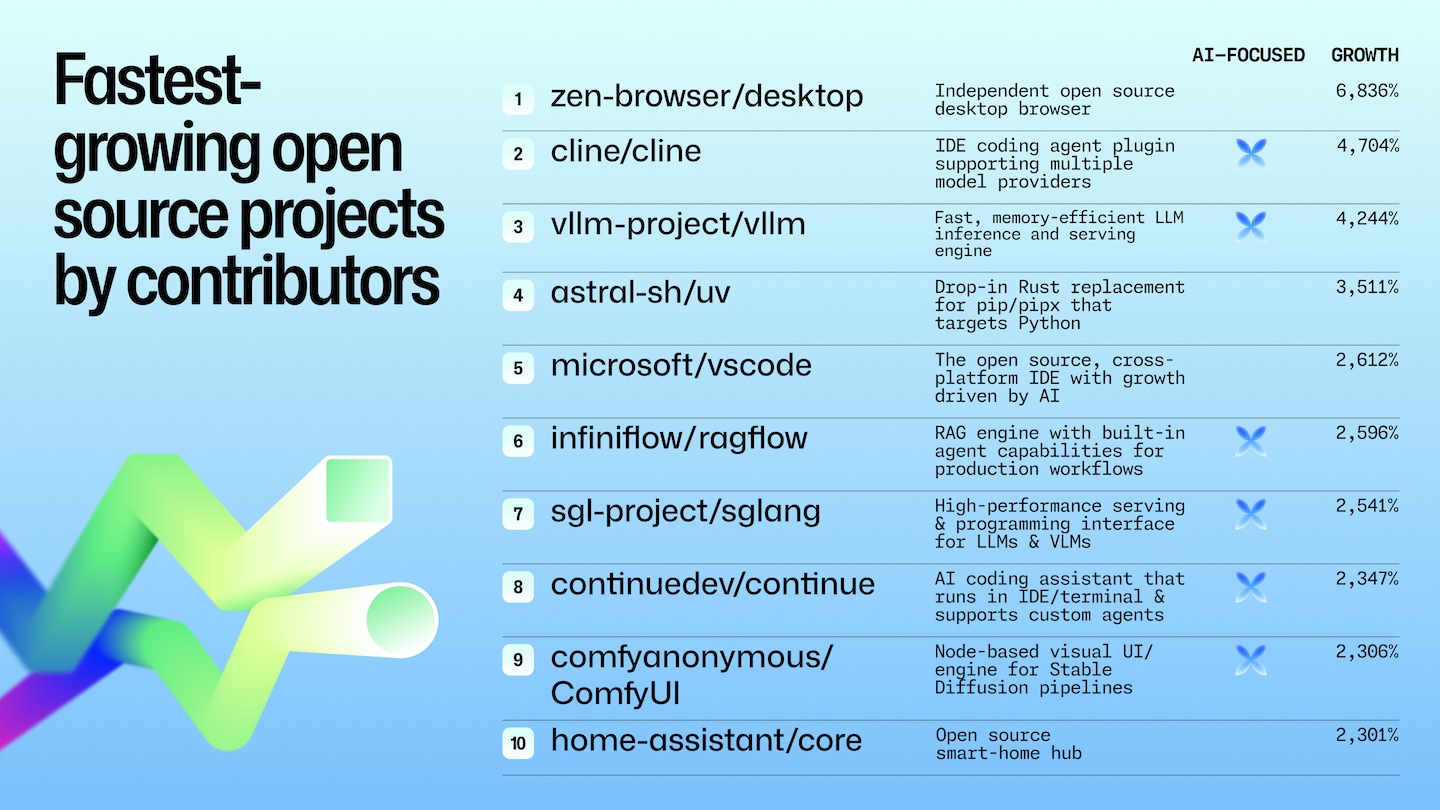
💡GitHub data reveals 2026 open source trends critical for AI devs' tool choices.
⚡ 30-Second TL;DR
What Changed
Analyzes 2025 GitHub open source activity data
Why It Matters
Helps AI practitioners anticipate popular open source tools and libraries for model training and deployment. Guides investment in emerging repos. Shapes strategy for collaborative AI projects.
What To Do Next
Download GitHub's 2025 open source dataset to analyze rising AI repos.
Key Points
- •Analyzes 2025 GitHub open source activity data
- •Predicts key trends for open source in 2026
- •Draws lessons from recent data for future planning
🧠 Deep Insight
Background and context from public sources — not the original article. 5 sources cited.
🔑 Enhanced Key Takeaways
- •Google is expanding GSoC 2026 with approximately 30 new organizations focused on AI, ML, and Security, signaling institutional commitment to these domains[1]
- •Claude Code is authoring 4% of GitHub public commits currently, with projections reaching 20%+ by end of 2026, representing a fundamental shift in software development workflows[2]
- •Open source is experiencing an 'Eternal September' phenomenon, prompting GitHub to introduce interaction limits and maintainer protection tools to preserve community trust[3]
- •AI agents like OpenClaw achieved 180,000 GitHub stars rapidly, triggering a $2 trillion market cap correction in SaaS as investors reassess software defensibility in an AI-augmented economy[4]
- •Organizational structures are evolving toward fluid, project-based teams of AI-augmented generalists replacing permanent cross-functional structures, fundamentally reshaping how open source contributions are coordinated[5]
🛠️ Technical Deep Dive
• Claude Code integration with GitHub enables AI-assisted commit authoring at scale, currently 4% of public commits[2] • ONNX Runtime (Microsoft) provides cross-platform ML inference optimization in C++, Python, and C# with 15k+ GitHub stars[1] • Stability AI's Generative Models framework supports image/video generation with 24k+ GitHub stars, representing enterprise-grade open source AI infrastructure[1] • Great Expectations offers Python-based data validation and quality assurance with 10k+ GitHub stars, addressing data pipeline reliability[1] • OpenClaw represents vibe-coded AI agent architecture achieving viral adoption with 180,000 GitHub stars in record timeframe[4]
🔮 Future ImplicationsAI analysis grounded in cited sources
The convergence of AI-assisted development (Claude Code), rapid AI agent adoption (OpenClaw), and expanded institutional support (GSoC 2026) is reshaping software economics. The $2 trillion SaaS market correction reflects investor concerns that AI agents may commoditize traditional software, forcing companies to compete on defensibility rather than feature parity[4]. Open source maintainers face unprecedented scaling challenges as contribution volume increases while quality assurance becomes critical[3]. Organizations adopting fluid, AI-augmented team structures may gain competitive advantage over those maintaining rigid hierarchies[5]. The trajectory suggests 2026 will be a pivotal year determining which software categories remain defensible versus those disrupted by AI automation.
⏳ Timeline
📎 Sources (5)
Factual claims are grounded in the sources below. Forward-looking analysis is AI-generated interpretation.
- dev.to — Gsoc 2026 Predictions 30 New Aimlsecurity Organizations You Should Start Contributing to Now 5ccn
- newsletter.semianalysis.com — Claude Code Is the Inflection Point
- devops.com — Open Sources Eternal September Github Keeps Maintainers Covered for All Seasons
- techbuzz.ai — The 2 Trillion Saa Spocalypse How to Become Unsloppable in 2026
- GitHub — Vibe Coding Enterprise 2026
Weekly AI Recap
Read this week's curated digest of top AI events →
👉Related Updates

AI-curated news aggregator. All content rights belong to original publishers.
Original source: GitHub Blog ↗
This is a summary, not the original. Read the source, or get the weekly briefing.
Weekly AI briefing
One email a week. Unsubscribe anytime.