Germany and Spain resist EU-wide Huawei ban
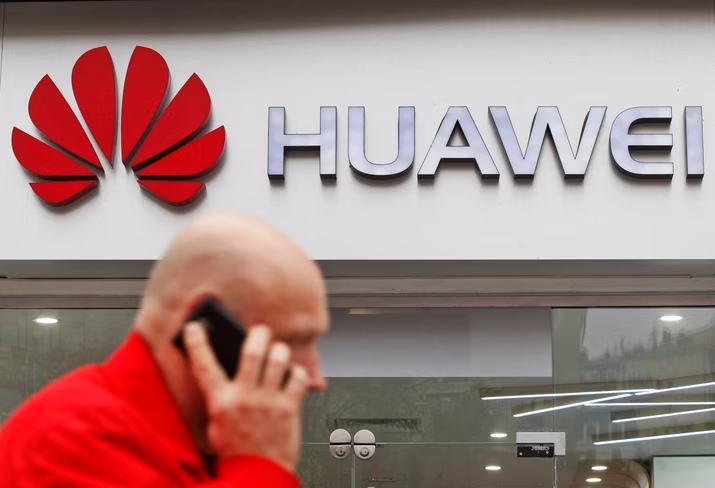
Geopolitical friction over telecom hardware directly impacts the infrastructure layer for AI and 5G deployment.
30-Second TL;DR
What Changed
Germany and Spain lead opposition against EU-wide Huawei/ZTE ban
Why It Matters
The internal EU disagreement creates uncertainty for telecom operators planning their 5G and AI-infrastructure rollouts. It highlights the tension between geopolitical security and economic pragmatism in the tech sector.
What To Do Next
If you are building AI-integrated telecom solutions, monitor EU regulatory updates to assess potential supply chain shifts for hardware components.
Key Points
- •Germany and Spain lead opposition against EU-wide Huawei/ZTE ban
- •Concerns cited include potential economic retaliation from China
- •High financial costs of replacing AI-ready telecom infrastructure are a major factor
Deep Insight
Background and context from public sources — not the original article. 30 sources cited.
Enhanced Key Takeaways
- •The European Commission's latest recommendation, issued in early May 2026, expands beyond the 2020 version, urging member states to exclude Huawei and ZTE not only from 5G core networks but also from the wider connectivity infrastructure.
- •China has formally threatened the EU with reciprocal countermeasures, including potential investigations into EU businesses, if the proposed Cybersecurity Act leads to the mandatory exclusion of Chinese firms from European networks.
- •Despite current resistance to an EU-wide ban, Germany had already committed in 2024 to remove Huawei and ZTE components from its core 5G mobile network by the end of 2024 for national security reasons.
- •The estimated cost for mobile companies to replace Huawei and ZTE technology across the entire EU ranges from €3.4 billion to €4.3 billion over three years, translating to approximately €6-8 per mobile subscriber.
- •An EU court adviser indicated in March 2026 that governments can block Huawei equipment, but such actions require concrete evidence of a threat, rather than broad national security claims, which could impact the legal enforceability of a blanket ban.
Competitor Analysis
- Huawei/ZTE (Chinese Vendors)
- ~Two-thirds combined with Ericsson (Huawei #1)
- Ericsson/Nokia (European Vendors)
- ~Two-thirds combined with Huawei (Ericsson #2, Nokia #3)
- Samsung (Other Vendor)
- Among top 5, but smaller share
- Huawei/ZTE (Chinese Vendors)
- Among top 4 leaders
- Ericsson/Nokia (European Vendors)
- Among top 4 leaders
- Samsung (Other Vendor)
- Upcoming vendor group
- Huawei/ZTE (Chinese Vendors)
- Historically competitive pricing
- Ericsson/Nokia (European Vendors)
- Often come at a premium
- Samsung (Other Vendor)
- Not explicitly detailed in search results
- Huawei/ZTE (Chinese Vendors)
- Rapid deployment
- Ericsson/Nokia (European Vendors)
- Not explicitly detailed in search results
- Samsung (Other Vendor)
- Not explicitly detailed in search results
- Huawei/ZTE (Chinese Vendors)
- Leveraging domestic market scale, 5G-Advanced, AI integration
- Ericsson/Nokia (European Vendors)
- Repositioning as end-to-end 5G solution providers, software capabilities, enterprise opportunities (private mobile networks)
- Samsung (Other Vendor)
- Not explicitly detailed in search results
- Huawei/ZTE (Chinese Vendors)
- High, leading in new logos
- Ericsson/Nokia (European Vendors)
- Leader in business performance
- Samsung (Other Vendor)
- Not explicitly detailed in search results
- Huawei/ZTE (Chinese Vendors)
- Designated 'high-risk suppliers' due to potential state influence, supply-chain vulnerabilities, espionage/sabotage risks
- Ericsson/Nokia (European Vendors)
- Generally considered lower risk by EU/US
- Samsung (Other Vendor)
- Not explicitly detailed in search results
| Feature/Category | Huawei/ZTE (Chinese Vendors) | Ericsson/Nokia (European Vendors) | Samsung (Other Vendor) |
|---|---|---|---|
| Market Share (Global RAN, 2025) | ~Two-thirds combined with Ericsson (Huawei #1) | ~Two-thirds combined with Huawei (Ericsson #2, Nokia #3) | Among top 5, but smaller share |
| Market Share (Global Core, 2024) | Among top 4 leaders | Among top 4 leaders | Upcoming vendor group |
| Pricing | Historically competitive pricing | Often come at a premium | Not explicitly detailed in search results |
| Deployment Speed | Rapid deployment | Not explicitly detailed in search results | Not explicitly detailed in search results |
| Strategic Focus | Leveraging domestic market scale, 5G-Advanced, AI integration | Repositioning as end-to-end 5G solution providers, software capabilities, enterprise opportunities (private mobile networks) | Not explicitly detailed in search results |
| Business Performance (2025) | High, leading in new logos | Leader in business performance | Not explicitly detailed in search results |
| Security Concerns | Designated 'high-risk suppliers' due to potential state influence, supply-chain vulnerabilities, espionage/sabotage risks | Generally considered lower risk by EU/US | Not explicitly detailed in search results |
Technical Deep Dive
- Huawei's 5G-Advanced (5G-A) Solutions:
- Focus on 'Networks for AI' and 'AI for Networks' to achieve L4 network autonomy through digital sites and RAN Agents.
- Includes Sub-1 GHz Massive MIMO for extensive coverage and improved downlink, uplink, and low-latency experiences.
- Features Blade AAU X, an industry-first single antenna solution for Massive MIMO deployment across all sub-6 GHz bands, reducing site space and OPEX.
- U6GHz AAU integrates over 1,500 antenna elements and uses MU-MIMO algorithms for continuous 10 Gbps.
- Offers ultra-wide band AAU series, wide-angle Pano Radio series, lightweight EasyAAU series, and Sub1GHz AAU with best coverage solutions for 5-gigabit speeds and smart antennas that adapt to AI traffic patterns.
- Utilizes GigaGreen hardware and GigaBand software for upgrades like uplink speeds over 1Gbps, widespread AI connectivity, and smart resource management.
- ZTE's AI 5G Fixed Wireless Access (FWA) Products:
- ZTE G5 Pro 5G AI CPE: Supports Wi-Fi 7 with Multi-Link Operation (MLO) for theoretical peak download speeds of 4.29Gbps, 4K QAM modulation, dual 2.5G Ethernet ports, a 4nm quad-core processor, and a 13dBi high-gain antenna system. Includes AI-branded network management tools for bandwidth allocation, scene recognition, and parental controls via the ZTE Smart Life app.
- ZTE G5 Ultra (AI 5G FWA): Equipped with a 13dBi ultra-high gain antenna and ZTE's AI antenna algorithm, achieving approximately 50% wider high gain beamwidth, 20% faster data rate in weak signal scenarios, and 25% wider signal coverage. Supports Wi-Fi 7 (6GHz/5GHz/2.4GHz tri-band) with peak data rates up to 19Gbps.
- ZTE G6 Max (5G-A outdoor CPE): World's first 5G-A outdoor CPE supporting Sub-6GHz and mmWave, delivering peak speeds of 12.5Gbps by aggregating 800MHz mmWave and 400MHz Sub6GHz bandwidths. Features ZTE's 6th Gen Outdoor AI Antenna Solution (up to 14dBi gain) boosting download speeds by 30% and expanding coverage by 20% (up to 14km).
- ZTE G6 Ultra (5G-A AI Wi-Fi 8 CPE): World's first 5G-A AI Wi-Fi 8 design-ready CPE, combining AI with Tri-band 4MIMO Wi-Fi 8 technology for peak speeds of 10Gbps. Integrates ZTE's 6th Gen Indoor AI Antenna Solution (14dBi gain) and AI signal tracking/beam scanning algorithm 6.0 for 30% increase in download speeds and 20% wider coverage.
- ZTE's AI dynamic bandwidth technology intelligently identifies over 4,000 main applications, boosting bandwidth efficiency by 20% and cutting latency/congestion by 50% and 30% respectively.
Future ImplicationsAI analysis grounded in cited sources
Timeline
- 2017China's National Intelligence Law passed, heightening global security concerns over Chinese tech companies.
- 2020-01The EU unanimously adopted the '5G cybersecurity toolbox,' recommending restrictions on 'high-risk suppliers' but leaving implementation to national governments.
- 2020Sweden banned Chinese vendors from its 5G networks, leading to a significant fall in Ericsson's revenues in China the following year.
- 2024Germany agreed to strip Huawei and ZTE components from its core 5G mobile network by the end of the year for national security reasons.
- 2025-11The European Commission reportedly considered turning its 2020 guidance into a binding requirement to remove Huawei and ZTE equipment.
- 2026-05The European Commission formally recommended that all 27 EU member states exclude Huawei and ZTE equipment from telecom infrastructure, escalating years of voluntary guidance.
Sources (30)
Factual claims are grounded in the sources below. Forward-looking analysis is AI-generated interpretation.
Weekly AI Recap
Read this week's curated digest of top AI events →
Related Updates


AI-curated news aggregator. All content rights belong to original publishers.
Original source: The Next Web (TNW) ↗
This is a summary, not the original. Read the source, or get the weekly briefing.
The weekly digest
One email a week. Unsubscribe anytime.