Florida politician denies using AI for legislation drafting
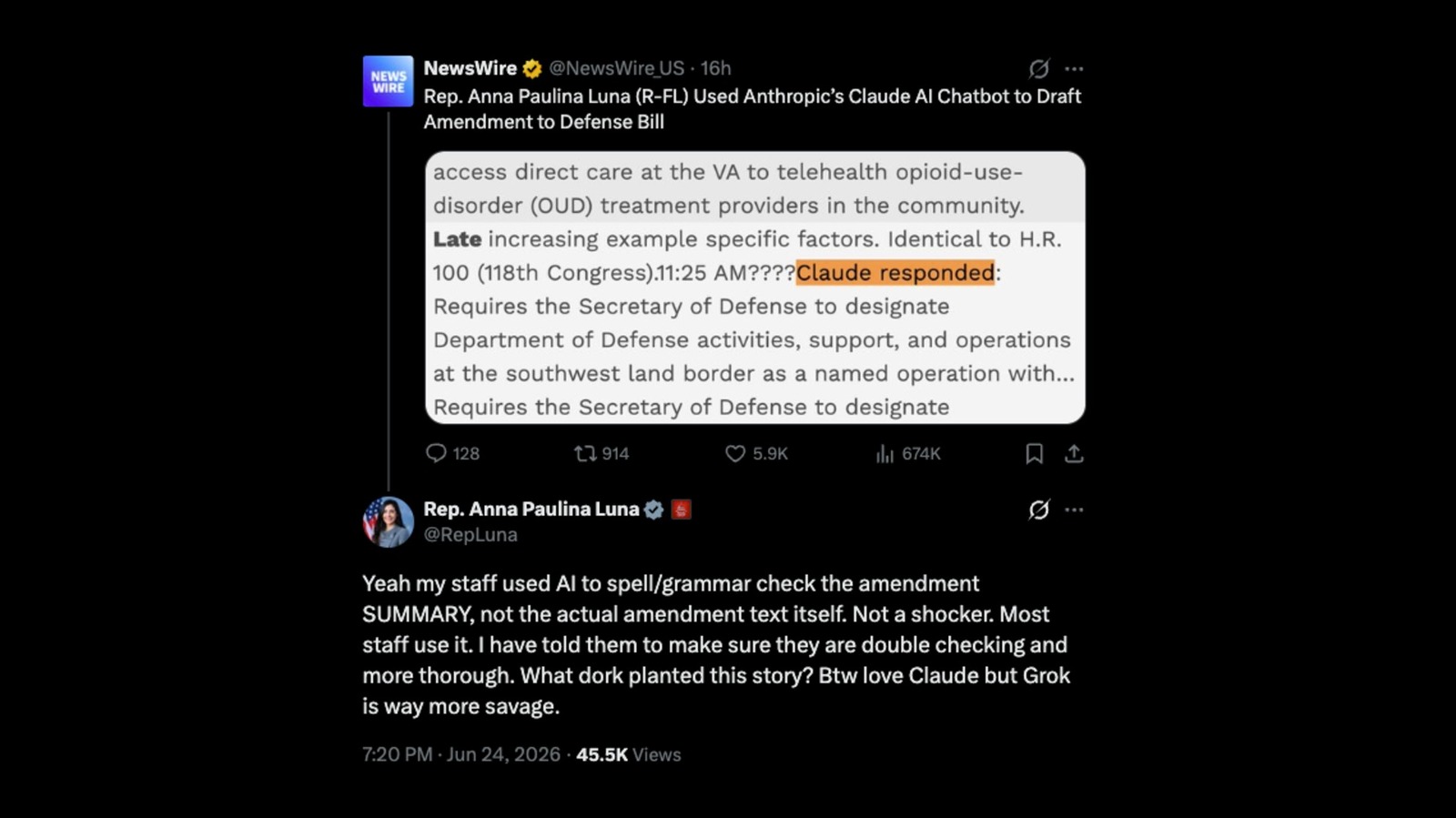
Understand the growing political and ethical scrutiny surrounding the use of LLMs in legislative workflows.
30-Second TL;DR
What Changed
Florida Republican denies AI-assisted legislative drafting
Why It Matters
This incident reflects the increasing pressure on public officials to disclose AI usage in official workflows. It highlights the reputational risks associated with AI integration in sensitive sectors like lawmaking.
What To Do Next
Review your internal AI usage policies to ensure clear documentation of where LLMs are used for assistive tasks versus generative tasks.
Key Points
- •Florida Republican denies AI-assisted legislative drafting
- •Claude was used exclusively for spelling and grammar checks
- •Highlights growing political scrutiny over AI usage in governance
Deep Insight
AI-generated analysis for this event — not the original article.
Enhanced Key Takeaways
- •The controversy centers on Florida State Representative Carolina Amesty, who faced accusations regarding the use of AI tools in the drafting of House Bill 1191.
- •Critics and ethics watchdogs raised concerns that using AI, even for editing, could violate legislative transparency standards or introduce subtle biases into public policy.
- •The incident has prompted the Florida House of Representatives to review internal guidelines regarding the use of generative AI tools by staff members.
- •Amesty's office maintained that the use of Anthropic's Claude was limited to 'proofreading' and 'polishing' existing text written by human legislative aides.
- •This event is part of a broader trend in state legislatures across the U.S. where lawmakers are grappling with the lack of standardized policies for AI integration in the lawmaking process.
Technical Deep Dive
- The tool in question, Claude (developed by Anthropic), utilizes a Constitutional AI training approach, which emphasizes safety and alignment with human-defined principles.
- When used for grammar and spelling, the model operates in a text-completion or text-refinement mode, processing input tokens to predict the most statistically probable corrections based on standard linguistic patterns.
- Legislative drafting software often requires high-security, air-gapped environments, whereas standard web-based LLM interfaces like Claude may transmit data to external servers, raising potential data privacy concerns regarding sensitive legislative drafts.
Future ImplicationsAI analysis grounded in cited sources
Timeline
- 2024-03Representative Carolina Amesty faces public scrutiny over the drafting process of HB 1191.
- 2024-04Amesty's office issues a formal clarification regarding the limited use of AI tools for grammar correction.
- 2024-05Florida legislative leadership begins internal discussions on establishing guidelines for AI usage in official duties.
Weekly AI Recap
Read this week's curated digest of top AI events →
Related Updates

AI-curated news aggregator. All content rights belong to original publishers.
Original source: Engadget ↗
This is a summary, not the original. Read the source, or get the weekly briefing.
The weekly digest
One email a week. Unsubscribe anytime.