Embodied AI: The Future of Deep Space Exploration
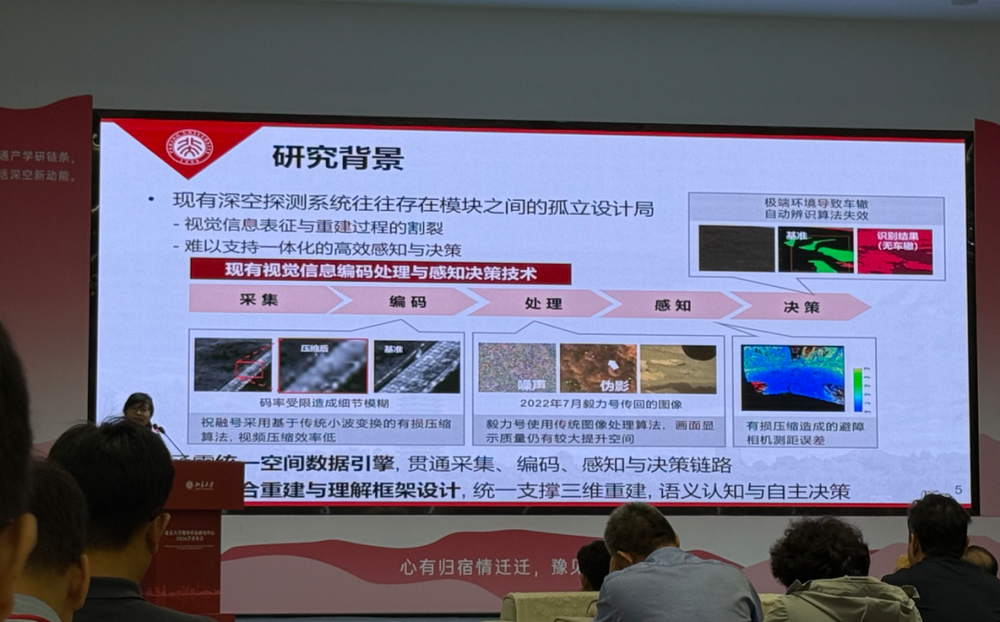
💡How planetary scientists are using Embodied AI and SAM to automate deep space exploration.
⚡ 30-Second TL;DR
What Changed
AI is becoming a core research infrastructure for planetary science, beyond just an auxiliary tool.
Why It Matters
This marks a significant trend in deploying embodied AI in extreme environments, setting new standards for autonomous robotics.
What To Do Next
Explore the integration of vision-language models with robotic control systems for autonomous navigation tasks.
Key Points
- •AI is becoming a core research infrastructure for planetary science, beyond just an auxiliary tool.
- •Embodied AI (robotics) is essential for deep space exploration due to long communication delays.
- •Research is shifting from 'how to return samples' to 'how robots can autonomously select samples'.
- •Integration of large models (like Segment Anything) is being used to analyze planetary geological data.
🧠 Deep Insight
AI-generated analysis for this event — not the original article.
🔑 Enhanced Key Takeaways
- •NASA's 'Autonomous Exploration for Gathering Increased Science' (AEGIS) system has been successfully deployed on Mars rovers to autonomously identify and target geological features for laser spectroscopy without human intervention.
- •The integration of neuromorphic computing chips is being explored for deep space robotics to reduce power consumption by orders of magnitude compared to traditional GPU-based AI processing.
- •Swarm intelligence algorithms are being tested for multi-agent planetary exploration, allowing small, low-cost robots to coordinate mapping and resource scouting tasks autonomously.
- •Radiation-hardened AI hardware, such as the High-Performance Spaceflight Computing (HPSC) processor, is becoming a prerequisite for deploying advanced embodied AI models in high-radiation environments like Jupiter's moons.
- •Digital Twin technology is now being used to create high-fidelity simulations of planetary surfaces, enabling reinforcement learning agents to train in virtual environments before deployment on physical hardware.
🛠️ Technical Deep Dive
- Architecture: Hierarchical Reinforcement Learning (HRL) is utilized to decouple high-level mission objectives from low-level motor control in quadrupedal systems.
- Perception: Integration of Vision-Language Models (VLMs) allows robots to interpret natural language commands from ground control into actionable navigation paths.
- Edge Computing: Implementation of onboard Tensor Processing Units (TPUs) optimized for low-power, radiation-tolerant environments to execute inference locally.
- Navigation: Simultaneous Localization and Mapping (SLAM) algorithms are being fused with semantic segmentation to enable terrain traversability analysis in real-time.
🔮 Future ImplicationsAI analysis grounded in cited sources
⏳ Timeline
Weekly AI Recap
Read this week's curated digest of top AI events →
👉Related Updates


AI-curated news aggregator. All content rights belong to original publishers.
Original source: 虎嗅 ↗
This is a summary, not the original. Read the source, or get the weekly briefing.
The weekly digest
One email a week. Unsubscribe anytime.