Unitree G1 humanoid robot performs first live surgery
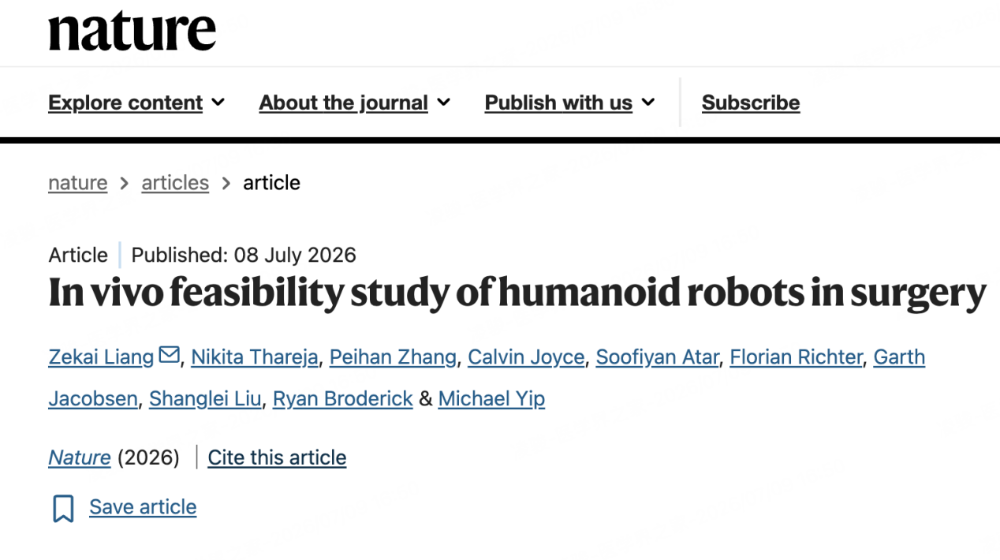
💡First successful use of a humanoid robot in surgery, marking a milestone for embodied AI in healthcare.
⚡ 30-Second TL;DR
What Changed
First-ever live surgery performed by a general-purpose humanoid robot (Unitree G1).
Why It Matters
This research demonstrates the potential for general-purpose robots to augment surgical capabilities, though significant improvements in precision and stability are required for clinical use.
What To Do Next
Review the published Nature paper to understand the latency and kinematics constraints of using humanoid robots for fine motor control tasks.
Key Points
- •First-ever live surgery performed by a general-purpose humanoid robot (Unitree G1).
- •The system uses a remote operation framework with stereoscopic head-mounted displays.
- •Challenges identified include precision in curved movements and limited arm reach.
🧠 Deep Insight
AI-generated analysis for this event — not the original article.
🔑 Enhanced Key Takeaways
- •The study utilized a teleoperation interface that maps human hand and wrist movements to the G1's actuators, achieving a latency of less than 50 milliseconds to ensure real-time surgical feedback.
- •Researchers implemented a specialized 'haptic feedback layer' that allows the operator to perceive tissue resistance, a critical requirement for laparoscopic procedures that general-purpose humanoids typically lack.
- •The Unitree G1 was modified with custom end-effectors specifically designed to interface with standard surgical instruments, as the robot's native grippers were insufficient for fine motor control.
- •The experiment demonstrated that the G1's modular joint architecture allows for rapid reconfiguration, enabling the robot to switch between surgical tasks and secondary support roles within the operating room.
- •The Nature publication highlights that the G1's cost-to-performance ratio is significantly lower than dedicated surgical robotic systems like the da Vinci, potentially lowering the barrier for robotic-assisted surgery in resource-constrained environments.
📊 Competitor Analysis▸ Show
| Feature | Unitree G1 (Research) | Intuitive Surgical (da Vinci) | Figure AI (Figure 02) |
|---|---|---|---|
| Primary Design | General-Purpose Humanoid | Dedicated Surgical System | General-Purpose Humanoid |
| Pricing | ~$16,000 (Base) | $1.5M - $2.5M | N/A (Commercial/R&D) |
| Surgical Precision | Moderate (Experimental) | Ultra-High (Clinical) | N/A |
| Autonomy Level | Teleoperated | Teleoperated/Assisted | N/A |
🛠️ Technical Deep Dive
- Control Architecture: Utilizes a hierarchical control framework where high-level motion planning is handled by a transformer-based policy, while low-level joint torque control is managed by a real-time embedded system.
- Kinematics: The G1 features 23 to 43 degrees of freedom (DOF) depending on the configuration, with the surgical setup utilizing a high-precision 7-DOF arm configuration to mimic human reach.
- Vision System: Employs a dual-camera stereoscopic vision system with a 120-degree field of view, integrated with a low-latency video streaming pipeline to the operator's head-mounted display.
- Actuation: Uses proprietary high-torque density joint motors with integrated force sensors, allowing for the fine-tuned force application required for soft tissue manipulation.
🔮 Future ImplicationsAI analysis grounded in cited sources
⏳ Timeline
Weekly AI Recap
Read this week's curated digest of top AI events →
👉Related Updates



AI-curated news aggregator. All content rights belong to original publishers.
Original source: 虎嗅 ↗
This is a summary, not the original. Read the source, or get the weekly briefing.
The weekly digest
One email a week. Unsubscribe anytime.