Embodied AI Chip Market Accelerates Amid Competitive Race
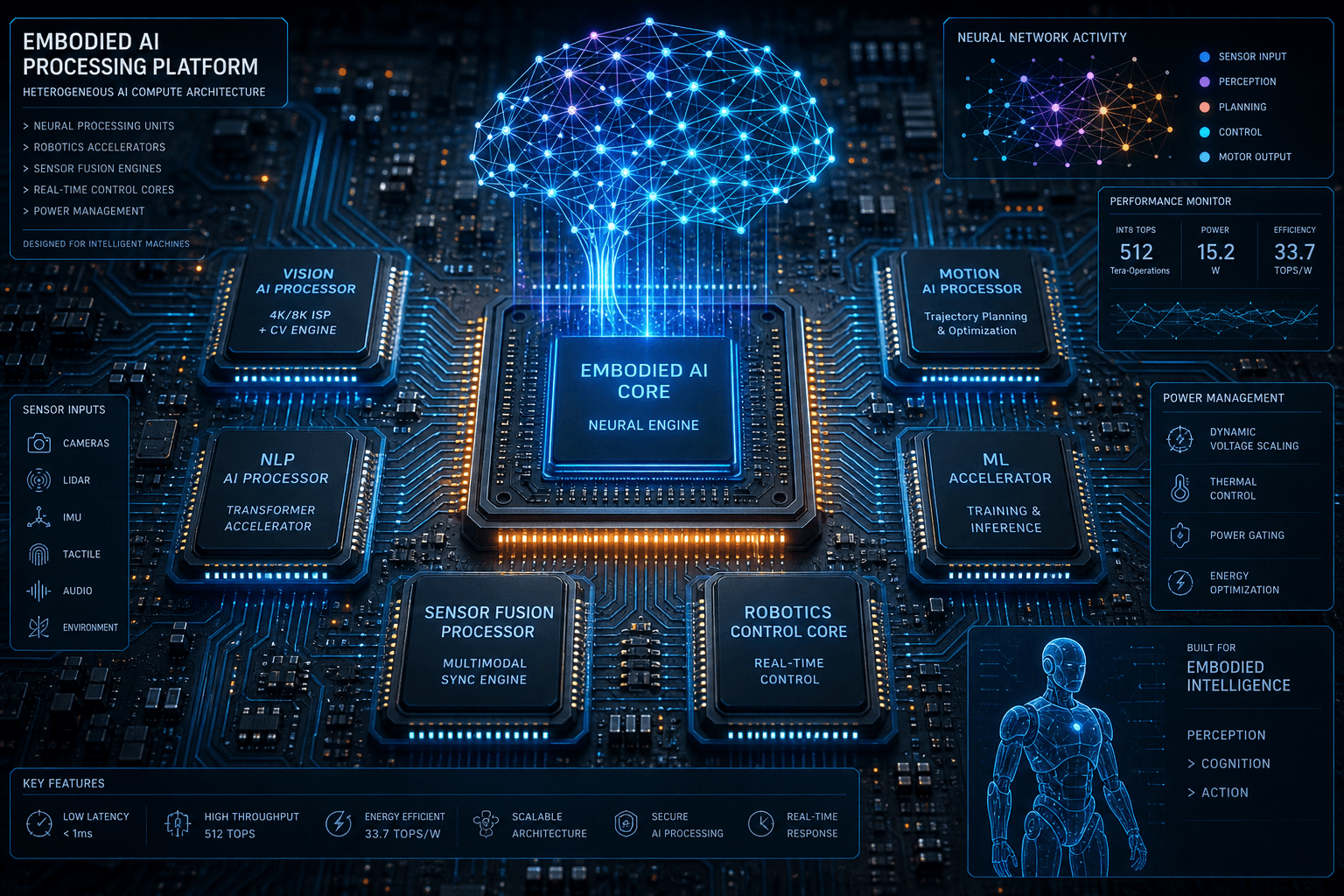
Discover the hardware trends driving the next generation of robotics and embodied AI agents.
30-Second TL;DR
What Changed
Rising demand for specialized chips in robotics and embodied AI
Why It Matters
Increased competition in the chip sector will likely accelerate the development of more capable and affordable humanoid robots and autonomous agents.
What To Do Next
Monitor the hardware specifications of emerging embodied AI chips to determine if they support your current robotics software stack.
Key Points
- •Rising demand for specialized chips in robotics and embodied AI
- •Multiple market players entering the hardware race for dominance
- •Focus on low-latency and high-efficiency inference at the edge
Deep Insight
AI-generated analysis for this event — not the original article.
Enhanced Key Takeaways
- •The integration of neuromorphic computing architectures is becoming a primary strategy to achieve the sub-10W power envelopes required for humanoid robot autonomy.
- •Major semiconductor foundries are shifting toward 3nm and 2nm process nodes specifically optimized for high-density, low-power AI inference to support embodied AI workloads.
- •Standardization efforts like the Open Robotics Middleware Framework (Open-RMF) are increasingly being hardware-accelerated at the silicon level to reduce communication bottlenecks between sensors and actuators.
- •The market is seeing a pivot from general-purpose GPUs to domain-specific architectures (DSAs) that prioritize Transformer-based model acceleration for real-time spatial reasoning.
- •Supply chain dynamics are shifting as embodied AI developers move toward 'chiplet' designs, allowing for modular upgrades to processing units without replacing the entire robotic control system.
Competitor Analysis
- NVIDIA (Jetson Thor)
- Blackwell-based SoC
- Tesla (FSD/Dojo)
- Custom ASIC
- Emerging Embodied AI Startups
- Neuromorphic/FPGA-Hybrid
- NVIDIA (Jetson Thor)
- Ultra-low (ms)
- Tesla (FSD/Dojo)
- Low (ms)
- Emerging Embodied AI Startups
- Ultra-low (sub-ms)
- NVIDIA (Jetson Thor)
- General Robotics
- Tesla (FSD/Dojo)
- Autonomous Vehicles
- Emerging Embodied AI Startups
- Humanoid/Dexterous Manipulation
- NVIDIA (Jetson Thor)
- Enterprise Licensing
- Tesla (FSD/Dojo)
- Vertical Integration
- Emerging Embodied AI Startups
- Custom Silicon/IP Licensing
| Feature | NVIDIA (Jetson Thor) | Tesla (FSD/Dojo) | Emerging Embodied AI Startups |
|---|---|---|---|
| Architecture | Blackwell-based SoC | Custom ASIC | Neuromorphic/FPGA-Hybrid |
| Target Latency | Ultra-low (ms) | Low (ms) | Ultra-low (sub-ms) |
| Primary Focus | General Robotics | Autonomous Vehicles | Humanoid/Dexterous Manipulation |
| Pricing Model | Enterprise Licensing | Vertical Integration | Custom Silicon/IP Licensing |
Technical Deep Dive
- Implementation of Transformer Engine support in silicon to accelerate attention mechanisms essential for real-time path planning.
- Utilization of high-bandwidth memory (HBM3e) to handle massive sensor data streams from LiDAR, depth cameras, and tactile sensors simultaneously.
- Integration of dedicated hardware blocks for SLAM (Simultaneous Localization and Mapping) to offload CPU/GPU tasks.
- Adoption of asynchronous data flow architectures to minimize power consumption during idle states in robotic movement.
Future ImplicationsAI analysis grounded in cited sources
Timeline
- 2024-03NVIDIA announces Project GR00T and the Jetson Thor chip for humanoid robots.
- 2025-01Major industry shift toward specialized silicon for embodied AI as humanoid robot prototypes reach commercial testing phases.
- 2026-02Introduction of first-generation commercial chips specifically marketed for 'Embodied AI' by emerging semiconductor firms.
Weekly AI Recap
Read this week's curated digest of top AI events →
Related Updates


AI-curated news aggregator. All content rights belong to original publishers.
Original source: Pandaily ↗
This is a summary, not the original. Read the source, or get the weekly briefing.
The weekly digest
One email a week. Unsubscribe anytime.