China's 3D Printing Dominance and Patent Challenges
Understand how AI-driven sensor fusion and software optimization are disrupting traditional hardware industries.
30-Second TL;DR
What Changed
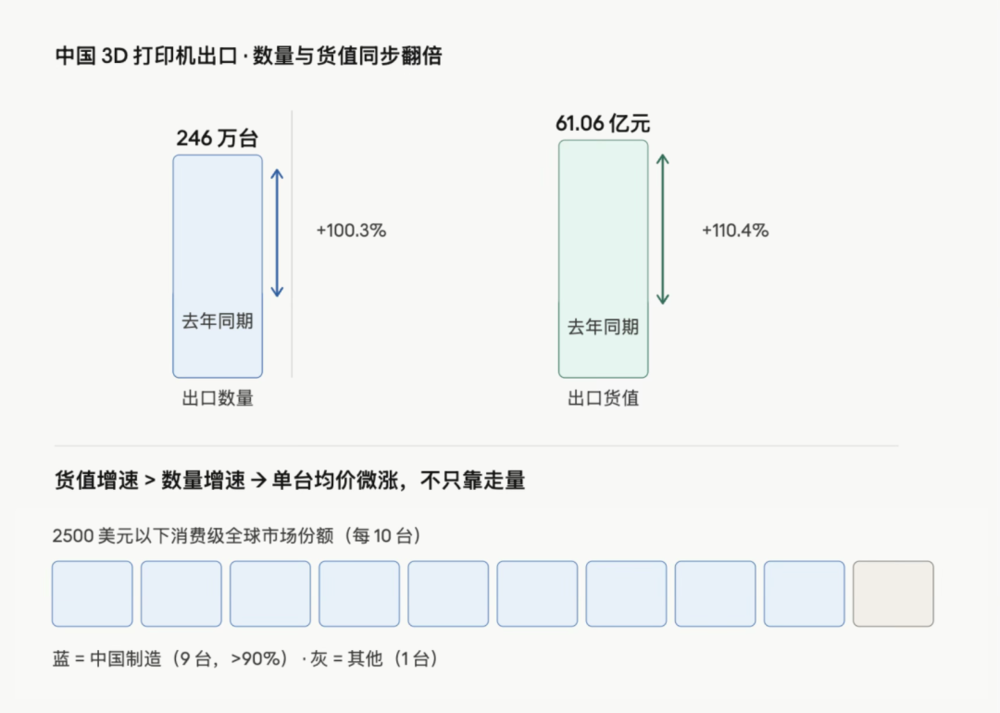
China produces 90% of sub-$2500 3D printers globally.
Why It Matters
The shift from hardware-only to software-defined manufacturing is accelerating, forcing traditional players to adapt or face obsolescence.
What To Do Next
Analyze how your hardware product can integrate AI-driven sensor fusion to improve user experience and automation.
Key Points
- •China produces 90% of sub-$2500 3D printers globally.
- •Success stems from leveraging existing industrial supply chains and consumer electronics R&D methodologies.
- •Companies like Bambu Lab are disrupting the market by integrating advanced sensors and algorithms.
- •Western incumbents are using broad patent litigation to stifle competition from Chinese innovators.
Deep Insight
AI-generated analysis for this event — not the original article.
Enhanced Key Takeaways
- •The surge in Chinese 3D printing dominance is heavily supported by the 'Shenzhen Speed' manufacturing model, which allows for rapid iteration cycles of less than 6 months from prototype to mass production.
- •Recent patent litigation has shifted from simple mechanical design claims to complex software-defined features, specifically targeting automated bed leveling and vibration compensation algorithms.
- •Chinese manufacturers are increasingly pivoting toward 'industrial-grade' desktop machines, moving up-market to compete with established Western players like Stratasys and 3D Systems in the professional prototyping segment.
- •The Chinese government's 'Made in China 2025' initiative has provided significant subsidies for additive manufacturing R&D, specifically focusing on high-speed FDM (Fused Deposition Modeling) technology.
- •Cross-border e-commerce platforms like AliExpress and Temu have fundamentally altered the distribution landscape, allowing Chinese 3D printer brands to bypass traditional Western retail intermediaries and maintain lower price points.
Competitor Analysis
- Bambu Lab (X1-Carbon)
- ~$1,199
- Prusa Research (MK4)
- ~$1,099
- Creality (K1 Max)
- ~$699
- Bambu Lab (X1-Carbon)
- Up to 500mm/s
- Prusa Research (MK4)
- Up to 200mm/s
- Creality (K1 Max)
- Up to 600mm/s
- Bambu Lab (X1-Carbon)
- LiDAR/AI Inspection
- Prusa Research (MK4)
- Loadcell Sensor
- Creality (K1 Max)
- AI Camera/Lidar
- Bambu Lab (X1-Carbon)
- Closed/Cloud-based
- Prusa Research (MK4)
- Open Source
- Creality (K1 Max)
- Hybrid
| Feature | Bambu Lab (X1-Carbon) | Prusa Research (MK4) | Creality (K1 Max) |
|---|---|---|---|
| Price | ~$1,199 | ~$1,099 | ~$699 |
| Speed | Up to 500mm/s | Up to 200mm/s | Up to 600mm/s |
| Key Tech | LiDAR/AI Inspection | Loadcell Sensor | AI Camera/Lidar |
| Ecosystem | Closed/Cloud-based | Open Source | Hybrid |
Technical Deep Dive
- Active Vibration Compensation: Utilizes high-frequency accelerometers on the toolhead to measure and cancel out resonance, enabling high-speed printing without ghosting artifacts.
- Multi-Color AMS (Automatic Material System): Employs a filament buffer and multi-spool hub to enable seamless switching between up to 16 colors/materials during a single print job.
- AI-Driven First Layer Inspection: Uses a combination of LiDAR sensors and computer vision to detect nozzle clogs, spaghetti failures, and first-layer adhesion issues in real-time.
- Motion Control Architecture: Leverages custom-tuned FOC (Field Oriented Control) algorithms for stepper motors to achieve high torque at high speeds while maintaining positional accuracy.
Future ImplicationsAI analysis grounded in cited sources
Timeline
- 2022-06Bambu Lab launches its flagship X1 series via Kickstarter, disrupting the market with high-speed, AI-integrated printing.
- 2023-04Creality releases the K1 series, signaling a direct response to the high-speed printing trend set by newer market entrants.
- 2024-02Major Western 3D printing incumbents begin filing patent infringement lawsuits targeting automated bed leveling and filament management systems.
- 2025-11Chinese 3D printing manufacturers form an industry alliance to coordinate legal responses to international patent challenges.
Weekly AI Recap
Read this week's curated digest of top AI events →
AI-curated news aggregator. All content rights belong to original publishers.
Original source: 虎嗅 ↗
This is a summary, not the original. Read the source, or get the weekly briefing.
The weekly digest
One email a week. Unsubscribe anytime.