Einstein's Century-Old Prediction of Spacetime Warping Confirmed
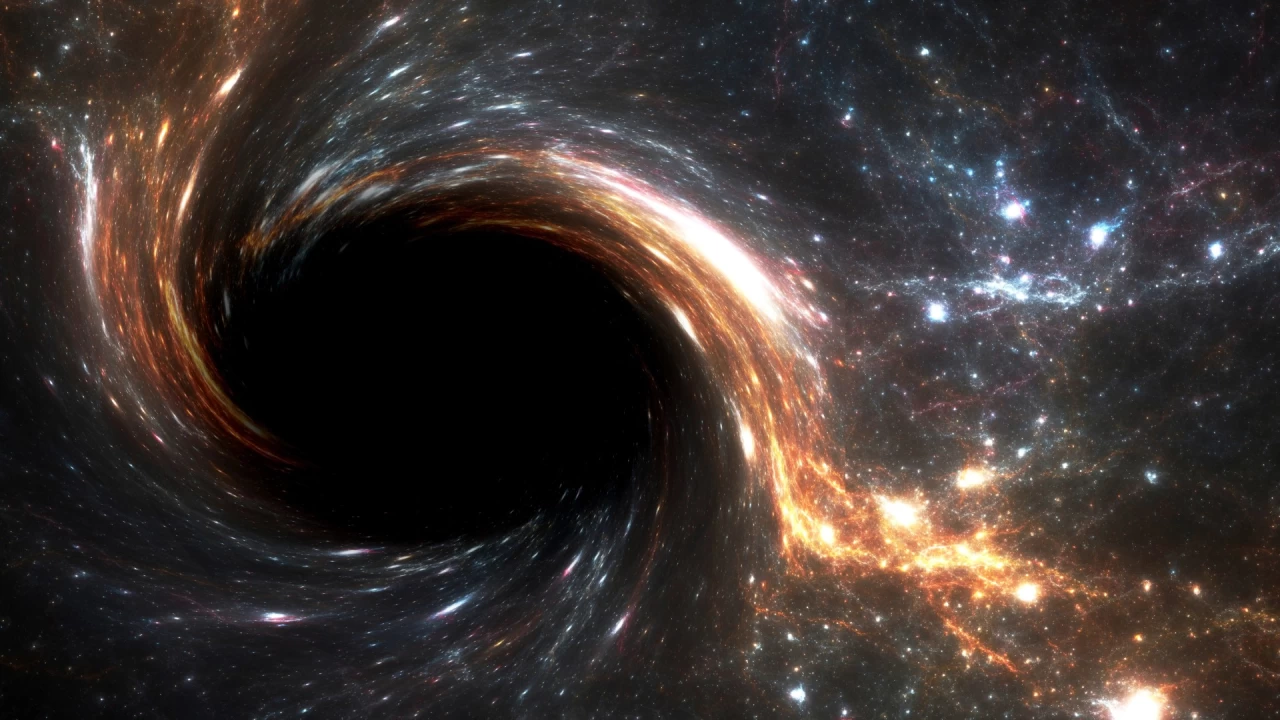
💡Understanding spacetime physics is key for researchers building next-gen gravitational wave and space-based AI models.
⚡ 30-Second TL;DR
What Changed
Direct observation of spacetime distortion near a black hole
Why It Matters
This breakthrough validates fundamental physics models that underpin our understanding of gravity and space, which are critical for high-precision computational modeling.
What To Do Next
Incorporate high-fidelity physics simulations into your research workflows to better model complex gravitational environments.
Key Points
- •Direct observation of spacetime distortion near a black hole
- •Confirmation of Einstein's General Relativity predictions
- •Evidence of matter oscillation caused by spacetime vortices
🧠 Deep Insight
Web-grounded analysis with 13 cited sources.
🔑 Enhanced Key Takeaways
- •The direct observation confirmed the phenomenon known as Lense-Thirring precession, or frame-dragging, where a rotating black hole twists the fabric of spacetime, pulling nearby matter along.
- •This specific observation was made during a 'tidal disruption event' (TDE) designated AT2020afhd, which involved a star being torn apart by a supermassive black hole.
- •Evidence for the spacetime vortex was gathered by detecting rhythmic, 20-day cycle wobbles in the X-ray and radio signals emanating from the accretion disk and jets formed by the shredded stellar material.
- •This marks the first direct detection of frame-dragging around a black hole, building upon previous confirmations of the effect around Earth by Gravity Probe B and around other celestial bodies like pulsars.
🛠️ Technical Deep Dive
- The observed phenomenon is Lense-Thirring precession, also referred to as frame-dragging, a direct consequence of Einstein's General Relativity.
- The observation focused on a tidal disruption event (TDE) named AT2020afhd, where a star's destruction by a supermassive black hole created a rapidly rotating accretion disk and powerful jets.
- Data collection involved analyzing X-ray observations from the Neil Gehrels Swift Observatory (Swift) and radio data from the Karl G. Jansky Very Large Array (VLA).
- Electromagnetic spectroscopy was also utilized to characterize the composition and behavior of the matter surrounding the black hole.
- The key signature of the spacetime twisting effect was a coordinated, 20-day periodic wobble detected in both the X-ray and radio signals from the disk and jets.
- The sensitivity required for such detections is immense, with instruments like LIGO capable of sensing spacetime distortions smaller than 1/10,000 the width of a proton.
🔮 Future ImplicationsAI analysis grounded in cited sources
⏳ Timeline
📎 Sources (13)
Factual claims are grounded in the sources below. Forward-looking analysis is AI-generated interpretation.
Weekly AI Recap
Read this week's curated digest of top AI events →
👉Related Updates
Same topic
Explore #astrophysics
Same product
More on general-relativity-/-astrophysics
Same source
Latest from cnBeta (Full RSS)

PACA: Open-source tool for ancient fossil coordinate mapping
First atmosphere detected on habitable-zone exoplanet

Samsung Secures $200B Broadcom AI Infrastructure Deal

How AMD's 2006 ATI Acquisition Built Today's AI Empire
AI-curated news aggregator. All content rights belong to original publishers.
Original source: cnBeta (Full RSS) ↗