Cyborg Cockroach Pulls Hundreds Times Weight
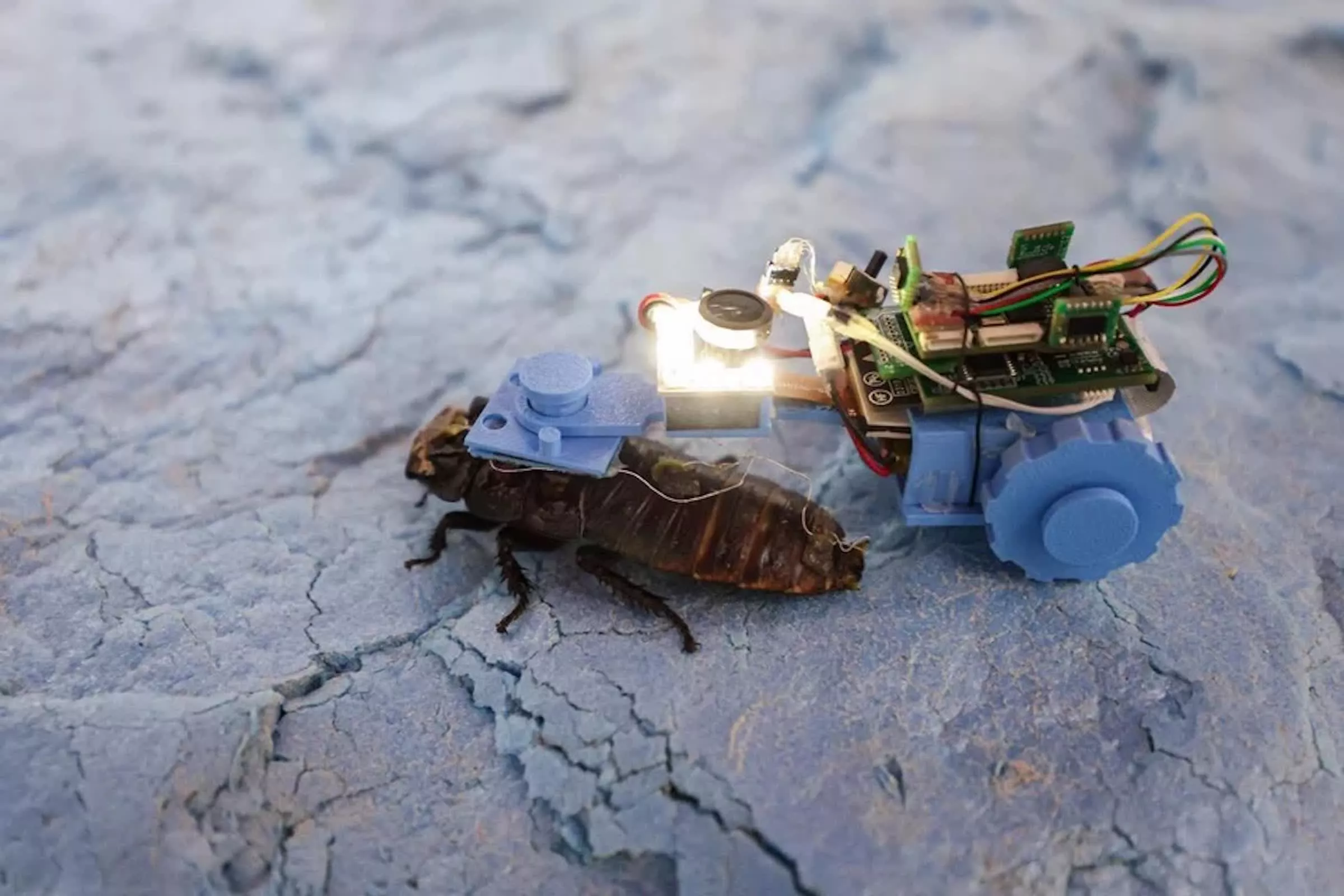
💡Bio-hybrid roach hauls 100x weight: boosts embodied AI for rescue robots.
⚡ 30-Second TL;DR
What Changed
Pulls loads hundreds times body weight
Why It Matters
Paves way for resilient bio-hybrid robots in disaster zones, inspiring embodied AI beyond silicon-based systems.
What To Do Next
Study cyborg insect papers on arXiv for bio-inspired control in robotics projects.
Key Points
- •Pulls loads hundreds times body weight
- •Targets search-and-rescue robotics
- •Advances micro-engineering capabilities
- •Hybrid bio-mechanical design
🧠 Deep Insight
Background and context from public sources — not the original article. 8 sources cited.
🔑 Enhanced Key Takeaways
- •Beyond search-and-rescue, current research has pivoted toward practical infrastructure maintenance, specifically utilizing cyborg cockroaches to pull miniature sensor-equipped 'chariots' through narrow, aging pipelines to detect leaks and structural damage.
- •The technology has evolved from manual, hour-long assembly to automated manufacturing, with new robotic assembly lines capable of fusing control modules to insects in just over one minute.
- •Recent iterations have achieved significant power efficiency gains, with the latest models operating on 25% less voltage than previous versions, thereby extending the operational battery life of the bio-hybrid system.
🛠️ Technical Deep Dive
- •Control Mechanism: Utilizes lightweight electronic 'backpacks' that deliver subtle electrical pulses to the insect's nervous system (antennae or cerci) to steer movement.
- •Payload Integration: Latest models feature miniature wheeled 'chariots' carrying cameras, torches, and batteries, allowing the insect to pull equipment rather than just carrying it.
- •Navigation: Employs adaptive control algorithms, including swarm-based strategies that mimic human group formation to coordinate movement across complex, unknown terrain.
- •Power Efficiency: Recent hardware optimizations have reduced voltage requirements by 25%, improving the endurance of the onboard power supply.
- •Manufacturing: Automated assembly process uses depth-sensing cameras and robotic arms (e.g., UR3e) to attach control modules in approximately 60 seconds.
🔮 Future ImplicationsAI analysis grounded in cited sources
⏳ Timeline
📎 Sources (8)
Factual claims are grounded in the sources below. Forward-looking analysis is AI-generated interpretation.
Weekly AI Recap
Read this week's curated digest of top AI events →
👉Related Updates

AI-curated news aggregator. All content rights belong to original publishers.
Original source: cnBeta (Full RSS) ↗
This is a summary, not the original. Read the source, or get the weekly briefing.
Weekly AI briefing
One email a week. Unsubscribe anytime.