🇨🇳cnBeta (Full RSS)•Stalecollected in 8h
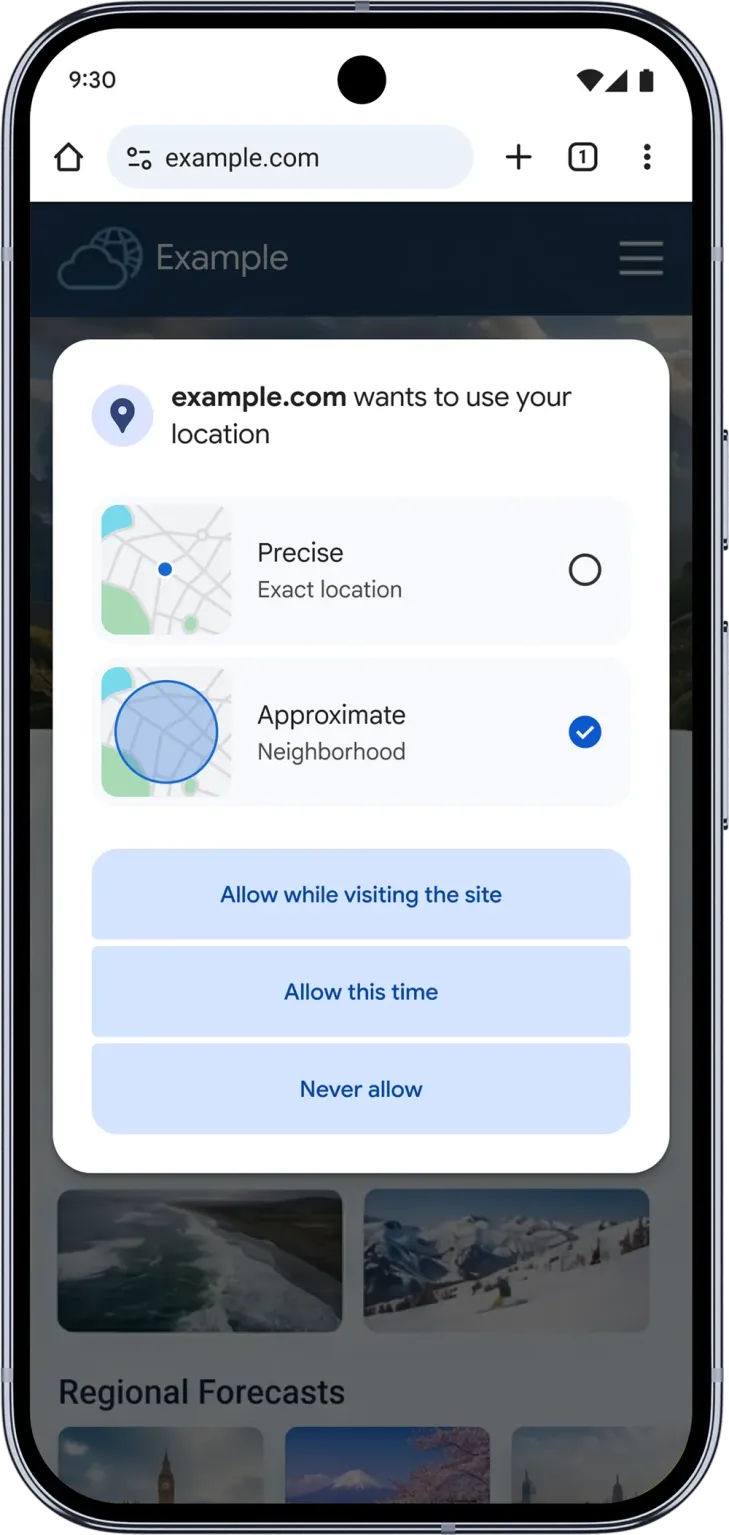
Chrome Android Adds Approximate Location Sharing
💡Chrome's privacy upgrade matters for AI web apps using location data safely.
⚡ 30-Second TL;DR
What Changed
Android Chrome introduces 'approximate location' sharing option
Why It Matters
Empowers users with better privacy in geolocation services, potentially boosting trust in web apps.
What To Do Next
Test approximate location permission in Chrome Android DevTools for geo-aware web apps.
Who should care:Developers & AI Engineers
Key Points
- •Android Chrome introduces 'approximate location' sharing option
- •Reduces precise location sharing for enhanced privacy
- •Precise needed for delivery/ATM; approximate for weather/news
🧠 Deep Insight
AI-generated analysis for this event.
🔑 Enhanced Key Takeaways
- •This feature aligns Chrome with the Android OS-level 'Approximate Location' permission introduced in Android 12, standardizing the privacy UX across the browser and the operating system.
- •The implementation utilizes the browser's Geolocation API, allowing websites to request a 'coarse' accuracy level, which typically provides a location within a radius of approximately 3 kilometers (roughly 1.8 miles).
- •Google is leveraging the Privacy Sandbox initiative to ensure that while location data is obfuscated, it remains sufficient for localized content delivery without enabling cross-site tracking or user fingerprinting.
📊 Competitor Analysis▸ Show
| Feature | Chrome (Android) | Safari (iOS) | Firefox (Android) |
|---|---|---|---|
| Approximate Location | Supported | Supported (via iOS system) | Supported |
| Granular Control | Per-site prompt | Per-site prompt | Per-site prompt |
| Privacy Focus | Privacy Sandbox | Intelligent Tracking Prevention | Enhanced Tracking Protection |
🛠️ Technical Deep Dive
- •Implementation relies on the W3C Geolocation API specification, specifically the 'enableHighAccuracy' boolean flag.
- •When 'Approximate' is selected, the browser overrides the high-accuracy GPS signal with a coarse coordinate derived from network-based location services (Wi-Fi/Cell tower triangulation).
- •The browser injects a noise-injection algorithm to the coordinates to prevent 'location pinning' through repeated requests.
- •The permission state is stored in the site settings database, allowing users to toggle between precise and approximate modes per origin.
🔮 Future ImplicationsAI analysis grounded in cited sources
Ad-tech revenue models will shift toward contextual targeting over location-based targeting.
As browsers restrict precise location access, advertisers will rely more on page content and coarse regional data to maintain ad relevance.
Web developers will increasingly adopt the 'Permissions Policy' header to request only the minimum location accuracy required.
Standardizing on approximate location reduces the friction of user permission prompts, leading to higher opt-in rates for location-based features.
⏳ Timeline
2021-10
Android 12 launches with system-wide 'Approximate Location' permission.
2023-05
Google announces Privacy Sandbox for Android to reduce cross-app tracking.
2025-02
Chrome begins testing granular location permission prompts in Canary builds.
📰
Weekly AI Recap
Read this week's curated digest of top AI events →
👉Related Updates
Same topic
Explore #privacy-control
Same product
More on chrome-android
Same source
Latest from cnBeta (Full RSS)

Microsoft plans to transform Minecraft into a global creator platform
cnBeta (Full RSS)•Aug 1

SpaceX Rocket Debris to Impact Moon
cnBeta (Full RSS)•Aug 1

Apple warns of potential AI compute resource shortages
cnBeta (Full RSS)•Aug 1

ShieldFont uses obfuscated typography to block AI scrapers
cnBeta (Full RSS)•Aug 1
AI-curated news aggregator. All content rights belong to original publishers.
Original source: cnBeta (Full RSS) ↗