Chinese Tech Giants Pivot to AI-Driven Healthcare
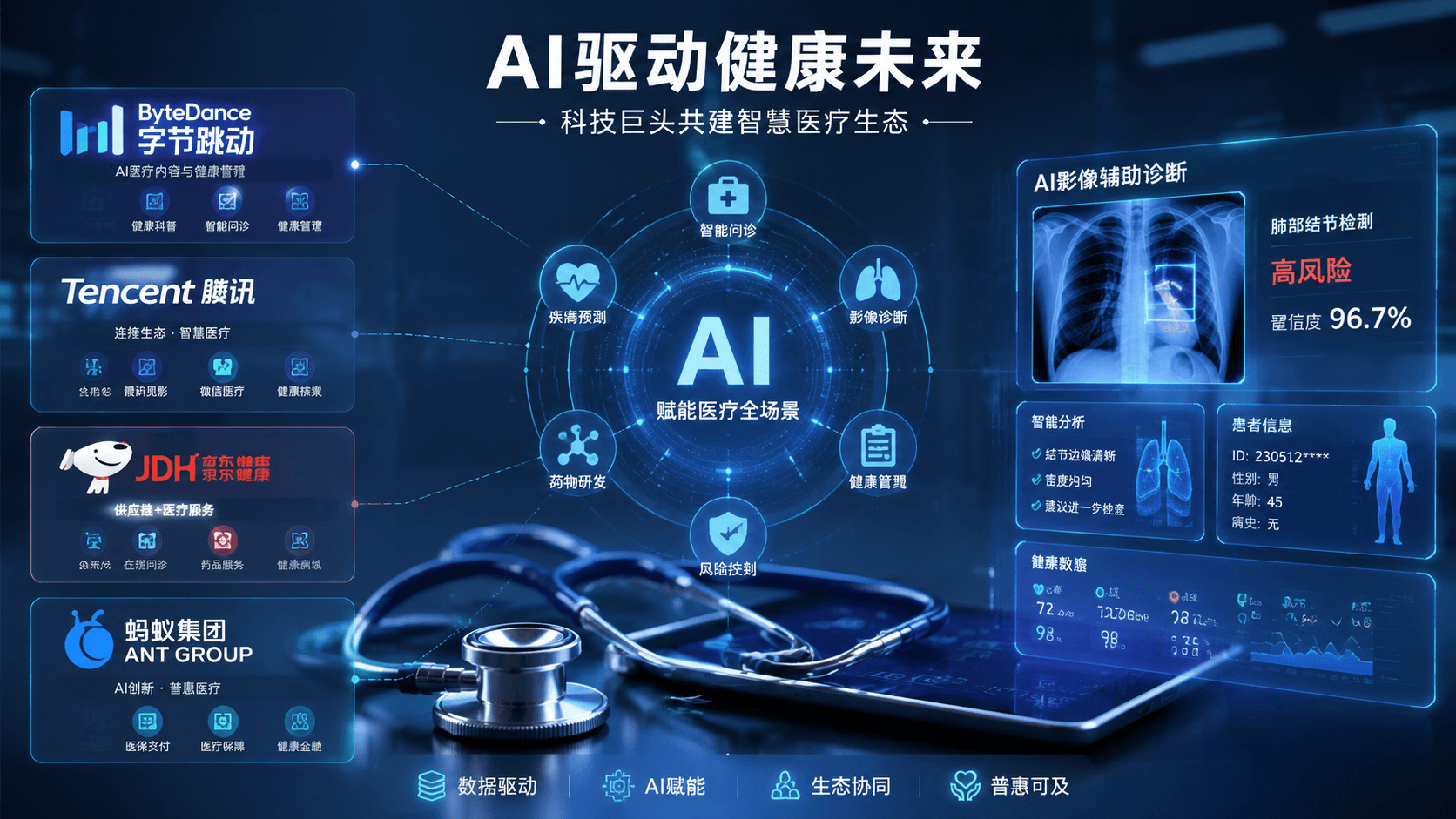
Understand how Chinese tech giants are reshaping the global healthcare AI landscape through massive capital deployment.
30-Second TL;DR
What Changed
ByteDance and Tencent are leading the charge in AI healthcare integration.
Why It Matters
This massive capital influx will likely accelerate the development of specialized medical LLMs in China, creating new competitive pressures for global healthcare AI startups.
What To Do Next
Monitor the medical LLM benchmarks released by these companies to identify potential opportunities for cross-market model fine-tuning.
Key Points
- •ByteDance and Tencent are leading the charge in AI healthcare integration.
- •JD Health and Ant Group are leveraging existing digital infrastructure for AI medical services.
- •The investment wave focuses on utilizing AI for diagnostics and personalized patient care.
Deep Insight
AI-generated analysis for this event — not the original article.
Enhanced Key Takeaways
- •The Chinese government's 'Healthy China 2030' initiative serves as the primary regulatory and policy driver, incentivizing tech giants to bridge the gap between rural healthcare accessibility and urban medical expertise.
- •Tencent's 'Miying' platform has evolved from a medical imaging diagnostic tool into a comprehensive AI ecosystem that now includes chronic disease management and hospital workflow automation.
- •ByteDance is increasingly utilizing its short-video algorithms to personalize health education content, aiming to combat medical misinformation while driving traffic to its telemedicine consultation services.
- •Ant Group is focusing on the intersection of AI and InsurTech, using proprietary machine learning models to automate medical claims processing and reduce fraud in the national health insurance system.
- •Data privacy concerns have led to the development of 'Federated Learning' architectures, allowing these companies to train AI models on hospital data without transferring sensitive patient records to centralized servers.
Competitor Analysis
- Tencent (Miying)
- Medical Imaging/Diagnostics
- ByteDance (Health)
- Content/Telemedicine
- JD Health
- E-commerce/Supply Chain
- Ant Group (Health)
- Insurance/FinTech
- Tencent (Miying)
- High (Clinical Grade)
- ByteDance (Health)
- Medium (Consumer Grade)
- JD Health
- High (Logistics/Retail)
- Ant Group (Health)
- High (Risk/Claims)
- Tencent (Miying)
- Hospital Systems
- ByteDance (Health)
- Social Media/Apps
- JD Health
- Retail/Pharmacy
- Ant Group (Health)
- Payment/Insurance
| Feature | Tencent (Miying) | ByteDance (Health) | JD Health | Ant Group (Health) |
|---|---|---|---|---|
| Primary Focus | Medical Imaging/Diagnostics | Content/Telemedicine | E-commerce/Supply Chain | Insurance/FinTech |
| AI Maturity | High (Clinical Grade) | Medium (Consumer Grade) | High (Logistics/Retail) | High (Risk/Claims) |
| Integration | Hospital Systems | Social Media/Apps | Retail/Pharmacy | Payment/Insurance |
Technical Deep Dive
- Utilization of Transformer-based architectures for processing Electronic Health Records (EHR) to predict patient outcomes.
- Implementation of Convolutional Neural Networks (CNNs) for high-resolution medical image analysis in oncology and ophthalmology.
- Deployment of Large Language Models (LLMs) fine-tuned on Chinese medical literature to power virtual triage chatbots.
- Adoption of Privacy-Preserving Machine Learning (PPML) techniques, specifically secure multi-party computation, to comply with China's Personal Information Protection Law (PIPL).
Future ImplicationsAI analysis grounded in cited sources
Timeline
- 2017-08Tencent launches 'Miying', its first AI-powered medical imaging diagnostic product.
- 2020-12JD Health completes its IPO on the Hong Kong Stock Exchange, signaling market confidence in digital health.
- 2022-09ByteDance acquires Amcare Healthcare, marking a significant move into physical medical service provision.
- 2024-05Ant Group expands its AI-driven insurance claims processing to cover more provincial medical networks.
Weekly AI Recap
Read this week's curated digest of top AI events →
Related Updates




AI-curated news aggregator. All content rights belong to original publishers.
Original source: Pandaily ↗
This is a summary, not the original. Read the source, or get the weekly briefing.
The weekly digest
One email a week. Unsubscribe anytime.